Enclaves and Exclaves: Defining Complex Territorial Boundaries
Geography is rarely as simple as a single, continuous line on a map. Across the globe, political boundaries often create fragmented territories that challenge our standard understanding of borders. These anomalies—known as enclaves and exclaves—arise from centuries of feudal inheritance, treaties, and geopolitical shifts. While they may seem like mere cartographic curiosities, these territories often present significant legal and practical challenges for the people living within them.
Key Facts
- An enclave is a territory entirely surrounded by a single other entity.
- An exclave is a portion of a state geographically separated from its main territory.
- Semi-enclaves and semi-exclaves possess an unsurrounded sea border.
- Pene-exclaves (functional exclaves) are territories that can only be conveniently accessed via another country.
- True sovereign enclaves include Lesotho, San Marino, and Vatican City.
- The 2015 Land Boundary Agreement between India and Bangladesh eliminated 197 enclaves.
Defining the Core Concepts
To understand territorial fragmentation, we must distinguish between how a piece of land relates to its surrounding neighbors versus how it relates to its own parent state.
Enclaves
An enclave is a territory that is entirely surrounded by the territory of only one other state or entity. An enclave can be a fully independent sovereign state or a part of a larger territory. While often used loosely to describe any surrounded area, a strict definition requires the territory to be enclosed by a single foreign entity. Examples of independent sovereign enclaves include Lesotho (surrounded by South Africa) and San Marino and Vatican City (both surrounded by Italy).
Exclaves
An exclave is a portion of a state or district that is geographically separated from the main part of that state by alien territory. While many exclaves are also enclaves, this is not always the case. If an exclave borders more than one foreign state, it is not an enclave.
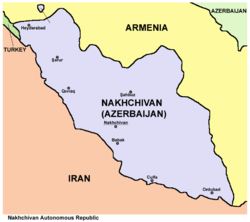
For example, the Nakhchivan Autonomous Republic is an exclave of Azerbaijan, but it is not an enclave because it borders Armenia, Iran, and Turkey.
Advanced Territorial Classifications
Beyond the basic definitions, geographers use specific terms to describe territories with sea access or practical accessibility issues.
Semi-Enclaves and Semi-Exclaves
These are areas that would be enclaves or exclaves if they did not have an unsurrounded sea border. Semi-enclaves can be independent states, such as Monaco, The Gambia, and Brunei. For a sovereign state to be classified as a semi-enclave, its land boundary must be longer than its sea coastline.
Pene-Exclaves (Functional Exclaves)
A pene-exclave is a territory that, while technically attached to its parent state, can only be conveniently approached—particularly by wheeled traffic—through another country. These are often caused by geographical barriers like mountains or river course changes.
Examples include Point Roberts in the United States, which is accessible by land only through Canada, and the Kleinwalsertal valley in Austria, which is accessible only from Germany due to surrounding high mountains.
The Hierarchy of Enclaves
In complex geopolitical scenarios, enclaves can exist within other enclaves, creating a nested hierarchy:
- First-order enclave: A foreign territory surrounded by the main territory of a state.
- Counter-enclave (Second-order): A piece of the original state located inside a first-order enclave.
- Counter-counter-enclave (Third-order): A piece of the first-order enclave located inside a second-order enclave.
This complexity was historically prevalent in the Holy Roman Empire and later in the border regions of India and Bangladesh. In 2015, India and Bangladesh resolved many of these issues by exchanging 162 first-order enclaves, effectively removing 197 total enclaves to alleviate the statelessness of residents.
Comparison of Territorial Types
| Type | Bordered by Only 1 Alien Territory? | Belongs to Larger Territory? | Unsurrounded Sea Border? |
|---|---|---|---|
| Enclave | Yes | Maybe | No |
| Exclave | No (1 or more) | Yes | No |
| Semi-enclave | Yes | Maybe | Yes |
| Semi-exclave | No (1 or more) | Yes | Yes |
Frequently Asked Questions
What is the difference between an enclave and an exclave?
An enclave is defined by being surrounded by another territory, whereas an exclave is defined by being separated from its own main territory. A piece of land can be both: an exclave of its home country and an enclave within a foreign country.
Can a country be both an enclave and a sovereign state?
Yes. Lesotho, San Marino, and Vatican City are sovereign states that are also enclaves because they are entirely surrounded by a single other country.
What is a pene-exclave?
A pene-exclave is a "practical" exclave. It is a territory that is technically connected to its parent state but is functionally inaccessible except by traveling through a foreign country, often due to mountains or water.
Why do enclaves and exclaves exist?
They usually result from historical political arrangements, such as the transfer of feudal domains through inheritance or sale, or through diplomatic treaties and border agreements.
How are enclaves eliminated?
Enclaves are typically eliminated through land boundary agreements where countries exchange territories or cede them to the surrounding state, as seen in the 2015 agreement between India and Bangladesh.