Emperor Meiji and the Transformation of Modern Japan
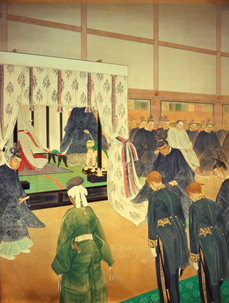
The reign of Emperor Meiji (born Mutsuhito) marks one of the most dramatic turning points in global history. Between 1867 and 1912, Japan evolved from a secluded, feudal state into a formidable imperial power. This era, known as the Meiji period, saw the dismantling of centuries-old social structures and the rapid adoption of Western industrial and political systems.
At the time of Mutsuhito's birth in 1852, Japan was governed by the Tokugawa shogunate, an isolationist military government that ruled through a network of 270 decentralized domains led by daimyō (feudal lords). The stability of this system was shattered in 1853 when Commodore Matthew C. Perry of the United States Navy arrived with his "Black Ships," forcing Japan to open its borders to international trade.
Key Facts
- Reign: 30 January 1867 – 29 July 1912.
- Core Achievement: Oversaw the transition from a feudal shogunate to a modern imperial power.
- Key Legislation: Promulgated the Meiji Constitution of 1889 and the Charter Oath of 1868.
- Territorial Expansion: Annexed Taiwan (1895) and Korea (1910).
- Military Success: Led Japan to victory in the First Sino-Japanese War and the Russo-Japanese War.
The Meiji Restoration and Accession
The tension between those loyal to the shogunate and those seeking modernization culminated in the Boshin War. Samurai from the Chōshū and Satsuma domains defeated the shogunate, restoring political power to the Emperor. On 4 January 1868, the young emperor formally proclaimed the "restoration" of Imperial rule.
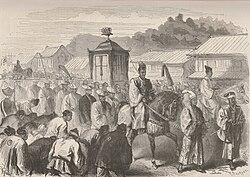
As the symbolic head of state, Emperor Meiji moved the center of power from Kyoto to Tokyo. His early years were defined by a struggle to balance traditional Japanese values with the urgent need for modernization to avoid the "Unequal Treaties"—agreements that had stripped Japan of tariff authority and legal jurisdiction over foreigners.
Political Reform and Consolidation
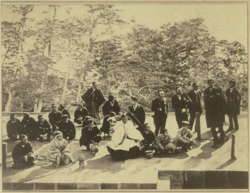
While the Emperor was the sovereign, actual governance was managed by the genrō, an oligarchy of powerful military, political, and economic leaders. Together, they implemented a series of sweeping reforms to centralize the state.
Institutional Milestones
- 1868: The Charter Oath established the framework for modernization.
- 1885: Establishment of the Cabinet.
- 1888: Creation of the Privy Council.
- 1889: The Meiji Constitution established a parliament, though real power remained with the genrō.
- 1890: The Imperial Diet was convened, and the Imperial Rescript on Education was issued.
Imperial Expansion and Global Standing
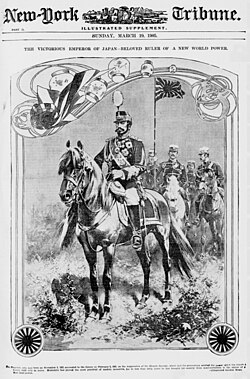
Under Emperor Meiji, Japan sought to prove its status as a first-class power through military strength and territorial acquisition. The nation achieved significant victories over China and Russia, signaling its arrival as a major player on the world stage.
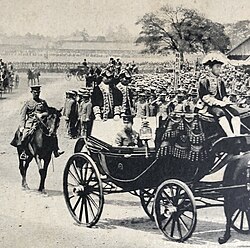
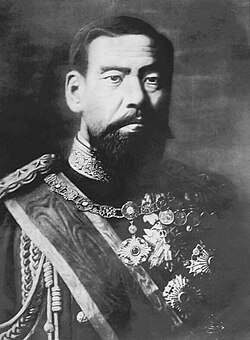
By the end of his reign, Japan had annexed Taiwan in 1895 and Korea in 1910. The Emperor's image evolved from that of a secluded youth to a bearded, dignified statesman, reflecting the nation's own growth in confidence and power.
Personal Life and Legacy
Emperor Meiji married Ichijō Haruko in 1869. While she became the first Empress Consort to play a public role in centuries, she had no children. The Emperor fathered fifteen children with five official ladies-in-waiting, though only five survived to adulthood. His eldest son, Yoshihito, succeeded him as Emperor Taishō.
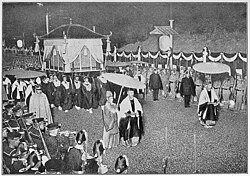
The Emperor passed away on 29 July 1912, at the age of 59, due to complications from diabetes, nephritis, and gastroenteritis. His death marked the end of an era that fundamentally reshaped the East Asian geopolitical landscape.
| Category | Details |
|---|---|
| Birth Name | Mutsuhito |
| Reign Dates | 1867–1912 |
| Predecessor | Emperor Kōmei |
| Successor | Emperor Taishō |
| Key Conflicts | Boshin War, First Sino-Japanese War, Russo-Japanese War |
| Major Reforms | Meiji Constitution, Abolition of Shogunate, Industrialization |
Frequently Asked Questions
What was the Meiji Restoration?
The Meiji Restoration was a political revolution in 1868 that ended the Tokugawa shogunate's military rule and restored practical imperial power to Emperor Meiji, triggering a period of rapid modernization and Westernization.
Who were the genrō?
The genrō were a small group of oligarchs—mostly former samurai and daimyō—who served as the Emperor's senior advisors and held the actual governing power during the Meiji era.
How did Japan change during Emperor Meiji's reign?
Japan transformed from a decentralized, feudal society into a centralized, industrial imperial power with a modern constitution, a national army, and a presence in international diplomacy.
What were the "Unequal Treaties"?
These were agreements forced upon Japan by Western powers that deprived Japan of the right to set its own tariffs and the authority to try foreign nationals in Japanese courts.
Which territories did Japan annex under Emperor Meiji?
During his reign, Japan annexed Taiwan in 1895 following the First Sino-Japanese War and Korea in 1910.