Elephant Birds: The Giant Flightless Wonders of Madagascar
Among the most extraordinary creatures to ever walk the Earth were the elephant birds, a group of massive, flightless ratites that once dominated the landscape of Madagascar. Known for their staggering size and the largest eggs of any known amniote, these birds represent a fascinating chapter in avian evolution and the delicate balance between wildlife and human expansion.
First brought to European attention in the 17th century through the accounts of French governor Étienne de Flacourt, these birds remained a mystery until the mid-19th century. In 1851, Isidore Geoffroy Saint-Hilaire scientifically described Aepyornis maximus, sparking widespread public interest due to the discovery of their colossal eggs.
Key Facts
- Maximum Height: Up to 3 metres (9.8 ft) in an upright posture.
- Maximum Weight: Estimated between 700 and 1,000 kg for Aepyornis maximus.
- Egg Size: The largest eggs ever recorded, with volumes up to 13 litres.
- Location: Endemic to the island of Madagascar.
- Extinction Window: Likely between 800 and 1050 AD.
- Classification: Part of the order Aepyornithiformes.
Taxonomy and Evolutionary History
Elephant birds belong to the Palaeognathae, a group of birds that includes modern ratites like ostriches and kiwis. While it was once believed that ratites evolved from a single flightless ancestor on the supercontinent Gondwana, modern genetic evidence suggests a different story. It is now understood that flightlessness evolved independently multiple times across different lineages long after Gondwana broke apart.
Within the order Aepyornithiformes, two primary genera are recognized: Aepyornis and Mullerornis. Mitochondrial genome analysis indicates that these two groups diverged significantly, with a split estimated to have occurred between 27 and 30 million years ago during the Oligocene epoch.
Physical Characteristics
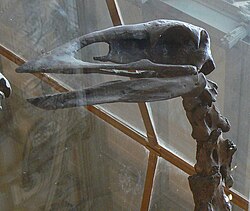
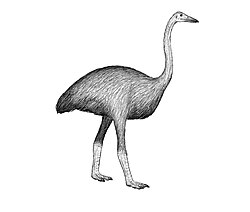
The elephant birds were built for a terrestrial existence. They possessed long legs, elongate necks, and relatively small heads. Their beaks were straight, thick, and conical, lacking the hooks found in many other bird species. Interestingly, their skulls featured punctuated marks that may have served as attachment points for head feathers or fleshy structures.
Species Comparison
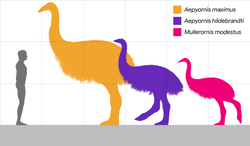
The diversity in size among elephant birds was significant:
- Mullerornis modestus: The smallest species, weighing approximately 80 kg (180 lb) with a more gracile (slender) build.
- Aepyornis hildebrandti: A mid-sized giant with an estimated mass of 230–285 kg.
- Aepyornis maximus: The behemoth of the group, with mass estimates ranging from 275 kg up to 1,000 kg. Females are believed to have been larger than males.
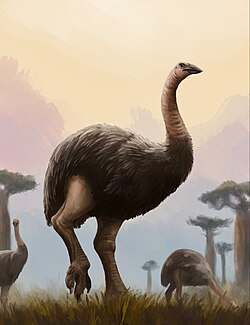
Their skeletal structure was robust, particularly in Aepyornis, where the femur and tibiotarsus were stocky and thick to support their immense weight. Their wings were vestigial, meaning they were reduced and non-functional for flight.
The Mystery of the Giant Eggs
The eggs of Aepyornis are legendary in the field of paleontology. These eggs could reach 40 centimetres in length and weigh approximately 10.5 kg. To produce such massive shells, female birds required vast amounts of calcium, which was stored in the medullary bone of their femurs.
In a curious geological twist, two Aepyornis maximus eggs were discovered in dune deposits in Western Australia. Scientists hypothesize that these eggs floated from Madagascar to Australia via the Antarctic Circumpolar Current, a theory supported by similar occurrences of penguin and ostrich eggs washing ashore in distant regions.
| Species | Estimated Mass | Build | Egg Characteristics |
|---|---|---|---|
| Mullerornis modestus | ~80 kg | Gracile | Small (~0.86 kg) |
| Aepyornis hildebrandti | 230–285 kg | Robust | Large |
| Aepyornis maximus | 275–1,000 kg | Very Robust | Colossal (~10.5 kg) |
The Path to Extinction
The disappearance of the elephant birds is closely tied to the arrival of humans on Madagascar. A 2021 study suggests they became extinct between 800 and 1050 AD. This period coincides with major environmental shifts where humans used fire to convert forests into grasslands for cattle pastoralism.
While there is limited evidence of direct hunting, the loss of forested habitat likely made the birds more vulnerable. Humans may have also consumed their massive eggs. Although some have suggested introduced diseases as a cause, the fact that humans and elephant birds coexisted for centuries makes this less likely than environmental degradation.
Frequently Asked Questions
How big were the largest elephant bird eggs?
The largest eggs of Aepyornis maximus had a volume of 5.6 to 13 litres, reached lengths of up to 40 centimetres, and weighed approximately 10.5 kg.
Why were elephant bird eggs found in Australia?
It is hypothesized that the eggs floated from Madagascar to the coast of Western Australia, carried by the Antarctic Circumpolar Current.
When did elephant birds go extinct?
Recent radiocarbon dating suggests they disappeared between 800 and 1050 AD, coinciding with human-induced environmental changes in Madagascar.
Were elephant birds related to the moa?
Both are ratites (flightless birds), but they evolved flightlessness independently. Genetic evidence shows that elephant birds are more closely related to the kiwi than to the moa.
What caused their extinction?
The primary cause is believed to be habitat loss, as humans converted forests into grasslands for cattle, though the consumption of eggs by humans may have also contributed.