Electronic Instruments in Rock Music: A Technological Evolution
The evolution of rock music has always been inextricably linked to technological progress. From the earliest experiments with sound manipulation to the digital revolution, the integration of electronic instruments has allowed artists to expand the sonic boundaries of the genre. This synergy between creativity and engineering has given rise to entirely new styles, transforming rock from a guitar-driven sound into a diverse landscape of electronic textures.
Key Facts
- CSIRAC (1950–1) was the first computer capable of playing music.
- The Mellotron introduced polyphonic sample-playback to rock in the mid-1960s.
- The Moog synthesizer, created in 1964, allowed for the electronic manipulation of pitch and frequency.
- MIDI and computer software later enabled the rise of genres like electroclash and dance-punk.
- Early synthesizers were monophonic (one note at a time), while polyphonic versions emerged in the mid-1970s.
The Foundation of Electronic Sound
Before electronic instruments became staples of the rock stage, the groundwork was laid by experiments in musique concrète (a form of music composition that utilizes recorded sounds as raw material) and early tape manipulation. In 1950–1, the CSIRAC computer, designed by Trevor Pearcey and Maston Beard and programmed by Geoff Hill, became the first computer to play music.
Early instruments like the theremin—which uses two metal antennas to control frequency and volume via the player's hand positions—provided an eerie atmosphere. While initially used in classical music and science fiction films of the 1940s and 50s, these technologies eventually filtered into popular music.
The Rise of the Synthesizer
By the mid-1960s, electronic instruments became practical for studio use. The Mellotron, an electro-mechanical keyboard that played back sounds from magnetic audio tape strips, became a favorite for musicians seeking orchestral textures.
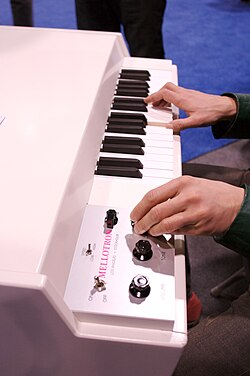
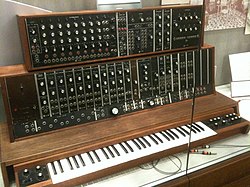
However, the landscape shifted with the arrival of the Moog synthesizer in 1964. Created by Robert Moog, this instrument generated sounds electronically, allowing musicians to "bend" notes and express a higher level of virtuosity. While early Moog units were massive and complex, the 1970 release of the Mini-moog provided a portable, user-friendly alternative for live performances.
From Monophonic to Polyphonic
Early synthesizers were limited to playing a single note at a time (monophonic). It wasn't until the mid-1970s that polyphonic synthesizers, such as the Prophet-5, allowed musicians to play chords, further expanding the harmonic possibilities of electronic rock.
Chronological Impact on Rock History
The 1960s: Experimentation and Integration
The late 1950s saw early attempts to merge electronic sound with popular forms by Tom Dissevelt and Kid Baltan. In a rock context, Joe Meek was a pioneer, notably with the 1962 hit "Telstar." By the mid-60s, the Mellotron was adopted by Graham Bond, Mike Pinder of The Moody Blues, and The Beatles, who used it on "Strawberry Fields Forever."
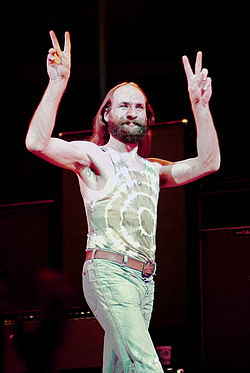
The Beach Boys made the first recorded use of an Electro-Theremin on a rock album with Pet Sounds (1966). Simultaneously, the Moog synthesizer began appearing on albums by The Doors, The Monkees, and eventually on The Beatles' Abbey Road.
The 1970s: The Path to Synthpop
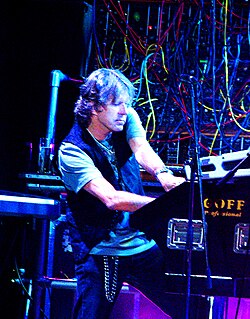
The 1970s saw a shift toward more structured electronic integration. Cat Stevens utilized synthesizers and music sequencers on Izitso (1977), while Ultravox incorporated the Roland TR-77 drum machine and ARP Odyssey synthesizer. This era paved the way for the Japanese band Yellow Magic Orchestra and Gary Numan, whose Kraftwerk-inspired work topped the charts in 1979.
The 1980s to the Present: Digital Evolution
The 1980s were dominated by commercially oriented synthpop. As technology progressed into the new millennium, the proliferation of recording software led to the birth of genres such as electroclash, dance-punk, and new rave.
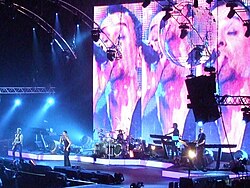
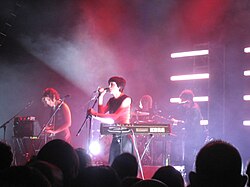
In the early 2000s, a synthpop revival occurred. Bands like Ladytron and The Killers utilized vintage synthesizer sounds to contrast with the prevailing post-grunge and nu-metal trends of the time.
Summary of Key Electronic Instruments
| Instrument | Primary Era | Key Characteristic | Notable Users |
|---|---|---|---|
| Theremin | 1940s–1960s | Antenna-based frequency/volume control | The Beach Boys |
| Mellotron | Mid-1960s | Magnetic tape sample-playback | The Beatles, King Crimson |
| Moog Synthesizer | Late 1960s–1970s | Electronically generated, pitch-bendable sound | The Doors, The Monkees |
| Digital Software/MIDI | 1980s–Present | Computer-based sequencing and sampling | Ladytron, The Killers |
Frequently Asked Questions
What is the difference between the Mellotron and the Moog?
The Mellotron is an electro-mechanical instrument that plays back pre-recorded sounds from magnetic tape strips. In contrast, the Moog is a synthesizer that generates sounds electronically, allowing for more manipulation of pitch and frequency.
What does monophonic mean in the context of synthesizers?
Monophonic refers to a synthesizer's inability to play more than one note at a time. Polyphonic synthesizers, which emerged later, can play multiple notes or chords simultaneously.
Which rock bands were pioneers in using the Mellotron?
Key pioneers included Mike Pinder of The Moody Blues, The Beatles, and members of progressive rock bands like King Crimson, Yes, and Genesis.
How did the Mini-moog change live performances?
The original Moog synthesizers were large and difficult to operate. The Mini-moog, released in 1970, was portable and simpler to use, making it practical for musicians to take on stage for live concerts.
What is electroclash?
Electroclash is a genre that emerged in the new millennium, driven by the spread of recording software and a renewed interest in 1980s electronic sounds and synthpop.