Electron Energy Levels and the Bohr Model
In the study of atomic physics, the Bohr model provides a foundational framework for understanding how electrons occupy specific energy levels around a nucleus. While modern quantum mechanics has since evolved, the Bohr model remains remarkably accurate for one-electron systems—such as the hydrogen atom, singly ionized helium, and doubly ionized lithium—as well as positronium and Rydberg states where a single electron is distant from the atomic core.
The model bridges the gap between classical physics and quantum theory, explaining why atoms emit light at specific frequencies rather than a continuous spectrum.
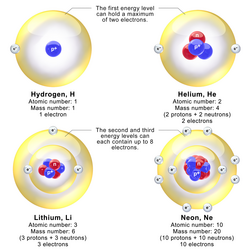
Key Facts
- Applicability: Most accurate for one-electron (hydrogenic) systems.
- Bohr Radius: The smallest possible radius for a hydrogen electron is approximately 52.9 pm.
- Energy Quantization: Electrons exist in discrete energy levels; the lowest level for hydrogen is -13.6 eV.
- Angular Momentum: In this model, angular momentum is an integer multiple of the reduced Planck constant (ħ).
- Rydberg Energy: A combination of natural constants that defines the energy scale of these levels.
The Mechanics of Atomic Orbits
To calculate the orbits of an electron, the Bohr model relies on two primary assumptions: one rooted in classical mechanics and one in quantum rules.
Classical Electrostatic Attraction
The model assumes the electron is held in a circular orbit by the Coulomb force (electrostatic attraction). The centripetal force required to keep the electron moving in a circle is provided by this attraction. Because the nucleus is significantly more massive than the electron, the nucleus remains virtually stationary.
The total energy of the electron is negative, meaning it is bound to the nucleus. Energy must be added to the system to pull the electron away to an infinite distance, where its energy would be zero. According to the virial theorem, the total energy is half of the potential energy, with the remainder being kinetic energy.
The Quantum Rule of Angular Momentum
Classical physics predicts that an orbiting electron should constantly emit electromagnetic radiation and eventually spiral into the nucleus. Bohr bypassed this by introducing a quantum rule: the angular momentum (L) of the electron must be an integer multiple of the reduced Planck constant (ħ). This quantization prevents the orbit from decaying and creates stable, discrete energy levels.
Deriving Energy Levels and the Bohr Radius
By combining the classical force equations with the quantization of angular momentum, we can determine the allowed radii and energy levels for an electron.
The allowed orbit radius (rn) is proportional to the square of the principal quantum number (n). For the hydrogen atom (where the atomic number Z = 1), the smallest radius (n = 1) is known as the Bohr radius, approximately 5.29 × 10⁻¹¹ meters.
The energy of the n-th level is calculated based on the atomic number (Z) and the quantum number (n). For hydrogen, the energy levels are approximately:
- n = 1: -13.6 eV
- n = 2: -3.4 eV
- n = 3: -1.51 eV
The Rydberg Energy and Fine-Structure Constant
The combination of constants used to calculate these levels is called the Rydberg energy (RE). This can be expressed using the rest mass energy of the electron (511 keV) and the fine-structure constant (α ≈ 1/137), which characterizes the strength of the electromagnetic interaction.
| Parameter | Symbol/Formula | Approximate Value (Hydrogen) |
|---|---|---|
| Bohr Radius | r1 | 52.9 pm |
| Ground State Energy | E1 | -13.6 eV |
| Fine-Structure Constant | α | 1/137 |
| Reduced Planck Constant | ħ | 1.054 × 10⁻³⁴ J·s |
Advanced Considerations
Hydrogenic Atoms and the N-Body Problem
The Bohr formula can be generalized for any nucleus with Z protons (hydrogenic atoms). However, this is only a rough approximation for atoms with more than one electron. In multi-electron systems, the n-body problem arises because electrons interact with each other via the Coulomb force, making analytical solutions impossible.
Reduced Mass and Positronium
For higher precision, the model uses the reduced mass of the electron and proton rather than the electron mass alone. This adjustment explains why the spectral lines of singly ionized helium do not differ from hydrogen by a factor of exactly four.
In the case of positronium (an electron orbiting a positron), the reduced mass is exactly half the electron mass. Consequently, the total kinetic energy is half of what it would be for an electron orbiting a heavy nucleus, resulting in energy levels that are half of the Rydberg energy.
Relativistic Limits and Charge Screening
When the atomic number Z reaches approximately 137 (1/α), the electron's motion becomes highly relativistic. Theoretically, such super-heavy nuclei would trigger electromagnetic charge screening, where the vacuum creates a bound electron and ejects a positron to reduce the nuclear charge.
Frequently Asked Questions
Why is the energy of an electron in the Bohr model negative?
The negative value indicates that the electron is bound to the nucleus. A negative energy means that work must be performed (energy must be added) to pull the electron away from the electrostatic attraction of the nucleus to a state of zero energy at an infinite distance.
What is the Bohr radius?
The Bohr radius is the most probable distance between the proton and the electron in the ground state (n=1) of a hydrogen atom, measuring approximately 52.9 picometers.
How does the Bohr model explain spectral lines?
Because angular momentum is quantized, electrons can only exist in discrete energy levels. When an electron jumps between these levels, it emits or absorbs a photon with a frequency exactly equal to the energy difference between those levels, creating distinct spectral lines.
Why can't the Bohr model be used for complex atoms?
The model only accounts for the interaction between one electron and the nucleus. In atoms with multiple electrons, the electrons repel each other via the Coulomb force, creating a complex system of interactions that cannot be solved with simple circular orbit equations.
What is the significance of the fine-structure constant in this model?
The fine-structure constant (α) relates the Rydberg energy to the rest mass energy of the electron. It essentially describes the strength of the electromagnetic coupling between the electron and the nucleus.