Egyptian Hieroglyphs: The Evolution and Mechanics of an Ancient Script
For millennia, the walls of temples and the depths of tombs have been adorned with one of the most visually striking writing systems in human history: Egyptian hieroglyphs. More than just art, this complex logographic script served as the primary vehicle for the Egyptian language from approximately 3250 BC until 400 AD. By blending artistic representation with phonetic precision, the ancient Egyptians created a system capable of recording everything from royal decrees to sacred myths.
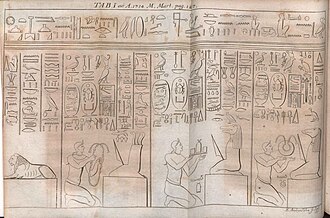
The script is characterized by its versatility in direction; it could be written from right-to-left, left-to-right, or in boustrophedon (an alternating direction where lines run in opposite directions). This flexibility allowed scribes to adapt the text to the architectural constraints of their monuments.
Key Facts
- Period of Use: Approximately 3250 BC to 400 AD.
- Script Type: Logographic, combining phonetic signs and semantic markers.
- Parent System: Evolved from proto-writing.
- Child Systems: Gave rise to Hieratic and Proto-Sinaitic scripts.
- Directionality: Right-to-left, left-to-right, or boustrophedon.
- Modern Encoding: Standardized in Unicode (U+13000–U+143FF).
History and Evolution
Origins and Early Development
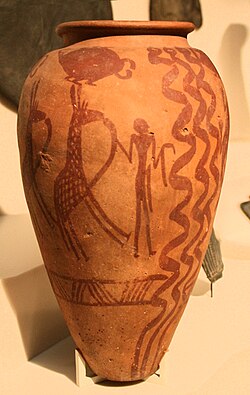
The journey of Egyptian writing began with proto-writing, appearing as early as 3250 BC. Early evidence includes pottery symbols from the Naqada II period and labels found in the tomb of Menes (c. 3200–3000 BC). These early inscriptions were often utilitarian, used for labeling goods or identifying royal names, such as the ivory labels featuring King Den (c. 2985 BC).
![Designs on tokens from Abydos, carbon dated to c. 3400–3200 BC.[20][21] They are similar to contemporary tags from Uruk.[22]](/images/15/be/15be5bacd49014277d4b496604a47a947ecbc5ac11a87485aa613866d91a56d5.jpg)
The Mature System and Late Period
As the script matured, it became a sophisticated tool for statecraft and religion. By the time of the Old Kingdom, it was capable of expressing complex grammar. A notable example is the seal impression from Peribsen's tomb (ca. 2660–2650 BC), which contains the first known complete sentence in Egyptian history, detailing the unification of the "Two Lands." Over time, the script evolved into various forms, including the more cursive Hieratic used for daily administration.
![Seal impression from Peribsen's tomb with the first known complete sentence in Egyptian history (ca. 2660–2650 BC): "Sealing of everything of Ombos (i.e., Naqada): He of Ombos has joined the Two Lands for his son, the Dual King Peribsen."[29][30]](/images/4a/b3/4ab380936ce06ca5b9fef98720ee8a7da214b5c5c7ed845c59d46db4854f6911.jpg)
Decipherment and Survival
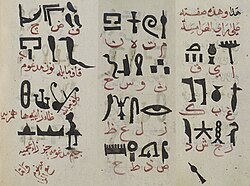
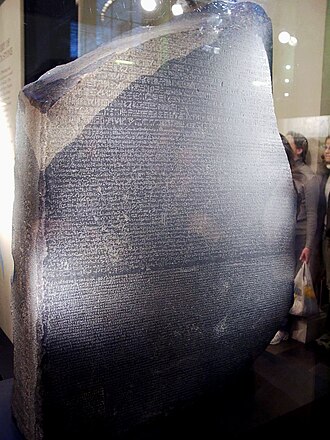
Following the Greco-Roman period, the knowledge of how to read hieroglyphs faded into obscurity. The script's survival in the modern era is largely due to the discovery of the Rosetta Stone, which provided a multilingual key that allowed scholars to finally crack the code of the ancient language.
How the Writing System Works
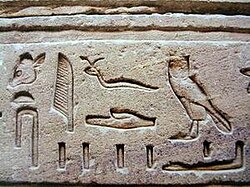
Egyptian hieroglyphs are not a simple alphabet. Instead, they employ a combination of three different types of signs to convey meaning and sound.
Phonetic Reading
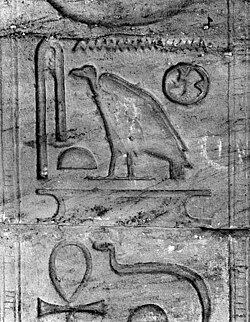
Many signs represent sounds rather than objects. Uniliteral signs represent a single consonant. For example, the character sꜣ can be used as a sound or within a word like sꜣw (meaning "keep" or "watch"). To ensure clarity, scribes often used phonetic complements—additional signs that repeat a sound to help the reader identify the intended word.
Semantic Reading and Logograms
Some signs are logograms, meaning the symbol represents the actual object it depicts. For instance, the symbol for the sun represents rꜥ (sun), and the symbol for a house represents pr (house). In some cases, the connection is metonymic; a temple flag represents nṯr (god), and a bird with a human head represents bꜣ (soul).

Determinatives
Because the script often omitted vowels, words could look identical. To solve this, Egyptians used determinatives—silent signs placed at the end of a word to indicate its general category. For example, a specific sign would indicate that a word refers to a baby, while another would indicate a woman or a length of cloth.
Special Notations and Artistic Standards
The Cartouche
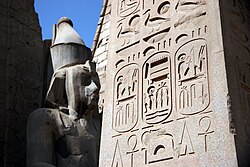
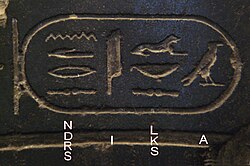
One of the most recognizable features of Egyptian writing is the cartouche, an oval loop that encircles the name of a royal figure. This served to protect the name and distinguish it from the surrounding text. Famous examples include the cartouches for Ramesses II and Cleopatra.
Scribal Precision
Hieroglyphs were often written using a grid system to maintain proportion and scale, regardless of the size of the monument. This allowed artists to maintain the aesthetic integrity of symbols representing concepts like "life," "stability," and "dominion."
![Artist's scaled drawing of hieroglyphs c. 1479–1458 BC, meaning 'life', 'stability', and 'dominion'. The grid lines allowed the artist to draw the hieroglyphs at whatever scale was needed.[31]](/images/cb/30/cb3043eb7ee15a9cc78dd1f95cda35d16c634f1991309eb1765f1aa2c2f803c2.jpg)
Summary of Script Characteristics
![Extract from the Tale of the Two Brothers.[39]](/images/79/aa/79aacb8af646f2475d63b7e30ed1f5f23d48125119064fcc6a691c670e868fd8.jpg)
| Sign Type | Function | Example/Detail |
|---|---|---|
| Phonograms | Represent sounds (consonants) | Uniliteral signs (e.g., sꜣ) |
| Logograms | Represent the object depicted | Sun symbol for rꜥ |
| Determinatives | Clarify meaning/category | Woman symbol for feminine names |
| Cartouche | Enclose royal names | Used for Pharaohs like Ramesses II |
Frequently Asked Questions
Was Egyptian hieroglyphs an alphabet?
No, it was a logographic system. While it had phonetic signs that functioned similarly to an alphabet, it also used logograms (symbols for words) and determinatives (symbols for categories), making it far more complex than a standard alphabet.
In which direction were hieroglyphs read?
They could be read from right-to-left, left-to-right, or in boustrophedon. To determine the direction, readers typically look at the faces of the human or animal figures; the text is read into the faces.
What is a cartouche?
A cartouche is an oval enclosure used to surround the name of a king or queen, serving as a visual marker of royalty and a symbolic protective barrier.
How were the hieroglyphs finally deciphered?
The decipherment was made possible by the Rosetta Stone, which featured the same text written in three different scripts: Hieroglyphic, Demotic, and Ancient Greek. This allowed scholars to compare the known Greek text with the unknown Egyptian scripts.
What is the difference between Hieroglyphs and Hieratic?
Hieroglyphs were the formal, pictorial script used primarily for monuments and religious texts. Hieratic was a simplified, cursive version of the script used by scribes for everyday administrative tasks and letters on papyrus.