Ecological Niche: How Species Coexist and Shape Their Environments
In the complex web of nature, no two species occupy the exact same space and role. This concept is known as the ecological niche—the specific match between a species and its environmental conditions. A niche is more than just a physical location; it describes how an organism responds to the distribution of resources and competitors, and how it, in turn, alters those same factors.
For example, a species may thrive when resources are abundant and predators are scarce. Simultaneously, that species might limit resource access for others or serve as a primary food source for a predator. Because environmental variables change based on geographic and biotic contexts, the dimensions of a niche vary from one species to another.
Key Facts
- Niche Definition: The intersection of environmental conditions and a species' response to resources and competition.
- Three Primary Models: Grinnellian (habitat-based), Eltonian (functional role), and Hutchinsonian (mathematical/statistical).
- Niche Construction: The process by which organisms actively modify their own environmental niches.
- Competitive Exclusion: The principle that two species competing for the exact same resources cannot coexist indefinitely.
- Niche Differentiation: The evolutionary process where species evolve different traits to reduce competition.
Three Perspectives on the Ecological Niche
Ecologists use different frameworks to define a niche depending on whether they are focusing on habitat, function, or mathematical probability.
The Grinnellian Niche
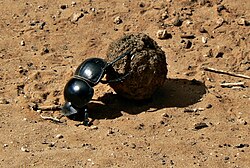
The Grinnellian niche is primarily determined by the habitat in which a species lives and the behavioral adaptations it has developed to survive there. It is often viewed as a "needs" niche—the specific area that meets the environmental requirements for an organism's survival.
The Eltonian Niche
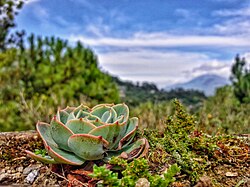
The Eltonian niche shifts the focus toward the functional role of a species within a food chain. Rather than just responding to an environment, an Eltonian niche emphasizes how a species changes its environment and behavior as it grows, specifically through its foraging activities and "food habits."
The Hutchinsonian Niche
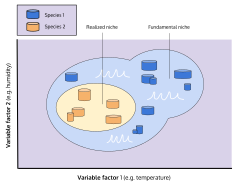
The Hutchinsonian niche employs mathematics and statistics to explain species coexistence. It defines the niche as an n-dimensional hypervolume where every dimension represents an environmental variable. This model helps scientists quantify how species overlap and compete within a community.
Contemporary Niche Theory and Coexistence
Modern ecology seeks to understand how multiple species can coexist without one driving the other to extinction. Contemporary niche theory suggests that for two consumer species to coexist, specific requirements regarding resource usage and competition must be met.
Niche Differentiation
To avoid direct conflict, species often undergo niche differentiation. This occurs through several mechanisms:
- Resource Partitioning: Species divide resources by using different parts of the environment or feeding at different times.
- Predator Partitioning: Species evolve to be preyed upon by different predators.
- Conditional Differentiation: Changes in niche usage based on specific environmental triggers.
- Competition-Predation Trade-off: A balance where a species may accept a less optimal resource to avoid a high-risk predator.
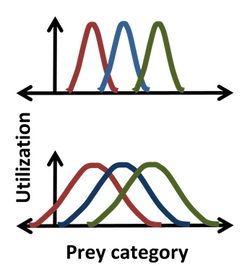
The "Ghosts" of Competition
Ecologists often refer to the "Ghost of Competition Past" to describe current species distributions. This suggests that the differences we see between species today are the result of intense competition in the distant past, which forced them to evolve different niches or led to the extinction of the weaker competitor.
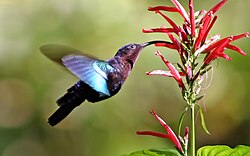
Niche Range and Geographic Distribution
A species' geographic range is often a spatial reflection of its niche. Ecologists distinguish between two types of niches in this context:
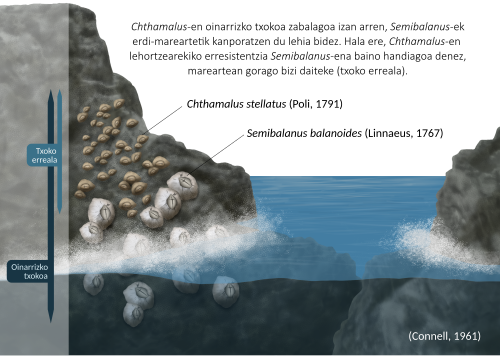
- Fundamental Niche: The full range of environmental conditions under which a species can survive and reproduce in the absence of competition.
- Realized Niche: The actual space a species occupies after accounting for interactions with other species, such as competition and predation.
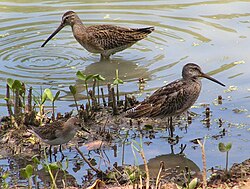
This distinction is clearly seen in shorebirds, where different bill lengths allow some species to feed in deeper water than others, effectively partitioning the shoreline.
Examples of Niche Specialization
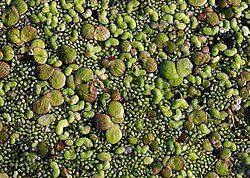
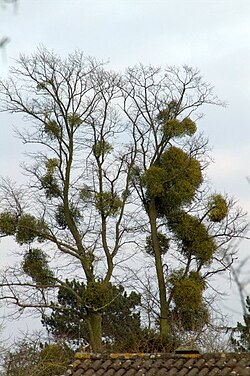
Niche specialization can occur through size or parasitic relationships. For instance, different species of duckweed differentiate by size to coexist on a single pond, while mistletoe acts as a hemi-parasite, exploiting a host tree for nutrients.
Summary of Niche Concepts
| Niche Type | Primary Focus | Key Driver | Perspective |
|---|---|---|---|
| Grinnellian | Habitat & Space | Environmental Requirements | Where a species lives |
| Eltonian | Functional Role | Foraging & Food Habits | What a species does |
| Hutchinsonian | Statistical Space | Multi-dimensional Variables | How species coexist |
Frequently Asked Questions
What is the difference between a fundamental and realized niche?
A fundamental niche is the entire set of conditions under which a species can survive without interference. A realized niche is the actual, often smaller, set of conditions the species occupies due to competition and predation.
How does niche construction work?
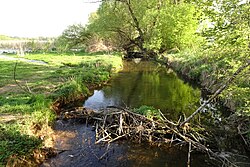
Niche construction occurs when an organism modifies its own environment, thereby altering the selection pressures acting upon it and other species. An example is a beaver building a dam, which changes the local ecosystem for many other organisms.
What is resource partitioning?
Resource partitioning is a process where species divide a limited resource (such as food or space) to avoid direct competition, allowing them to coexist in the same geographic area.
What is the competitive exclusion principle?
This principle states that two species competing for the exact same limiting resource cannot coexist at constant population values; one will eventually outcompete and eliminate the other.
Why is the Hutchinsonian niche considered "n-dimensional"?
It is called n-dimensional because it considers many different environmental variables (temperature, humidity, food size, pH levels, etc.) as separate axes in a mathematical space to define the species' requirements.