Eastern Gray Squirrel: Biology, Behavior, and Global Impact
The Eastern gray squirrel (*Sciurus carolinensis*) is one of the most recognizable rodents in the world. From the hardwood forests of North America to urban gardens and even as an invasive species in Europe, this highly adaptable mammal has established itself across diverse landscapes. Known for its bushy tail and agile climbing abilities, the gray squirrel is a fascinating subject of biological study, particularly regarding its genetic variations and ecological footprint.
With a fossil record dating back to the Late Pleistocene—approximately 19,000 years ago—this species has demonstrated remarkable resilience. Evidence from South Carolina suggests that even in ancient hardwood-conifer swamps, the ancestors of today's gray squirrels were already well-established.
Key Facts
- Scientific Name: Sciurus carolinensis
- Conservation Status: Least Concern (IUCN 3.1)
- Lifespan: Typically 6 years in the wild; up to 20 years in captivity
- Diet: Primarily herbivorous, including nuts, seeds, and mushrooms
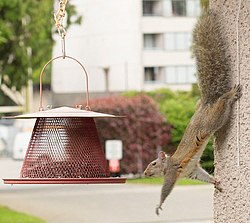
- Distinctive Feature: Large bushy tail and ability to rotate hind feet for head-first descent
- Genetic Variation: Includes melanistic (black) morphs with higher cold tolerance
Physical Characteristics and Variations
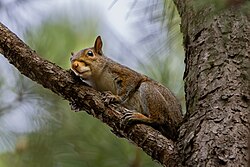
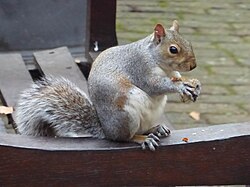
The Eastern gray squirrel is characterized by its predominantly gray fur, often accented with brown spots and streaks. It features a white underside, a trait known as countershading, which helps it blend into its environment. While most individuals follow this standard pattern, certain populations exhibit melanism—a genetic mutation of the MC1R gene that results in almost entirely black fur.
Melanistic squirrels are particularly common in parts of southeastern Canada. Interestingly, this dark coloration provides a biological advantage in cold climates; studies show that black squirrels experience an 18% reduction in heat loss and an 11% increase in non-shivering thermogenesis capacity when exposed to temperatures as low as −10 °C compared to the gray morph.
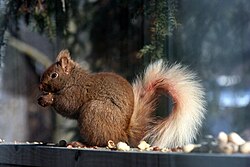
In terms of size, adults typically weigh between 400 and 600 grams. Their bodies measure 23 to 30 cm in length, complemented by a tail that ranges from 19 to 25 cm. Notably, the species does not display sexual dimorphism, meaning males and females are indistinguishable in size and color.
Dental Structure
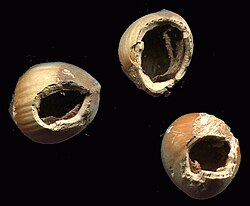
As members of the order Rodentia, gray squirrels possess specialized teeth designed for gnawing. They have a total of 22 teeth, following a dental formula of 1.0.2.3 1.0.1.3. Their sharp incisors are essential for processing hard materials like hazelnuts and acorns.
Growth and Life Cycle
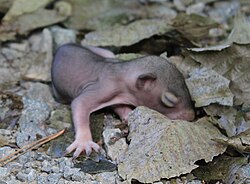
The life of a squirrel begins as a kit (also called a kitten or pup). At birth, these newborns are extremely vulnerable: they weigh only 13–18 grams, are entirely hairless, blind, and pink, though whiskers are present. Their development follows a strict timeline:
- 7–10 days: Skin begins to darken as juvenile fur prepares to grow.
- 19–21 days: Lower incisors erupt.
- 3–4 weeks: Ears open.
- 21–42 days: Eyes open.
- 7–10 weeks: Weaning is typically completed.
By 8 to 9 months, a kit reaches full adult body mass. However, survival in the wild is challenging; only about one in four kits survives to its first birthday. While adults can live for many years, mortality rates increase sharply after the age of eight.
Habitat and Nesting Behavior
Eastern gray squirrels are master architects of the canopy. They prefer constructing dens, known as dreys, on large tree branches or within hollow trunks. These nests are meticulously lined with insulating materials such as moss, thistledown, dried grass, and feathers to minimize heat loss.
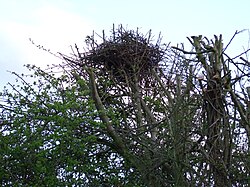
The choice of nesting site is critical for survival. Squirrels that utilize sturdy tree dens have a significantly higher survival rate—roughly 40% higher—than those forced to live in leaf nests. To ensure safety, a single squirrel will often claim 2–3 different dens simultaneously. They typically range over an area of 1.5 to 8 acres, though this territory may shrink in high-density urban environments.
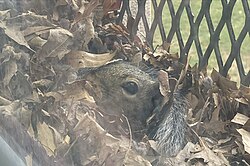
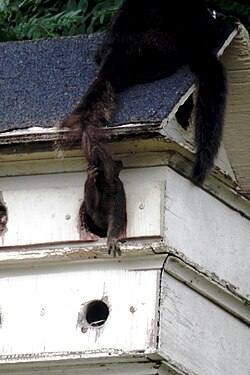
In urban settings, squirrels have adapted to use man-made structures, such as birdhouses, for shelter.
Ecological Impact and Invasive Status
While native to North America, the Eastern gray squirrel has become a significant invasive species in other parts of the world, most notably the United Kingdom. Introduced in the 1870s and later released in locations like London's Regents Park, they have had a profound impact on local ecosystems.
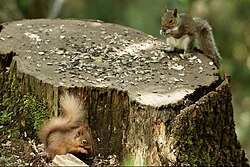
In these new environments, they often compete with native species, such as the red squirrel, for resources. This competition can lead to the displacement of native fauna, making the gray squirrel a subject of intense conservation management in Europe.
Summary of Biological Data
| Feature | Details |
|---|---|
| Scientific Name | Sciurus carolinensis |
| Order | Rodentia |
| Gestation Period | Approximately 44 days |
| Typical Litter Size | 1 to 4 young (up to 8) |
| Adult Weight | 400–600 g |
| Total Teeth | 22 |
Frequently Asked Questions
How long do gray squirrels live in the wild?
In the wild, an adult squirrel typically lives to be about six years old, though exceptional individuals can reach 12 years. Their life expectancy is much lower at birth, usually only 1–2 years, due to predation and environmental challenges.
What is the difference between a gray squirrel and a black squirrel?
Black squirrels are a melanistic variation of the Eastern gray squirrel caused by a mutation in the MC1R gene. They are not a separate species, but they do exhibit higher cold tolerance than the standard gray morph.
Why are gray squirrels considered invasive in the UK?
They are considered invasive because they were introduced to the UK and have since competed with and displaced native species, such as the red squirrel, altering the local ecological balance.
How do squirrels build their nests?
Squirrels build nests called dreys using twigs and leaves, often lining them with moss, feathers, and dried grass for insulation. They prefer hollow tree trunks or large branches for stability and protection.
Do male and female squirrels look different?
No, the Eastern gray squirrel does not exhibit sexual dimorphism, meaning there are no noticeable differences in size or coloration between males and females.