E. O. Wilson: The Architect of Sociobiology and Biodiversity
Edward Osborne Wilson was a towering figure in modern science, serving as a biologist, naturalist, ecologist, and entomologist whose work bridged the gap between the minute world of insects and the grand scale of human nature. Often referred to as the heir to Charles Darwin, Wilson's intellectual curiosity led him to develop sociobiology—the study of the biological basis of social behavior—and to champion the urgent need for global biodiversity preservation.
Throughout his career, Wilson transitioned from a specialist in myrmecology (the study of ants) to a polymath who sought a "consilience" of knowledge, attempting to unify the sciences and humanities into a single framework of understanding.
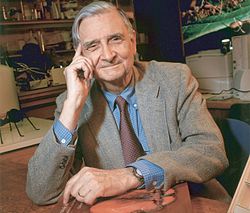
Key Facts
- Primary Field: Developed the field of sociobiology and was a world-renowned expert in myrmecology.
- Major Honors: Two-time Pulitzer Prize winner (1979 and 1991) and recipient of the National Medal of Science (1977).
- Core Theories: Proposed the biophilia hypothesis and contributed significantly to the theory of island biogeography.
- Conservation Legacy: Advocated for the "Half-Earth" proposal to save the planet's remaining species.
- Education: Earned his BS and MS from the University of Alabama and his PhD from Harvard University.
Scientific Contributions and Theories
Sociobiology and Human Nature
In his seminal 1975 work, Sociobiology: The New Synthesis, Wilson proposed that social behavior in animals, including humans, has a genetic component. This sparked significant controversy and academic debate, as it suggested that biological imperatives influence social structures. He further explored these themes in On Human Nature (1979), which earned him his first Pulitzer Prize.
The Study of Ants and Island Biogeography
Wilson's early career was defined by his obsession with ants. His doctoral thesis, A Monographic Revision of the Ant Genus Lasius (1955), laid the groundwork for his lifelong expertise. Beyond entomology, he co-developed the theory of island biogeography, which examines the factors affecting the species richness and biodiversity of isolated natural communities.
Biophilia and Consilience
Wilson introduced the biophilia hypothesis, suggesting that humans possess an innate, genetic tendency to seek connections with nature and other forms of life. Later, in his 1998 book Consilience: The Unity of Knowledge, he argued for a unified approach to knowledge, suggesting that all branches of learning—from physics to ethics—could eventually be linked through a single biological framework.
Academic Career and Legacy
Wilson spent much of his professional life at Harvard University and the Museum of Natural History. He was a prolific author and mentor, guiding numerous doctoral students and publishing a vast array of literature ranging from technical scientific texts to a novel, Anthill. His commitment to the environment culminated in the "Half-Earth" vision, a call to dedicate half of the Earth's land and sea to nature to prevent mass extinction.
| Category | Key Contribution / Award | Year/Detail |
|---|---|---|
| Major Field | Sociobiology | Founder/Developer |
| Pulitzer Prizes | On Human Nature & The Ants | 1979, 1991 |
| Scientific Medal | National Medal of Science | 1977 |
| Key Concept | Biophilia Hypothesis | Innate bond with nature |
| Conservation | Half-Earth | Biodiversity preservation |
Frequently Asked Questions
What is sociobiology?
Sociobiology is the systematic study of the biological basis of all social behavior, suggesting that social patterns are influenced by evolutionary processes and genetics.
What is the biophilia hypothesis?
The biophilia hypothesis is the idea that humans have an inherent, biological need to connect with nature and other living organisms.
What was Wilson's contribution to the study of ants?
As a leading myrmecologist, Wilson provided comprehensive revisions of ant genera and wrote The Ants, a definitive work on the biology and social structure of these insects.
What does "consilience" mean in Wilson's work?
Consilience refers to the "jumping together" of knowledge from different disciplines to create a unified understanding of the natural world and human experience.
What was the "Half-Earth" proposal?
The Half-Earth proposal is a conservation strategy suggesting that half of the planet's surface should be preserved as wilderness to protect biodiversity and prevent the extinction of species.