Dredging: Techniques, Purposes, and Environmental Impacts
Dredging is the specialized process of excavating material from a water environment. Whether it is deepening a shipping channel to accommodate massive cargo ships or recovering valuable minerals from the seabed, dredging is essential for global trade, coastal protection, and infrastructure development. This complex operation is typically carried out by a dredger—a specialist floating plant designed to loosen, extract, and transport underwater sediment.
The dredging process generally follows a four-part sequence: loosening the material, bringing it to the surface (extraction), transporting it, and finally, disposal.
Key Facts
- Primary Goals: Most dredging is performed to maintain navigable water depths or recover valuable materials.
- Ancient Roots: Evidence of dredging dates back to the 3rd millennium BC in the Nile and the 3rd century BC in Marseille.
- Scale: Modern vessels, such as the Cristobal Colon, can hold up to 46,000 cubic metres of material.
- Regulation: Due to environmental risks, dredging is strictly regulated; in the U.S., the Clean Water Act requires Army Corps of Engineers permits.
The Purposes of Dredging
Dredging serves various commercial, civil, and environmental functions, categorized by the intended outcome of the project.
Capital and Maintenance Dredging
Capital dredging is used to create new harbours, berths, or waterways, or to deepen existing ones to allow larger ships access. This often involves hard materials, requiring cutter suction dredges or drilling and blasting. In contrast, maintenance dredging is the most common form of the activity. It removes silt, sand, and mud that naturally accumulate over time, ensuring that channels and reservoirs remain at their required depths.
Land Reclamation and Construction
Dredging is frequently used for land reclamation, where sand, clay, or rock is mined from the seabed to construct new land or provide flood and erosion control. Similarly, the construction industry relies on dredging for winning construction materials, specifically sand and gravel used in concrete production, a practice heavily concentrated in Northwest Europe.
Environmental and Preparatory Works
- Beach Nourishment: Mining offshore sand to replace beach sediment eroded by storms or human activity.
- Flood Prevention: Increasing channel depth to expand the volume of water a channel can carry.
- Preparatory Dredging: Excavating foundations for future piers, docks, bridges, or wharves.
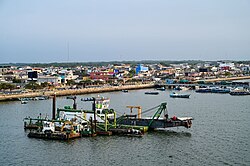
Types of Dredging Equipment
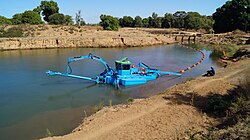
Dredging systems can be shore-based, barge-mounted, or integrated into purpose-built vessels. They are broadly divided into suction and mechanical types.
Suction Dredgers
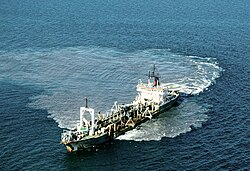
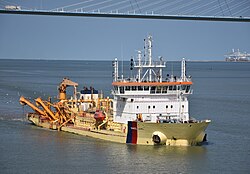
Suction dredgers act like giant underwater vacuums. A Trailing Suction Hopper Dredger (TSHD) trails a suction pipe with a drag head, loading spoil into internal hoppers. Once full, the vessel sails to a disposal site to dump or pump the material.
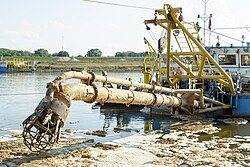
Other suction variants include Cutter-Suction Dredgers, which use a rotating head to break up hard material (with the Spartacus being the most powerful as of 2024), and Auger Suction Dredgers, which utilize a rotating Archimedean screw.
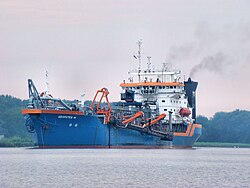
Mechanical Dredgers
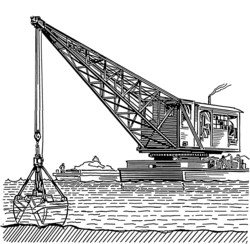
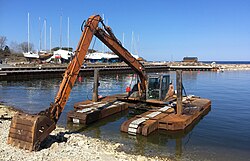
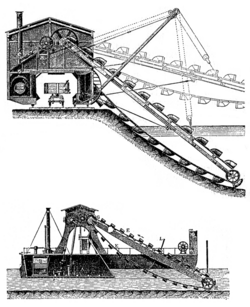
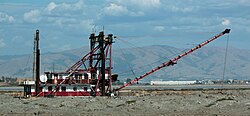
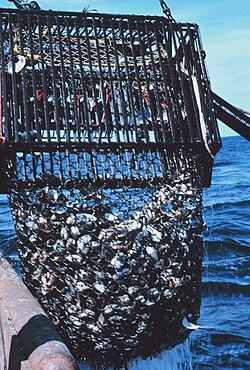
Mechanical dredgers use physical force to lift material. Bucket dredgers use a chain or wheel of circulating buckets, while Grab dredgers employ a clam shell bucket suspended from a crane or hydraulic arm. Backhoe or dipper dredgers use excavator-style attachments to maneuver material in shallow waters.
Specialized Equipment
Some operations use a Bed Leveler—a large blade pulled across the seabed to flatten it, similar to a bulldozer. Amphibious dredgers can operate in water or extend "spuds" (steel piles) to stand on the seabed, and some can even drive onto land.
Historical Evolution
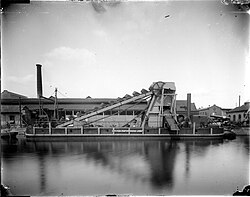
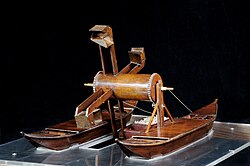
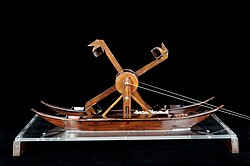
Dredging has evolved from manual labor to massive industrial machinery. Early reconstructions of mud-drags, such as those designed by Leonardo da Vinci, show the early conceptualization of sediment removal.
The 19th and 20th centuries saw a surge in dredging scale, most notably during the construction of the Suez Canal and the Panama Canal (completed in 1914), the latter being the most expensive U.S. engineering project of its time.
Environmental Impact and Regulation
While beneficial for infrastructure, dredging can cause significant ecological disruption. Key concerns include:
- Sedimentation: Changes in wetland chemistry and marsh productivity.
- Contamination: The potential for dredge spoil sites to become contaminated.
- Toxins: The release of Tributyltin (a banned anti-fouling biocide) into the water column.
To mitigate these risks, dredging is often restricted to licensed areas and monitored via GPS. In the United States, the Clean Water Act prohibits the discharge of dredged materials into wetlands without a permit from the Army Corps of Engineers.
Summary of Dredging Types
| Dredge Type | Mechanism | Primary Use Case |
|---|---|---|
| Trailing Suction (TSHD) | Suction pipe and hopper | Maintenance, beach nourishment |
| Cutter-Suction | Rotating cutter head + suction | Capital dredging, land reclamation |
| Grab/Clamshell | Mechanical bucket | Bay mud, confined areas |
| Bucket Dredger | Chain of buckets | Heavy sediment removal |
| Backhoe/Dipper | Hydraulic excavator arm | Shallow water, shoreline work |
Frequently Asked Questions
What is the difference between capital and maintenance dredging?
Capital dredging creates new waterways or deepens existing ones for the first time to allow larger ships. Maintenance dredging is the ongoing process of removing accumulated silt and sand to keep those waterways navigable.
How does a Trailing Suction Hopper Dredger (TSHD) work?
A TSHD trails a suction pipe along the seabed while moving. The pipe sucks up sediment and deposits it into a hopper (a large internal tank) within the ship's hull. Once full, the ship transports the material to a disposal site.
What are the environmental risks associated with dredging?
Dredging can disrupt wetland chemistry, cause sedimentation that harms marsh productivity, and release trapped toxins, such as Tributyltin, into the surrounding water.
Who are the world's largest dredging companies?
Based on 2012 sales data, the largest companies include China Harbour Engineering, Jan De Nul, DEME, Royal Boskalis, and Van Oord.
What is beach nourishment?
Beach nourishment is the process of mining sand from offshore areas and placing it onto a beach to replace sand lost to wave action, storms, or human activity, thereby protecting the coastline.