Dollar Sign: The History and Evolution of the World's Most Famous Currency Symbol
The dollar sign ($) is one of the most recognized symbols globally, serving as the shorthand for various currencies and a universal icon for wealth. While most people associate it exclusively with the United States, its origins are rooted in a complex web of international trade, colonial history, and linguistic evolution.
From the silver mines of Bolivia to the digital encoding of modern computers, the symbol has transitioned from a scribal abbreviation to a standardized character used in finance and programming.
Key Facts
- Unicode Designation: U+0024.
- Primary Theory: Likely evolved from a scribal abbreviation of the Spanish word pesos.
- U.S. Adoption: The U.S. dollar was defined by the Coinage Act of 1792 based on the value of the Spanish milled dollar.
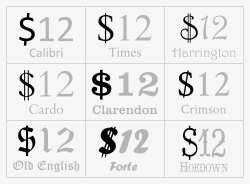
- Variants: Exists as both a single-stroke ($) and double-stroke (similar to the Portuguese cifrão) symbol.
- Global Use: Used by numerous currencies including the Brazilian real, Macanese pataca, and New Taiwan dollar.
The Origins of the Symbol
The exact origin of the dollar sign is a subject of historical debate, with several competing hypotheses based on documentary evidence.
The Peso Abbreviation Theory
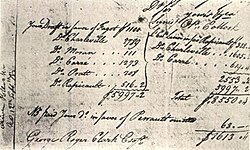
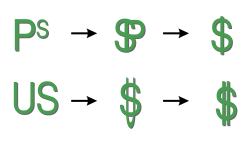
The most widely accepted theory suggests the symbol developed from a shorthand for the Spanish American peso. In late 18th-century manuscripts, scribes often wrote a lowercase 's' over the letter 'p'. Over time, the loop of the 'p' disappeared, leaving the vertical stroke and the 's', creating the '$' mark. This is supported by letters from the 1770s, such as those written by Irish trader Oliver Pollock, where "ps" was run together in a manner resembling the modern sign.
The Pillars of Hercules Theory
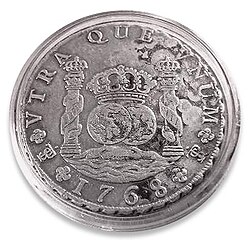
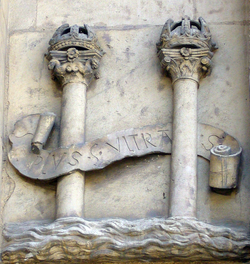
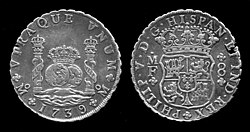
Another hypothesis links the symbol to the Pillars of Hercules, which represented the Strait of Gibraltar. This imagery appeared on the Spanish coat of arms and on real de ocho coins minted at the Potosí mint in Bolivia. These coins featured two pillars wrapped in a ribbon forming an 'S' shape. This connection is reinforced by the fact that in Qing Dynasty China, Spanish dollars were referred to as Shuāngzhù, meaning "double-pillar."
The Thaler Hypothesis
Some historians suggest the sign derives from the thaler (or Joachimsthaler), a large German silver coin. The word "dollar" itself is a derivative of the Dutch daalder, which came from thaler. It is conjectured that the symbol began as a superimposition of 'S' and 'I' or 'J', or perhaps a representation of a snake and cross emblem found on thaler coins.

The Dollar Sign in the United States
When the United States established its own currency via the Coinage Act of 1792, it modeled the U.S. dollar on the Spanish milled dollar. However, the symbol did not appear on early U.S. coins. The first printed occurrences are attributed to Philadelphia printer Archibald Binny in the 1790s.
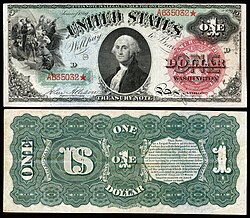
By 1869, the U.S. government issued $1 notes that featured a large monogram of a 'U' overlapping an 'S', along with a small double-stroke dollar sign in the forgery warning section.
The Cifrão and Portuguese Influence
In the Portuguese Empire, a double-stroke variant known as the cifrão was used. Unlike the U.S. dollar sign, which denotes the currency unit, the cifrão historically served as a thousands separator for the real (plural réis). For example, a value of 123,500 réis would be written as 123$500.
After Portugal adopted the escudo in 1911, the cifrão transitioned into a decimal separator. This practice continued in Cape Verde, where the cifrão remains the official sign of the Cape Verdean escudo and is still used as a decimal separator.
Modern Technical Implementation
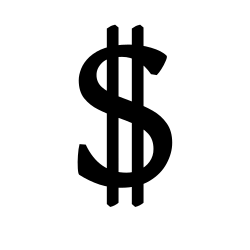
In the digital age, the dollar sign is standardized under the Unicode character U+0024. While some fonts render the symbol with one vertical bar and others with two, Unicode treats these as stylistic variants rather than distinct characters.
Programming and Software
Beyond finance, the '$' symbol is a critical operator in various programming languages:
- Assembly (Motorola/MOS): Used to define hexadecimal constants.
- Pascal/Delphi: Used for hexadecimal constants.
- R: Serves as a subsetting operator.
Summary of Currency Usage
| Currency Name | Symbol/Code | Notes |
|---|---|---|
| Brazilian real | R$ | Uses the dollar sign as part of the symbol |
| New Taiwan dollar | NT$ / $ | Commonly used in international trade |
| Cape Verdean escudo | $ (Cifrão) | Uses the double-stroke variant as a decimal separator |
| Samoan tālā | $ | Tālā is a transliteration of "dollar" |
| Nicaraguan córdoba | C$ | Prefix combined with the dollar sign |
Frequently Asked Questions
Does the dollar sign come from the letters "US"?
This is a common myth, but it is generally discredited by documentary evidence. While some 19th-century writers and novels (such as Atlas Shrugged) suggested it was a monogram of "US," historical evidence points more strongly toward the Spanish peso abbreviation.
What is the difference between the one-stroke and two-stroke dollar sign?
Visually, the two-stroke version is often associated with the Portuguese cifrão. Technically, however, modern computer encodings like Unicode treat them as the same character (U+0024), with the number of strokes being a matter of font design.
Why was the Spanish dollar so important to the U.S.?
The Spanish milled dollar was a globally accepted silver coin of consistent weight and purity. Because it was widely circulating in the Americas, the U.S. Congress used it as the benchmark for the value of the new U.S. dollar in 1792.
Is the dollar sign used in any non-currency contexts?
Yes. In programming languages like R, it is used for subsetting data. In some assembly languages, it denotes hexadecimal constants. Historically, it was even used in the 1993 Turkmen Latin alphabet to transliterate the Cyrillic letter Ш.