Doctor Who: The Legacy of the World's Most Famous Time Lord
Since its debut in 1963, Doctor Who has evolved from a modest BBC experiment into a global cultural phenomenon. A masterful blend of science fiction, adventure, and drama, the series follows the adventures of a Time Lord known as "The Doctor," who travels through time and space in the TARDIS—a time machine and spacecraft that is famously larger on the inside than the outside.
Created by Sydney Newman, C. E. Webber, and Donald Wilson, the show is renowned for its unique ability to reinvent itself. Through the process of regeneration, the lead character can change their appearance and personality, allowing the series to persist across decades and introduce new lead actors while maintaining a continuous narrative thread.

Key Facts

- Origin: Created in the United Kingdom and first broadcast on 23 November 1963.
- Scale: Comprises 26 classic seasons (1963–1989) and 15 modern series (2005–2025).
- Volume: A total of 892 episodes across 319 stories, though 95 episodes are currently missing.
- Global Reach: Broadcast across the UK, Oceania, the Americas, and Asia, with recent distribution via Disney+.
- Accolades: Recipient of prestigious honors, including a Peabody Award in 2013.
The Evolution of the Doctor
The central conceit of the series is the Doctor's ability to regenerate. This narrative device has allowed a diverse array of actors to step into the role, each bringing a distinct energy to the character. From the stern authority of William Hartnell to the modern charisma of Ncuti Gatwa, the Doctor's identity is ever-shifting.

Chronology of the Doctor's Incarnations
The Doctor has undergone numerous changes in appearance and personality over the years. The following table outlines the primary incarnations of the series lead.
| Incarnation | Actor | Tenure |
|---|---|---|
| First Doctor | William Hartnell | 1963–1966 |
| Second Doctor | Patrick Troughton | 1966–1969 |
| Third Doctor | Jon Pertwee | 1970–1974 |
| Fourth Doctor | Tom Baker | 1974–1981 |
| Fifth Doctor | Peter Davison | 1982–1984 |
| Sixth Doctor | Colin Baker | 1984–1986 |
| Seventh Doctor | Sylvester McCoy | 1987–1989 |
| Eighth Doctor | Paul McGann | 1996 |
| Ninth Doctor | Christopher Eccleston | 2005 |
| Tenth Doctor | David Tennant | 2005–2010 |
| Eleventh Doctor | Matt Smith | 2010–2013 |
| Twelfth Doctor | Peter Capaldi | 2014–2017 |
| Thirteenth Doctor | Jodie Whittaker | 2018–2022 |
| Fourteenth Doctor | David Tennant | 2023 |
| Fifteenth Doctor | Ncuti Gatwa | 2023–2025 |

Companions and Iconic Foes
The Doctor rarely travels alone, usually accompanied by companions—humans or other beings who provide a grounded perspective to the Doctor's alien nature. These companions, such as Amy Pond, help humanize the Doctor and drive the emotional core of the stories.
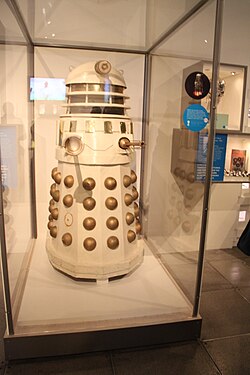
However, the journey is often interrupted by legendary adversaries. The Daleks, cybernetic mutants obsessed with purity, and the Cybermen, humans who have replaced their organic parts with machinery, remain the most enduring threats. The Doctor also faces The Master, a fellow Time Lord and arch-nemesis.


Production and Cultural Impact
The production of Doctor Who has mirrored the evolution of television technology. Early episodes utilized a multi-camera setup (1963–1989), while the modern era shifted to single-camera production to achieve a more cinematic feel. The show's music, beginning with Ron Grainer's original theme, has become as iconic as the TARDIS itself.

Beyond the screen, the "Whoniverse" extends into a vast array of media, including novels, audio dramas, and video games. The show's influence is visible in the widespread practice of cosplay and the creation of dedicated attractions like the Doctor Who Experience in Cardiff.
![The Doctor Who Experience in Cardiff. The programme's broad appeal attracts audiences of children and families as well as science fiction fans.[49]](/images/78/d2/78d29bd619eedf5e2635b5c7b73ab7e05a4154ff6f64db0a6e2298a90924d6f8.jpg)

The series has also engaged in philanthropic efforts. For example, a Doctor Who-themed Paddington Bear statue, designed by Peter Capaldi, was auctioned to benefit the National Society for the Prevention of Cruelty to Children (NSPCC).

Global Reach and Legacy
Doctor Who is a staple of British popular culture and has found success worldwide. From broadcasts in Asia and Oceania to its current partnership with Disney+ for international distribution, the show continues to attract diverse audiences of all ages.



Frequently Asked Questions
What is the TARDIS?
The TARDIS is the Doctor's time machine and spacecraft. While it looks like a 1960s British police box on the outside, it is dimensionally transcendental, meaning it is significantly larger on the inside.
Why does the lead actor change?
The actor changes because of a biological process called regeneration. When the Doctor is mortally wounded or aged, they can renew their entire physical form, which often results in a new personality and appearance.
Are there any missing episodes?
Yes, 95 episodes from the classic era are currently missing from the BBC archives, though efforts continue to restore or reconstruct them.
Who are the Daleks?
The Daleks are one of the Doctor's most famous enemies. They are mutated beings housed in armored, tank-like shells, known for their ruthless desire to conquer the universe.
Where can I watch Doctor Who now?
Depending on the region, Doctor Who is available through the BBC and Disney+, which handles much of the international distribution for the modern series.