Doctor of Philosophy (PhD): Global Requirements, History, and Variations
The Doctor of Philosophy, commonly abbreviated as PhD or DPhil, represents the highest level of postgraduate education in most academic disciplines. Far from being limited to the study of philosophy, this degree is awarded across a vast array of fields, signifying that the holder has made a significant, original contribution to human knowledge through rigorous research.
Pursuing a doctorate is a substantial commitment, typically lasting between 3 and 8 years. While the core objective—the production of a thesis or dissertation—remains constant, the path to completion varies significantly depending on the country, the institution, and the specific field of study.
Key Facts
- Duration: Typically ranges from 3 to 8 years.
- Prerequisites: Usually requires a Bachelor's or Master's degree, depending on the region.
- Core Requirement: Completion of original research and a defended dissertation.
- Terminology: Known as a PhD in most countries, but as a DPhil at the University of Oxford.
- Scope: Awarded in nearly all academic disciplines, including sciences, humanities, and professional fields.
The Evolution of the Doctorate
The PhD has evolved from the early academic structures of medieval and early modern Europe. A pivotal shift occurred during educational reforms in Germany, which established the modern research-based model of the doctorate. This German model, emphasizing original research and a systematic approach to scholarship, eventually influenced the development of doctoral programs in the United Kingdom and the United States.
In the UK, the degree is traditionally the Doctor of Philosophy (PhD), though the University of Oxford maintains the DPhil designation. In the US, the PhD is the standard terminal degree for research-oriented academics, often integrating coursework with a final dissertation.
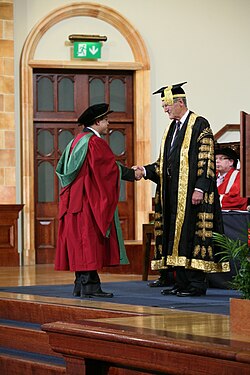
![A PhD gown at the University of Cambridge. Reflecting the status of the PhD as a lower doctorate, it uses a black Master's gown with scarlet facings rather than the scarlet Doctor's gown of the higher doctorates at Cambridge.[138]](/images/24/93/249387c15a17178b887641ad2ce2f30260cbdca1a885d6b3cb14f2d45b5f3a61.jpg)
Global Variations in Doctoral Degrees
While the PhD is the most recognized title globally, many countries maintain unique naming conventions and structural requirements for their highest degrees.
Asia and the Middle East
In China, the doctorate is categorized by discipline; for example, one may earn a Doctor of Science, Doctor of Engineering, or Doctor of Economics. In Japan, the degree is known as hakase, and in Korea, it is baksa. Many Middle Eastern countries, such as Saudi Arabia and Egypt, use the term Doctorah.
Europe and Russia
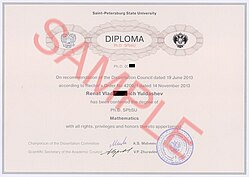
European systems vary widely. Germany offers specialized doctorates such as the Dr. iur. (Law) and Dr. med. (Medicine). In Russia and former Soviet Republics, a dual system often exists: the Candidate of Science (equivalent to a PhD) and the higher Doctor of Science (Sc.D.).
The Americas and Oceania
In the United States, Canada, and Australia, the PhD is the standard research doctorate. In Latin American countries like Argentina, Brazil, and Colombia, the degree is typically referred to as the Doctorado.
Requirements and Completion
The journey to a PhD generally involves three primary phases: admission, research/funding, and completion.
- Admission: Requirements vary. Some programs require a Master's degree, while others allow entry directly from a Bachelor's degree.
- Funding: Support can come via scholarships, research grants, or university fellowships. In some regions, PhD candidates are employed as researchers.
- Completion: The final stage involves writing a dissertation—a comprehensive document detailing original research—and defending it before a committee of experts. Some systems, such as those in Australia, allow for a PhD by publication, where a series of peer-reviewed papers are submitted instead of a traditional monograph.
| Region/Country | Common Title | Typical Prerequisites | Key Characteristic |
|---|---|---|---|
| United States | PhD | Bachelor's or Master's | Coursework + Dissertation |
| United Kingdom | PhD / DPhil | Master's | Heavy emphasis on independent research |
| Germany | Doktor (Dr.) | Master's | Field-specific titles (e.g., Dr. rer. pol.) |
| Russia | Candidate of Science | Master's equivalent | Two-tier system (Candidate vs. Doctor) |
| China | Bó shì | Master's | Discipline-specific doctoral titles |
Frequently Asked Questions
What is the difference between a PhD and a DPhil?
There is no functional difference in academic standing; a DPhil is simply the specific term used by the University of Oxford for the Doctor of Philosophy degree.
How long does it typically take to complete a PhD?
The duration generally ranges from 3 to 8 years, depending on the country, the field of study, and whether the student is studying full-time or part-time.
Can you get a PhD without a Master's degree?
Yes, in some countries and institutions (particularly in the United States), students can enter a doctoral program directly after completing a Bachelor's degree.
What is a 'PhD by publication'?
This is an alternative completion route, common in some Australian institutions, where a candidate submits a collection of published peer-reviewed papers along with a supporting narrative instead of a traditional single-volume thesis.
Is a PhD the same as a professional doctorate?
No. A PhD is a research doctorate focused on creating new knowledge, whereas professional doctorates (such as a Doctor of Education or Doctor of Medicine) are typically focused on applying existing knowledge to professional practice.