Disjunct Distribution in Biology
In the study of biology, a taxon (a group of one or more populations of an organism) is said to have a disjunct distribution when its related groups are separated by significant geographical distances. Rather than existing in one continuous area, these populations are split into two or more isolated pockets. This phenomenon provides critical insights into how species expand, contract, and adapt to a changing planet.
Key Facts
- Definition: A distribution where related populations are geographically separated.
- Primary Causes: Environmental changes (continental drift, sea-level rise), biological expansion (rafting, animal transport), and human activity.
- Lusitanian Distribution: A specific pattern where species appear in Iberia and Ireland but nowhere in between.
- Asa Gray Disjunction: A pattern where Eastern North American plants are most closely related to those in East Asia.
- Fragmentation: Can be caused by geological shifts or the loss of suitable habitats.
Mechanisms of Range Fragmentation
Disjunct distributions often arise from range fragmentation, where a once-continuous population is split. This can occur through massive environmental shifts, such as the building of mountains, the drifting of continents, or the rising of sea levels that create physical barriers.
Conversely, a disjunction can be caused by the expansion of a species into a new, distant territory. This may happen through rafting (floating on debris) or via other animals transporting a propagule (any material, such as a seed or spore, that can give rise to a new individual). For example, birds may consume seeds and deposit them in new locations through fecal matter during migration.
Other contributing factors include changes in wind, stream, and ocean currents, as well as anthropogenic (human-caused) introductions, whether accidental or deliberate through horticulture and agriculture.
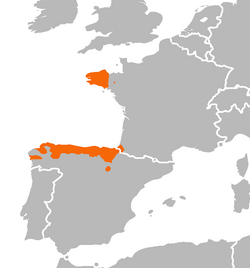
The Role of Habitat Fragmentation and Extinction
When a suitable environment becomes fragmented, populations can become isolated. If the gap between these habitats becomes too wide for species to traverse, the populations diverge. Extinction also plays a major role; a species may vanish from the center of its range, leaving only scattered populations in habitable pockets, such as specific elevations on a mountain range, island chains, or narrow strips along a coastline.
Notable Global Distribution Patterns
Biogeographers have identified several recurring patterns of disjunction across the globe:
- Europe and East Asia: Common in various plant and animal taxa.
- Europe and South Africa: Seen in the genus Erica.
- Mediterranean and Hoggart: Observed in the genus Olea.
- Amphi-Pacific: Distributions spanning Australia and South America.
The Asa Gray Disjunction
The Asa Gray disjunction is a well-known pattern where plant species in Eastern North America have their closest relatives in East Asia, while being entirely absent from Western North America and Europe. This is believed to be a relict of the Arcto-Tertiary Geoflora, a plant assemblage that covered much of the Northern Hemisphere until the late Neogene. Climatic changes eventually fragmented this flora, a theory supported by fossils found in Western North America where these plants no longer exist today.
Lusitanian Distribution
A Lusitanian distribution occurs when a species is found in Iberia (roughly modern-day Portugal and Spain) and Ireland, but is absent from the regions between them. Examples include the strawberry tree (Arbutus unedo), several heather species (Calluna spp.), the Pyrenean glass snail (Semilimax pyrenaicus), and the Kerry slug (Geomalacus maculosus).
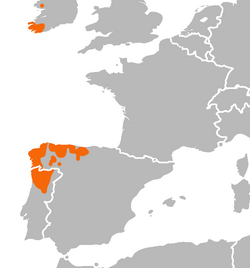
While an older theory suggested an ice-free refugium off the coast of Ireland during the Quaternary glaciation, this is now discredited. Modern evidence suggests a human-mediated cause. Genetic studies show that the Irish population of the Eurasian pygmy shrew is closely related to populations in Andorra, rather than Britain. This suggests a founder event where the species was introduced by boat during the Paleolithic or Mesolithic Stone Age.
This is mirrored by genetic similarities between human populations in western Ireland and northern Spain, suggesting that Lusitanian fauna were likely introduced accidentally via trade goods during early human migrations.
Summary of Disjunct Distribution Examples
| Pattern Name | Regions Involved | Example Taxa |
|---|---|---|
| Lusitanian | Iberia & Ireland | Kerry slug, Strawberry tree |
| Asa Gray | Eastern North America & East Asia | Arcto-Tertiary Geoflora relicts |
| Amphi-Pacific | Australia & South America | Various taxa |
| Other | Japan & Cameroon | Oxygyne (plants) |
| Other | USA, Japan, & Taiwan | Chorioactis (fungi) |
Frequently Asked Questions
What is a disjunct distribution?
It is a biological pattern where two or more related groups of a taxon are separated by a significant geographical distance, rather than being distributed continuously.
How does continental drift cause disjunction?
As landmasses move apart over millions of years, populations that were once together are physically separated by oceans or other barriers, leading to a disjunct distribution.
What is the current theory on the Lusitanian distribution in Ireland?
It is now believed that these species were introduced accidentally by humans traveling by boat from Iberia to Ireland during the Paleolithic or Mesolithic periods.
What was the Arcto-Tertiary Geoflora?
It was a widespread plant assemblage that covered much of the Northern Hemisphere until the late Neogene, when climate change fragmented it, resulting in patterns like the Asa Gray disjunction.
Can animals cause disjunct distributions?
Yes, animals can transport propagules, such as seeds, to distant locations through migration and subsequent deposition in fecal matter.