Die Wacht am Rhein: The History of Germany's Patriotic Anthem
Die Wacht am Rhein (The Watch on the Rhine) stands as one of the most significant patriotic anthems in German history. Born from a period of intense geopolitical tension, the song evolved from a poetic response to territorial threats into a powerful symbol of national unity and military resolve. For over a century, it served as a sonic backdrop to the Franco-Prussian War and both World Wars, reflecting the complex and often volatile relationship between Germany and France.
Key Facts
- Author: Written as a poem by Max Schneckenburger during the Rhine Crisis of 1840.
- Composer: The most popular melody was composed by Karl Wilhelm in 1854.
- Purpose: Originally a call for German unity and the defense of the Rhine river borders.
- Status: Served as an unofficial second national anthem of the German Empire.
- Modern Status: Now holds primarily historical significance and is rarely performed.
The Origins of the Anthem
The roots of the song lie in centuries of conflict. From the Thirty Years' War through the Napoleonic Wars, the Rhineland faced repeated French invasions and occupations, including the pillaging of Alsace and the Palatinate during the Nine Years' War. This historical enmity reached a boiling point during the Rhine Crisis of 1840.
During this crisis, French Prime Minister Adolphe Thiers claimed that the Upper and Middle Rhine should be France's "natural eastern border." This sparked a "Rhine song movement" across Germany, as citizens feared a return to French annexation. Inspired by Nikolaus Becker's "Der Deutsche Rhein," a Swabian merchant named Max Schneckenburger wrote the poem "Rheinwache," which was later renamed "Die Wacht am Rhein."
Unlike previous songs that praised specific monarchs, this anthem called for Germans to set aside sectionalism and sectarianism. It urged the various kingdoms and principalities to unite into a single state to protect their territorial integrity.
Musical Evolution and Popularity
While Schneckenburger's poem was first set to music in Bern by J. Mendel, that version failed to gain traction. The song's true rise to fame began in 1854 when Karl Wilhelm, the musical director of Krefeld, created a new musical setting. He performed it with a men's chorus on June 11, the silver wedding anniversary of Prince Wilhelm of Prussia (the future Emperor Wilhelm I). This version quickly spread, particularly after performances in Dresden.
The lyrics consist of five original stanzas—calling for Germans to defend the shore so that "no enemy sets his foot" there—with additional stanzas added later. One notable addition appeared on World War I postcards, explicitly hailing "Wilhelm" and calling for the erasure of shame with "enemy blood."
Role in German History and Warfare
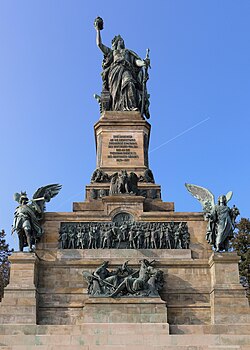
Following the French defeat in the Franco-Prussian War (1870–1871) and the subsequent unification of Germany under Otto von Bismarck, the song became an unofficial second national anthem. Its importance was cemented when Bismarck granted pensions to the composer and the author's family. The lyrics were even inscribed on the 1883 Niederwald monument near Rüdesheim am Rhein.
Throughout the early 20th century, the song remained a staple of German patriotism. During World War II, it served as the opening tune for the Wehrmachtbericht (the daily military radio report) until 1941. It was even used as the codename for the 1944 offensive known as the Battle of the Bulge.
Interestingly, the scenario described in the song—defending the Rhine from an invading force—rarely occurred in the manner envisioned. Due to Germany's offensive strategies, most fighting in 1870, 1914, and 1940 took place on French soil. It was not until Operation Plunder in 1945 that Allied forces successfully crossed the Rhine, though by then Germany was near total collapse.
Summary of the Anthem's Legacy
| Category | Details |
|---|---|
| Original Poem | Written by Max Schneckenburger (1840) |
| Definitive Music | Composed by Karl Wilhelm (1854) |
| Core Theme | Defense of the Rhine and German unification |
| Key Historical Events | Rhine Crisis, Franco-Prussian War, WWI, WWII |
| Cultural Impact | Featured in films like All Quiet on the Western Front and Casablanca |
Cultural Adaptations and Global Influence
The melody of "Die Wacht am Rhein" traveled far beyond German borders. In the United States, the tune was adapted for Yale University's alma mater, "Bright College Years," in 1881. In Japan, Doshisha University adopted the melody for its school song. Even in Italy, poet Giovanni Pascoli wrote "La vedetta delle Alpi" (The Guard on the Alps) as a "twin anthem," replacing the Rhine with the Alps as the sacred boundary.
The song has also appeared frequently in cinema to evoke patriotic fervor or nationalistic tension. It is used in All Quiet on the Western Front to show students being whipped into a frenzy before enlisting, and in Casablanca, where it is sung by German officers before being drowned out by the French national anthem, La Marseillaise.
Frequently Asked Questions
Why was the song written?
It was written in response to the Rhine Crisis of 1840, when French Prime Minister Adolphe Thiers suggested that the Rhine River should be France's natural eastern border, sparking fears of annexation in Germany.
Who wrote the music for the most famous version?
While there were earlier versions, the most popular musical setting was composed by Karl Wilhelm in 1854 and performed for Prince Wilhelm of Prussia.
Was the song ever the official national anthem?
No, it was an unofficial second national anthem during the German Empire, often rivaling the "Deutschlandlied" in popularity.
Does the song still have a role in modern Germany?
No. Following the 1963 Élysée Treaty, which established Franco-German friendship, the enmity that fueled the song ended. Today, it is viewed as a historical artifact and is rarely played.
How was the song used in World War II?
It was used as the introductory music for the daily Wehrmachtbericht radio reports and served as the codename for the Battle of the Bulge offensive in 1944.