Deutsche Physikalische Gesellschaft
The Deutsche Physikalische Gesellschaft (DPG), known in English as the German Physical Society, stands as the oldest organization of physicists in the world. Founded in 1845, the DPG serves as a cornerstone for both pure and applied physics, fostering essential connections among German physicists and facilitating the exchange of groundbreaking ideas with international colleagues.
With a membership that reached a peak of 63,012 in 2014 and stood at 52,220 in 2022, the society is committed to the highest standards of scientific integrity. Its bylaws emphasize freedom, tolerance, truthfulness, and dignity in scientific work, while actively promoting gender equality within the physical sciences.
Key Facts
- Founded: 1845
- Purpose: Research coordination and professional networking in pure and applied physics.
- Membership: 50,668 worldwide (as of 2025).
- Current President: Klaus Richter (2024–2026).
- Headquarters: Physikzentrum Bad Honnef, Germany.
- Key Awards: Max Planck Medal (Theoretical) and Stern–Gerlach Medal (Experimental).
Scientific Exchange and Meetings
While the DPG does not conduct its own research, it provides the critical infrastructure for scientists to share the latest findings. The society organizes several major events annually, including the DPG-Spring-Meetings, held at various venues across Germany, and the DPG-Fall-Meetings, which focus on specific research topics.
The society also prioritizes the next generation of scientists through the "Young DPG" (jDPG) working group, a nationwide network for physics students that hosts workshops and networking events. Additionally, in partnership with the Bonn-Cologne Graduate School of Physics and Astronomy (BCGS), the DPG organizes the annual BCGS Weekend Seminar, connecting students with field leaders through lectures and social events.
Awards and Academic Recognition
The DPG is renowned for granting awards of international prestige to honor outstanding achievements. The most distinguished of these are the Max Planck Medal for theoretical physics (established 1929) and the Stern–Gerlach Medal for experimental physics (established 1933).
To support emerging talent, the society offers the Gustav Hertz Prize for Young Physicists. Other collaborative honors include the Max Born Medal and Prize and the Otto Hahn Prize. Beyond academic research, the DPG recognizes science communication via the Medal for Natural Science Journalism and encourages school-level excellence through the DPG-Abiturpreis and DPG-Buchpreis, as well as support for the Jugend forscht national research contest.
| Award Name | Focus Area | Established |
|---|---|---|
| Max Planck Medal | Theoretical Physics | 1929 |
| Stern–Gerlach Medal | Experimental Physics | 1933 |
| Gustav Hertz Prize | Young Physicists | Various |
| Medal for Natural Science Journalism | Science Communication | Various |
| DPG-Abiturpreis | School Graduates | Various |
Publications and Scientific Communication
Historically, the DPG has been a driving force in scientific publishing. One of its most significant contributions was the establishment of the Zeitschrift für Physik in 1920. This journal was created by a committee including Albert Einstein and Arnold Sommerfeld to allow for the rapid publication of original research without the delays of peer review.
During the early 20th century, the Zeitschrift für Physik became one of the world's most prestigious journals, serving as the primary vehicle for the young generation of quantum physicists during the golden age of quantum mechanics. Other notable publications have included Fortschritte der Physik and Physikalische Blätter (now Physik Journal).
Public Outreach and Infrastructure
The DPG actively bridges the gap between complex science and the general public. A primary example is the "Highlights of Physics," an annual festival organized with the Federal Ministry of Education and Research that attracts approximately 30,000 visitors each year.
The society operates from two primary locations. The main office is located at the Physikzentrum Bad Honnef near Bonn, which serves as an international hub for students and Nobel laureates. In Berlin, the DPG manages the Magnus-Haus, an urban palace completed in 1760. The Magnus-Haus serves as a venue for lectures on socio-political and physical issues and houses the DPG's historical archive.
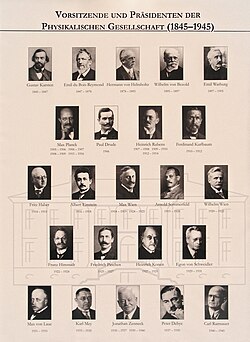
Historical Challenges and Reunification
The DPG faced severe turmoil during the Nazi regime (1933–1945). The era was marked by the persecution of Jewish scientists and the promotion of Deutsche Physik, a movement that rejected modern theoretical physics and quantum mechanics. Under the Law for the Restoration of the Professional Civil Service, approximately 25% of academic physicists lost their positions between 1932 and 1933.
Despite pressure from proponents of Deutsche Physik like Johannes Stark, some DPG leaders attempted to maintain independence. Carl Ramsauer, president from 1940 to 1945, and Wolfgang Finkelnburg steered the society away from regime ideology. In 1942, Ramsauer petitioned the Reich Education Ministry to address the decline of physics instruction caused by political interference.
Following World War II, the society was initially fragmented across Allied occupation zones. It was reunified in West Germany in 1950. Full national unification was only achieved after the fall of the Berlin Wall, when the DPG merged with the Physical Society of East Germany in 1990.
Frequently Asked Questions
What is the primary purpose of the DPG?
The DPG aims to foster connections among German physicists and promote the exchange of ideas between its members and international colleagues in the fields of pure and applied physics.
Which are the most prestigious awards given by the DPG?
The highest honors are the Max Planck Medal for theoretical physics and the Stern–Gerlach Medal for experimental physics.
What is the significance of the Zeitschrift für Physik?
Established in 1920 by a committee including Albert Einstein, it was a premier journal for the rapid publication of original research and was central to the development of quantum mechanics.
How does the DPG support students?
The DPG supports students through the "Young DPG" (jDPG) network, which provides workshops and networking opportunities, and through partnerships like the BCGS Weekend Seminar.
Where is the DPG's historical archive located?
The historical archive is housed in the Magnus-Haus, an urban palace located in Berlin.