Detroit, Lansing and Northern Railroad: A History of Growth and Consolidation
The Detroit, Lansing and Northern Railroad (DL&N) represents a pivotal chapter in the industrial expansion of 19th-century Michigan. Emerging from the financial collapse of its predecessor, the DL&N evolved into a critical transport artery, facilitating the movement of passengers and the massive extraction of timber from Michigan's old-growth forests before eventually merging into the larger Pere Marquette Railway system.
Key Facts
- Incorporated: December 27, 1876, following the foreclosure of the Detroit, Lansing and Lake Michigan (DL&LM).
- Peak Reach: Operated 268 miles of track by 1886.
- Primary Freight: Heavily reliant on lumber and forest products (62% of freight in 1886).
- Key Connections: Linked with the Grand Rapids and Indiana Railroad (GR&I) at Howard City and Big Rapids.
- Final Transition: Reorganized as the Detroit, Grand Rapids and Western Railroad in 1897, later becoming part of the Pere Marquette Railway in 1899.
Corporate Origins and Financial Turmoil
The roots of the DL&N lie in the Detroit, Lansing and Lake Michigan (DL&LM), which was incorporated on April 11, 1871. This entity was a consolidation of the Detroit, Howell and Lansing Railroad and the Ionia and Lansing Railroad, later adding the Ionia, Stanton and Northern Rail Road in 1872. However, the DL&LM suffered from severe financial instability. By 1876, the company faced an operating deficit exceeding $1.8 million and owed more than $6 million in mortgages at 8% interest, much of which was owed to its own Board of Directors.
Following a foreclosure in April 1876, trustees George O. Shauttuck and J. Lewis Stackpole purchased the assets for $60,000. On December 27, 1876, the Detroit, Lansing and Northern Railroad was organized. In a notable detail of corporate governance, while the railroad employed over 1,000 people in Michigan, none of its 438 stockholders or eleven directors were residents of the state.
The DL&N set ambitious goals: extending its mainline to Pentwater on Lake Michigan, connecting the Stanton line to the Flint and Pere Marquette Railroad at Chippewa, and maintaining a 7% annual dividend for preferred stockholders.
Operational Expansion and Infrastructure
At its start in December 1876, the DL&N inherited a substantial infrastructure consisting of 206 miles of track, 26 locomotives, over 750 railcars, and more than 10,000 feet of wooden bridges and trestles.
The network was divided into a Main Line and various branches:
- Main Line (160.6 miles): Connected Detroit to Lansing (August 1871), Lansing to Ionia (December 1869), Ionia to Greenville (September 1870), and Greenville to Howard City (August 1871).
- Branch Lines: An initial 20.9-mile line from Ionia to Stanton (February 1873) was later extended to McBride in 1877, Blanchard in 1878, and finally to Big Rapids in July 1880.
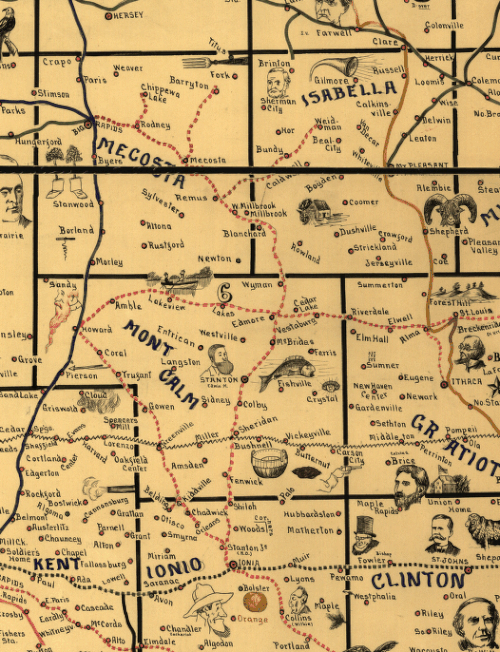
The railroad continued to grow through strategic leases and acquisitions. In 1882, it acquired a perpetual lease for the assets of the Saginaw & Western Railroad. By 1886, the DL&N reported 268 operating miles, including a 42-mile branch from Howard City to Alma, which allowed for an interchange with the Toledo, Ann Arbor and North Michigan Railroad.
Technological Advancements and Traffic
The DL&N operated during a period of significant technological transition. Following an 1885 state law, the railroad began converting to automatic couplers (devices that connect rail cars without manual intervention) and introduced Westinghouse air brakes to improve safety and efficiency.
The railroad's economy was inextricably linked to the logging industry. In 1886, 62% of its freight consisted of lumber and forest products. By its final full year of operation, while passenger numbers remained high at nearly 643,000, freight traffic had dipped to 541,000 short tons, with lumber accounting for 36% and coal for 13%.
Financial Decline and Final Consolidation
Despite surviving the Panic of 1893 and remaining profitable through 1895, the DL&N struggled with mounting debt. By 1895, the debt per mile owned and operated had risen to $19,158. The company faced a significant principal mortgage of $2.67 million due in 1907.
The financial pressure became unsustainable, and the DL&N entered receivership on April 1, 1896. It was reorganized on January 1, 1897, as the Detroit, Grand Rapids and Western Railroad (DGR&W), consolidating several other lines including the Saginaw Valley & St. Louis and the Saginaw & Grand Rapids. This entity was eventually absorbed into the Pere Marquette Railway on December 7, 1899.
| Metric | Early Period (c. 1876-1882) | Later Period (c. 1886-1896) |
|---|---|---|
| Track Mileage | 206 - 225 miles | 268 miles (1886) |
| Primary Freight | General Freight/Lumber | Lumber (62% in 1886) |
| Debt per Mile | $15,897 (1882) | $19,158 (1895) |
| Passenger Volume | 250,000+ (Predecessor) | ~643,000 (Final full year) |
Frequently Asked Questions
What was the relationship between the DL&LM and the DL&N?
The Detroit, Lansing and Lake Michigan (DL&LM) was the predecessor to the DL&N. After the DL&LM suffered massive debts and an operating deficit, it was foreclosed upon in 1876, and the Detroit, Lansing and Northern Railroad was organized to take over its assets.
Who owned the Detroit, Lansing and Northern Railroad?
The railroad was primarily owned by its lenders, who received stock in exchange for forgiving the debts of the DL&LM. Notably, none of the 438 stockholders or eleven directors were residents of Michigan.
How did the logging industry affect the railroad?
The logging industry was the primary driver of freight traffic. In 1886, lumber and forest products made up 62% of the railroad's freight, reflecting the acceleration of old-growth forest logging in Michigan.
What happened to the DL&N after 1896?
The DL&N entered receivership on April 1, 1896, and was reorganized as the Detroit, Grand Rapids and Western Railroad in 1897. By December 1899, it became part of the Pere Marquette Railway.
What technical safety improvements were implemented?
The railroad implemented Westinghouse air brakes and converted to automatic couplers, the latter of which was mandated by a Michigan state law passed in 1885.