Desert Climates: Characteristics of Arid and Semi-Arid Environments
A desert climate, also known as an arid climate, is defined by a severe imbalance where evaporation significantly exceeds precipitation. These environments are characterized by dry, often rocky or sandy surfaces that hold very little moisture, causing even the minimal rainfall they receive to evaporate rapidly. Under the Köppen climate classification system, these regions are categorized as BWh (hot desert) or BWk (cold desert).
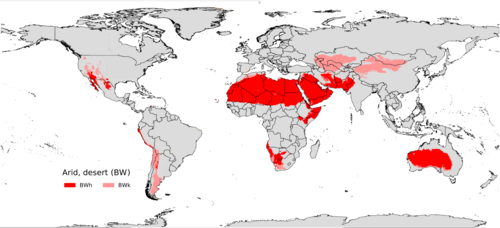
Key Facts
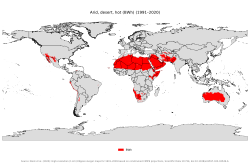
- BWh (Hot Desert) climates cover approximately 14.2% of Earth's land area.
- The dividing line between hot and cold deserts is a mean annual temperature of 18 °C (64.4 °F).
- Most desert regions receive between 25 and 200 mm of annual rainfall.
- Hot deserts are typically found under the subtropical ridge in lower middle latitudes.
- Cold deserts are often located in temperate zones or in the rain shadow of mountains.
Classifying Aridity and Precipitation
To determine if a location qualifies as an arid climate, scientists use a specific precipitation threshold. This calculation is based on the average annual temperature and the seasonality of rainfall. If a region's annual precipitation is less than 50% of this calculated threshold, it is classified as a BW (desert climate). If the precipitation falls between 50% and 100% of the threshold, the area is considered semi-arid.
While most deserts are extremely dry, there are notable exceptions. In some of the hottest areas, such as the Sahel, the Guajira Peninsula, and parts of Central Australia, extreme potential evapotranspiration (the amount of water that would evaporate from a surface) can result in annual rainfall as high as 430 mm (17 inches) while still maintaining an arid classification.
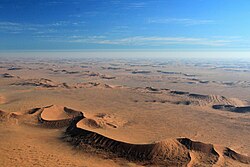
Extreme dryness is found in specific locations worldwide. The Atacama Desert in northern Chile has recorded an average annual rainfall of just 5 mm (0.20 in) over a 17-year period. Even more extreme is Kufra, Libya, which has recorded an annual rainfall of only 0.86 mm (0.034 in). In the United States, Death Valley has seen periods of extreme drought, such as a 40-month stretch between 1931 and 1934 where only 16 mm (0.63 in) of rain fell.
| Feature | Hot Desert (BWh) | Cold Desert (BWk) |
|---|---|---|
| Mean Annual Temperature | Above 18 °C (64.4 °F) | Below 18 °C (64.4 °F) |
| Typical Latitude | 20° to 33° North and South | 30s and 40s latitudes |
| Primary Cause | Subtropical high pressure | Rain shadows or temperate zones |
| Common Landscapes | Sandy, rocky, intense sun | Intermittent streams, barren terrain |
Hot Desert Climates (BWh)
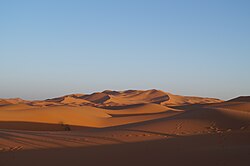
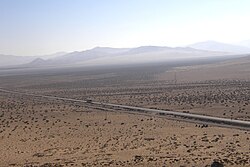
Hot desert climates are frequently found under the subtropical ridge, where stable descending air and high pressure prevent cloud formation, leading to intense sunshine and arid conditions. These climates exist on every continent except Antarctica, spanning vast areas of North Africa, West Asia, the Southwestern United States, and interior Australia.
These regions are lands of extremes. During the summer, midday temperatures commonly reach 43–46 °C (109–115 °F). The world's highest temperature records, exceeding 50 °C (122 °F), are generally found in these deserts; Death Valley holds a record of 56.7 °C (134.1 °F). Conversely, because of clear skies and exceptional radiation loss, night-time temperatures can drop to freezing, though they rarely stay far below freezing for long under the hot subtype.
Cold Desert Climates (BWk)
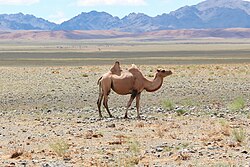
Cold desert climates are typically located in temperate zones. They often occur in the leeward rain shadow of high mountains—an area where mountains block moisture-bearing winds from reaching the land. Examples include the Patagonian Desert in Argentina, which is bounded by the Andes, and the Great Basin Desert in North America.
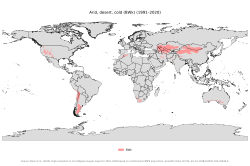
In Central Asia, mountains restrict precipitation from the eastern monsoon, creating significant cold deserts like the Taklamakan and Kyzyl Kum. Other notable cold deserts include the Ladakh region in the Himalayas and the Hautes Plaines in Morocco and Algeria. In Europe, this climate is limited to inland parts of southeastern Spain, such as Lorca.
Polar Deserts
While distinct from the BWk classification, polar regions in the Arctic and Antarctic also exhibit desert-like features. Because the cold, dry air freezes most precipitation, these areas receive very little moisture. They feature barren terrain and hypersaline lakes, such as the McMurdo Dry Valleys in Antarctica. However, because their average summer temperatures remain below 10 °C (50 °F), they are generally classified as polar climates rather than standard cold deserts.
Frequently Asked Questions
What is the main difference between a hot and cold desert?
The primary distinction is the mean annual temperature. A hot desert (BWh) has a mean annual temperature above 18 °C (64.4 °F), while a cold desert (BWk) has a mean annual temperature below that threshold.
How is a desert climate officially determined?
It is determined by comparing a location's annual precipitation to a calculated threshold. This threshold is derived from the average annual temperature and the seasonality of the rainfall.
Why are hot deserts so sunny and dry?
Hot deserts are often located under subtropical high-pressure zones. The descending air in these zones clears clouds and prevents the formation of low-pressure systems or atmospheric disturbances, leading to constant sunshine and dry air.
What causes cold deserts to form?
Cold deserts often form in the rain shadow of mountain ranges, where the mountains block moisture from reaching the area, or they are located in temperate latitudes where temperatures remain lower year-round.
Can a desert have high rainfall?
While most deserts receive between 25 and 200 mm of rain, some areas like the Sahel or parts of Central Australia can receive up to 430 mm of rain and still be classified as arid due to extremely high rates of evaporation.