Danish Language: History, Dialects, and Linguistic Structure
Danish (dansk) is a North Germanic language spoken primarily in Denmark and southern Schleswig, Germany. As a member of the Indo-European family, it shares deep roots with other Scandinavian languages, evolving from Old Norse to become the official tongue of the Kingdom of Denmark. Today, it is spoken by approximately 5.5 million native speakers and serves as a vital cultural and administrative link across the Danish Realm.
The language is characterized by its unique phonology and a rich history of borrowing, reflecting Denmark's strategic position in Northern Europe. From its early runic inscriptions to the modern standardized form regulated by the Dansk Sprognævn (Danish Language Council), Danish has evolved into a sophisticated tool for communication and law.
Key Facts
- Native Speakers: Approximately 5.5 million (as of 2012).
- Language Family: Indo-European > Germanic > North Germanic > East Scandinavian.
- Official Status: Official language of Denmark and the Faroe Islands; recognized minority language in Germany and Greenland.
- Writing System: Latin alphabet, including the unique characters Æ, Ø, and Å.
- Regulatory Body: Dansk Sprognævn (Danish Language Council).
The Evolution of Danish
The history of the Danish language is generally divided into several distinct eras. Philologist Johannes Brøndum-Nielsen categorized the period from 800 AD to 1525 as Old Danish, which further breaks down into Runic Danish (800–1100), Early Middle Danish (1100–1350), and Late Middle Danish (1350–1525).
One of the earliest legal records, the Jutlandic Law of 1241, exemplifies the transition of the language, famously stating, "Mæth logh skal land byggas" (With law shall a country be built).
The transition to a standardized written form accelerated with the advent of the printing press. The first printed book in Danish, the Rimkrøniken (Rhyming Chronicle), appeared in 1495. However, it was the 1550 translation of the Bible by Christiern Pedersen that established the de facto orthographic standards for the language.
Vocabulary and External Influences
The core of the Danish vocabulary consists of roughly 2,000 uncompounded words derived from Old Norse. However, Danish has been heavily influenced by external languages due to trade and politics:
- Middle Low German: The most significant influence; about 16–17% of contemporary standard vocabulary comes from this source.
- Graeco-Latin: Accounts for 4–8% of the vocabulary.
- French: Contributes 2–4%.
- English: Approximately 1%, with influence increasing significantly after World War II.
Geographic Distribution and Status
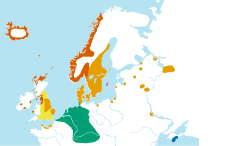
Danish is the national language of Denmark and one of two official languages in the Faroe Islands. In Greenland, while it is no longer an official language as of 2009, it remains a lingua franca (a bridge language used between speakers of different native tongues), with many native Greenlanders speaking it as a second language.
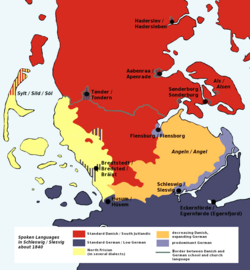
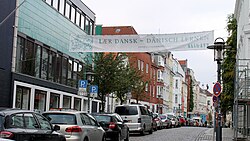
Beyond the Danish Realm, Danish is an officially recognized regional language in Flensburg, Germany, within the Schleswig-Holstein region.
Dialects and Phonology
Traditional Danish is divided into three primary dialect groups:
- Insular Danish (ømål): Spoken on the islands of Zealand, Funen, Lolland, Falster, and Møn.
- Jutlandic (jysk): Divided into North, East, West, and South Jutlandic.
- East Danish (østdansk): Including dialects from Bornholm, Scania, Halland, and Blekinge.
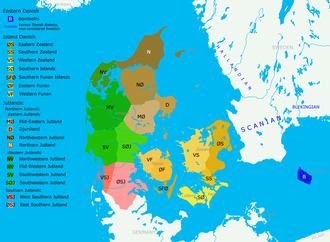
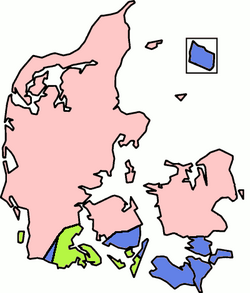
A defining feature of Danish phonology is the stød, a glottal constriction or "catch" in the throat. This feature is present in standard Danish and certain dialects, while others use tones (similar to Swedish or Norwegian) or neither.
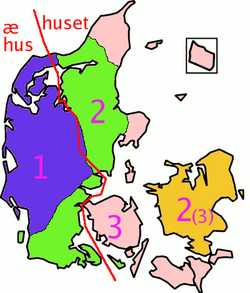
Grammatical gender also varies by region. While standard Danish uses two genders, some dialects maintain three. Additionally, the placement of the definite article varies; west of a specific linguistic line, the article precedes the word (similar to English), whereas east of the line, it is attached as a suffix.
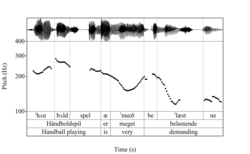
The melodic nature of the language is captured in its pitch traces, which define the rhythm and stress of spoken sentences.
Grammar and Writing System
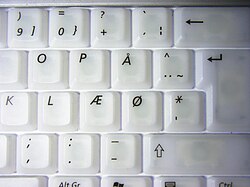
Danish utilizes the Latin alphabet with three additional vowels: Æ, Ø, and Å. These are essential for correct spelling and pronunciation.
Nouns and Numerals
Danish nouns are categorized by gender and number. The language uses an enclitic article (a suffix) for definiteness in many cases, though a preposed demonstrative article can also be used for emphasis.
The numeral system is particularly unique, especially for numbers between 40 and 90, which utilize a vigesimal (base-20) logic. For example, 50 (halvtreds) literally translates to "2 + 1/2 times twenty." For very large numbers, Danish employs the long scale, meaning a "billion" refers to a million million, while a thousand million is called a milliard.
Language Summary Table
| Feature | Description |
|---|---|
| Family | North Germanic (East Scandinavian) |
| Key Phonetic Feature | Stød (glottal constriction) |
| Major Loan Source | Middle Low German (16–17% of vocabulary) |
| Alphabet | Latin + Æ, Ø, Å |
| Number System | Vigesimal influence (base-20) for tens; Long scale for billions |
Frequently Asked Questions
What is the 'stød' in Danish?
The stød is a unique glottal constriction used in standard Danish and several dialects. It functions as a prosodic feature that helps distinguish meaning between words that otherwise sound identical.
How does Danish differ from other Scandinavian languages?
While mutually intelligible to varying degrees, Danish is part of the East Scandinavian branch. It differs from Swedish and Norwegian in its specific vowel system and the use of stød instead of the pitch accents found in those languages.
Why does Danish have so many words from Low German?
Middle Low German was the second official language of Denmark–Norway during the Late Middle Ages, leading to a massive absorption of loanwords into the Danish vocabulary.
What is the difference between a 'milliard' and a 'billion' in Danish?
Danish uses the long scale for large numbers. A milliard is one thousand million (1,000,000,000), whereas a billion is one million million (1,000,000,000,000).
Is Danish spoken outside of Denmark?
Yes, it is spoken in southern Schleswig (Germany), the Faroe Islands, and is used as a lingua franca in Greenland.