D.W. Griffith and the Evolution of Early Cinema
The foundation of modern filmmaking was laid in the early 20th century, a period of rapid experimentation where the language of cinema was first being written. At the center of this transformation was D.W. Griffith, a director whose career spanned the transition from short novelty clips to the sweeping feature-length epics that define the Hollywood tradition.
The Biograph Years and Technical Innovation
Griffith's journey began in 1908 when he joined the American Mutoscope and Biograph Company as a stage extra in Professional Jealousy. It was here that he formed a pivotal partnership with cameraman Billy Bitzer. When the studio's primary director, Wallace McCutcheon Sr., fell ill and his son failed to maintain the studio's success, Biograph co-founder Harry Marvin appointed Griffith to the director's chair. Griffith's debut, The Adventures of Dollie, marked the start of a prolific run, directing 48 shorts in his first year alone.
During this era, Griffith began implementing narrative techniques that would revolutionize storytelling. In his 1909 adaptation of Charles Dickens's The Cricket on the Hearth, he utilized cross-cutting—a technique where two separate stories or actions are shown alternatingly to create tension or parallel narratives. When questioned about this method, Griffith cited the literary influence of Dickens, specifically novels like Oliver Twist.
Griffith also left a physical mark on the industry; his 1910 short In Old California was the first film ever shot in Hollywood, California. By 1914, he pushed the boundaries of duration with Judith of Bethulia, his first feature film. This move was met with skepticism from Biograph executives, who feared that longer films would physically strain the audience's eyes.
Transition to Independence and the Rise of the Epic
Due to creative friction and budget overruns, Griffith left Biograph and joined the Mutual Film Corporation. This period saw him experimenting with location shooting, most notably in The Life of General Villa, a biographical-action film featuring Pancho Villa shot amidst the Mexican civil war. Griffith eventually established his own production presence through Reliance-Majestic Studios (later Fine Arts Studios), becoming a partner in the Triangle Film Corporation alongside Thomas H. Ince and Mack Sennett.
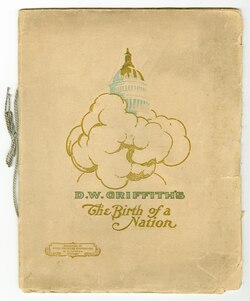
In 1915, Griffith released The Birth of a Nation (originally titled The Clansman), which is widely regarded as the first Hollywood epic. While the film was a technical triumph and a massive box-office success, it became a lightning rod for controversy. Based on Thomas Dixon Jr.'s novel, the film portrayed the Ku Klux Klan as heroes and depicted slavery and the Reconstruction era in a manner that was endorsed by the Dunning School of historians but vehemently condemned by the National Association for the Advancement of Colored People (NAACP).
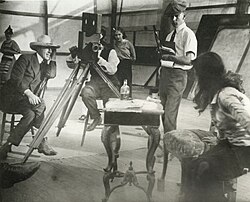
Despite attempts by the NAACP to ban the film in various cities, The Birth of a Nation became one of the first true "blockbusters," breaking all existing box-office records. The financial scale was so immense that actress Lillian Gish later noted the studio essentially lost track of the total earnings.
The Ambition and Fall of Intolerance
The backlash and riots in northern cities over the racial content of his previous work motivated Griffith to create Intolerance (1916). In this ambitious project, he sought to illustrate the destructive nature of intolerance across four distinct historical eras: the Fall of Babylon, the Crucifixion of Jesus, the St. Bartholomew's Day massacre of French Huguenots, and a contemporary story.
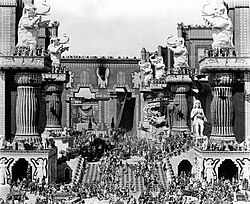
While visually stunning, Intolerance was a financial disaster. The lavish production costs and the expensive road show accompanying its release far exceeded its box-office returns. Because Griffith financed much of the film himself, the failure contributed to lifelong financial instability.
The Founding of United Artists
Following the dissolution of his production partnership in 1917, Griffith moved through Artcraft (Paramount Pictures) and First National Pictures. In a bid for creative and financial autonomy, he joined forces with Charlie Chaplin, Mary Pickford, and Douglas Fairbanks to found United Artists. This studio was revolutionary because it allowed artists to control their own interests rather than remaining dependent on the whims of commercial studio heads.
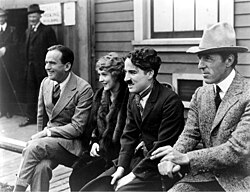
Although Griffith continued to direct, he never again reached the unprecedented commercial heights of The Birth of a Nation or the scale of Intolerance.
Key Facts
- First Hollywood Film: In Old California (1910) was the first movie filmed in Hollywood.
- Narrative Innovation: Griffith popularized cross-cutting, inspired by the novels of Charles Dickens.
- Box Office Milestone: The Birth of a Nation is considered one of the first "blockbusters" in cinema history.
- Industry Legacy: Co-founded United Artists to give creators more control over their work.
- Financial Impact: The massive self-funding of Intolerance led to Griffith's long-term financial ruin.
| Film Title | Year | Significance | Outcome |
|---|---|---|---|
| The Adventures of Dollie | 1908 | Directorial debut at Biograph | Successful start |
| In Old California | 1910 | First film shot in Hollywood | Historical milestone |
| Judith of Bethulia | 1914 | First feature-length film | Controversial duration |
| The Birth of a Nation | 1915 | First Hollywood epic | Record-breaking / Controversial |
| Intolerance | 1916 | Multi-era historical study | Financial failure |
Frequently Asked Questions
What is cross-cutting and how did Griffith use it?
Cross-cutting is a technique where the editor alternates between two or more scenes happening in different locations, often simultaneously. Griffith adopted this from the narrative style of Charles Dickens to build tension and link parallel stories.
Why was The Birth of a Nation so controversial?
The film presented a distorted view of the American Civil War and Reconstruction, portraying the Ku Klux Klan as heroic and slavery as benign, which led to protests and attempts at censorship by the NAACP.
What was the purpose of founding United Artists?
United Artists was founded by Griffith, Chaplin, Pickford, and Fairbanks to allow actors and directors to control their own financial interests and creative output, reducing their dependence on major commercial studios.
How did Intolerance affect Griffith's finances?
Griffith invested a massive personal budget into the film's production and its accompanying road show. Because the film failed to generate enough profit to cover these costs, it led to his financial ruin for the remainder of his life.
Which film was the first shot in Hollywood?
The short film In Old California, released in 1910, holds the distinction of being the first motion picture filmed in Hollywood, California.