Cuban Warblers: The Unique Endemic Birds of Teretistridae
The Cuban warblers are a specialized group of birds endemic to Cuba and its surrounding cays. Belonging to the genus Teretistris and the family Teretistridae, these birds were long mistaken for members of the New World warbler family. However, modern genetic research has revealed they are a distinct lineage, carving out a unique ecological niche within the Caribbean landscape.
Consisting of two closely related species—the yellow-headed warbler and the Oriente warbler—these birds are characterized by their vibrant yellow and grey plumage and their role as essential insectivores in Cuba's forests and scrublands.
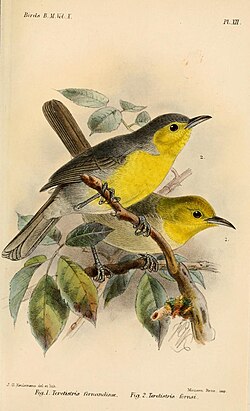
Key Facts
- Endemism: Found exclusively in Cuba and its adjacent cays.
- Taxonomy: Formerly classified as New World warblers (Parulidae), now placed in their own family, Teretistridae.
- Species: Comprises the yellow-headed warbler (west) and the Oriente warbler (east).
- Diet: Primarily insectivorous, with a preference for beetles.
- Size: Approximately 13 cm (5.1 in) in length.
Taxonomic History and Classification
For decades, the genus Teretistris was placed within the family Parulidae (New World warblers). This classification changed in 2002 when a study of mitochondrial and nuclear DNA across 25 genera revealed that Teretistris and five other genera did not belong in Parulidae.
A subsequent study in 2013 further supported this separation. While the exact placement among nine-primaried songbirds remains complex, researchers suggested a possible close relationship with the wrenthrush (genus Zeledonia). Consequently, the American Ornithological Society (AOC) and the International Ornithological Congress (IOC) officially recognized the separate family Teretistridae in 2017.
Species and Distribution
The Cuban warblers exhibit an allopatric distribution, meaning the two species live in separate geographic areas without overlapping significantly.
Yellow-headed Warbler (Teretistris fernandinae)
This monotypic species (having no subspecies) is found in the western part of Cuba. Its range includes the northern coast of the west, the Zapata Peninsula, the Guanahacabibes Peninsula, and Isla de la Juventud.
Oriente Warbler (Teretistris fornsi)
The Oriente warbler inhabits eastern Cuba, with a continuous presence in the south and a more fragmented range along the northern coast. It is also found on northern cays. A specific subspecies, turquinensis, has been identified in the mountains of Pico Turquino.
In the Matanzas Province, where the two species do co-occur, they maintain separation through habitat preference: the Oriente warbler stays along the coast, while the yellow-headed warbler remains inland.
Physical Characteristics
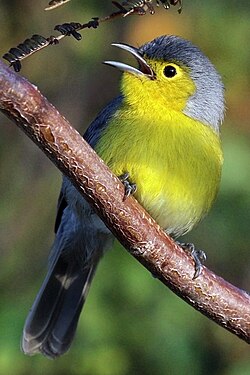
Both species are small birds, measuring roughly 13 cm (5.1 in) and weighing between 6 and 18 g. They share grey backs, wings, tails, and a distinctive yellow eye-ring. Their bills are robust, slightly curved, and greyish-black.
Despite their similarities, they can be distinguished by their head and underbelly coloration:
- Yellow-headed Warbler: Features an entirely yellow head, but has a grey breast, belly, and rear.
- Oriente Warbler: Has a grey crown and forehead, with yellow plumage extending down to the upper belly and a white lower belly.
Behavior and Ecology
Diet and Foraging
Cuban warblers are insectivores. Analysis of the Oriente warbler's diet shows a high consumption of beetles, supplemented by true bugs (Hemiptera), moths, and butterflies. They are also known to eat small lizards and, in the case of the Oriente warbler, small fruits.
The species utilize niche partitioning—the process by which competing species use different resources to coexist. The yellow-headed warbler typically feeds in the understory and mid-canopy. In contrast, the Oriente warbler feeds high in the canopy (above 5 m) in the morning, moving lower toward the ground in the evening to avoid the midday heat.
Social Structure
During the non-breeding season, these birds form small flocks of up to six individuals. These groups often act as the nucleus for larger, mixed-species feeding flocks, frequently attracting migratory birds from North America.
Breeding and Nesting
Breeding is seasonal, occurring from March to July, with eggs typically laid between March and May. Both species build cup-shaped nests, though their placement differs:
- Oriente Warbler: Builds an unlined cup of vines, roots, moss, and feathers, usually placed on a branch within 1 meter of height and concealed by epiphytes (plants that grow on other plants).
- Yellow-headed Warbler: Constructs a similar cup using grass and other materials, but places the nest close to the ground in low vegetation.
| Feature | Yellow-headed Warbler | Oriente Warbler |
|---|---|---|
| Scientific Name | Teretistris fernandinae | Teretistris fornsi |
| Primary Range | Western Cuba | Eastern Cuba |
| Head Color | Entirely yellow | Grey crown and forehead |
| Underbelly Color | Grey | Yellow (upper), White (lower) |
| Nest Location | Close to the ground | On branches (often in epiphytes) |
| IUCN Status | Least Concern (LC) | Least Concern (LC) |
Frequently Asked Questions
Are Cuban warblers actually warblers?
While they are called warblers and look like New World warblers, DNA studies conducted in 2002 and 2013 proved they are not closely related to the Parulidae family. They are now placed in their own unique family, Teretistridae.
What is the main difference between the two species?
The primary differences are geographic and visual. The yellow-headed warbler lives in western Cuba and has a fully yellow head with a grey belly. The Oriente warbler lives in eastern Cuba and has a grey crown with a yellow upper belly.
What do Cuban warblers eat?
They are primarily insectivores, with beetles making up a large portion of their diet. They also eat true bugs, moths, butterflies, small lizards, and occasionally small fruits.
How do they avoid competition with other birds?
They use niche partitioning. For example, the yellow-headed warbler feeds in the mid-canopy, while the Oriente warbler shifts its foraging height throughout the day based on temperature, moving from the high canopy in the morning to the ground in the evening.
Where can these birds be found?
They are endemic to Cuba and its surrounding cays, inhabiting natural forests with thick understories and drier scrub habitats from sea level up into the mountains.