Cryogenian Period: The Era of Snowball Earth
The Cryogenian Period, spanning from 720 to 635 million years ago (Ma), represents one of the most volatile chapters in Earth's history. Derived from the Ancient Greek words kryos (cold) and genesis (birth), this period is the second of the three divisions of the Neoproterozoic era. It is positioned between the Tonian and the Ediacaran periods.
Following a long stretch of environmental stability known as the Boring Billion, the Cryogenian shattered the status quo with drastic climate shifts. This era is most famous for the hypothesis of Snowball Earth, a state where severe icehouse conditions may have frozen the entire planet, including the oceans.
Key Facts
- Time Span: 720 to 635 million years ago.
- Defining Feature: Two massive global glaciations (Sturtian and Marinoan).
- Atmosphere: Oxygen levels were approximately 12 vol % (55% of modern levels), while CO2 was roughly 5 times higher than pre-industrial levels.
- Temperature: Mean surface temperatures averaged around 5 °C, which is 8.5 °C below pre-industrial averages.
- Biological Milestone: Transition from a cyanobacterial-dominated world to one dominated by algae.
The Great Glaciations
The Cryogenian is characterized by the most severe ice ages in Earth's history. Geologists identify two primary worldwide glaciations separated by a relatively warmer interglacial period.
The Sturtian Glaciation
Beginning at the start of the period, the Sturtian glaciation persisted from approximately 717 to 660 Ma. During this time, glacial deposits reached sea level even in low paleolatitudes, suggesting that ice sheets may have extended all the way to the equator.
The Marinoan Glaciation
Following a brief interglacial period marked by anoxic (oxygen-depleted) oceans and marine transgression, the Marinoan glaciation occurred. This second ice age ended around 632.3 Ma, marking the transition into the Ediacaran period.
While the "Snowball Earth" theory suggests total planetary freezing, some scientists propose a "slushball Earth" model, where a narrow band of open sea survived near the equator. Regardless of the specific model, these extreme conditions likely hindered primary production in shallow seas, leading to significant biosphere turnovers and mass extinctions.
Paleogeography and Tectonics
The physical layout of the Earth underwent massive changes during the Cryogenian. Around 750 Ma, the supercontinent Rodinia began to rift apart. This tectonic activity led to the closing of the superocean Mirovia and the formation of the superocean Panthalassa.
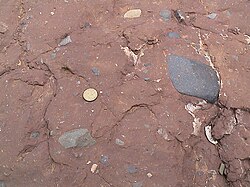
Many glacial deposits from this era, known as tillite (lithified glacial till), were accumulated along rifted continental margins. For example, the Rapitan Group in North America and the Adelaide Rift Complex in Australia provide critical evidence of these rhythmic glacial pulses. Some researchers suggest that the worldwide deposition of dolomite during this time may have reduced atmospheric carbon dioxide, contributing to the cooling effect.
Life in the Deep Freeze
Despite the harsh climate, the Cryogenian was a pivotal time for biological evolution. While overall biodiversity remained low between the two major glaciations, several key developments occurred:
- Microbial Shifts: The world transitioned from being dominated by cyanobacteria to being dominated by algae.
- New Life Forms: Fossils of testate amoeba (Arcellinida) first appeared. There is also evidence that red algae, green algae, stramenopiles, ciliates, and dinoflagellates evolved during this time.
- The Dawn of Animals: Some researchers argue that the oldest known fossils of sponges, or proto-sponges, formed during the Cryogenian, potentially marking the origin of animals.
- Planktonic Revolution: Toward the end of the period, heterotrophic plankton emerged to feed on unicellular algae and prokaryotes, ending the era of bacterial dominance in the oceans.
This biological "big bang" saw unicellular algae (Archaeplastida) increase their population by a factor of a hundred to a thousand.
Cryogenian Summary Table
| Feature | Details |
|---|---|
| Duration | 720 – 635 Ma |
| Era | Neoproterozoic |
| Major Glaciations | Sturtian and Marinoan |
| Upper Boundary | Defined by cap carbonates and carbon isotope changes |
| Key Tectonic Event | Breakup of supercontinent Rodinia |
| Atmospheric O2 | ~12 vol % |
Frequently Asked Questions
How is the start of the Cryogenian Period defined?
Unlike many periods defined by fossils, the base of the Cryogenian is defined chronometrically by a fixed rock age, currently set at approximately 720 million years ago.
What are cap carbonates?
Cap carbonates are distinct sedimentary layers that mark the end of the Cryogenian Period, signaling a rapid transition from glacial conditions to warmer climates.
What is the difference between Snowball Earth and Slushball Earth?
Snowball Earth suggests the entire planet was frozen over, while Slushball Earth suggests that some open water or slushy ice remained near the equator.
Did animals exist during the Cryogenian?
It is a subject of scientific debate; however, some evidence suggests that the first sponges or sponge-grade organisms may have appeared during this period.
What caused the extreme cooling of the Cryogenian?
While multiple factors contributed, the rifting of Rodinia and the widespread deposition of dolomite may have lowered atmospheric CO2 levels, triggering the severe glaciations.