Crucifixion: History, Methods, and Archaeological Evidence
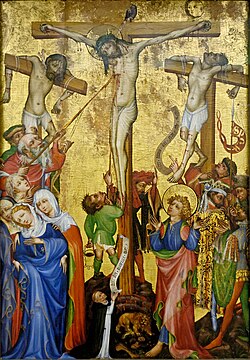
Crucifixion is a method of capital punishment and torture where a condemned person is tied or nailed to a large wooden cross, beam, or stake. The individual is typically left to hang until death, a process that can last from a few minutes to several days. While death often results from prolonged starvation and exhaustion, it can occur rapidly if an executioner accidentally severs a major artery during the nailing process, leading to massive blood loss.
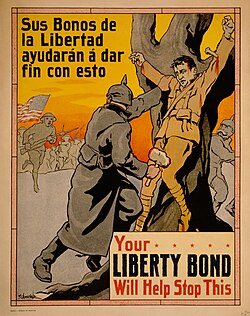
This brutal practice was widespread in the ancient world, utilized by civilizations such as Persia, Carthage, and Rome. While largely associated with antiquity, crucifixion remains a legally sanctioned punishment in some Muslim-majority countries today and is occasionally reported in connection with war crimes, genocide, and murder.
Key Facts
- Ancient Usage: Widely employed by the Persians, Carthaginians, and Romans.
- Cause of Death: Typically a slow process involving starvation, though rapid blood loss is possible.
- Archaeological Proof: The remains of a man named Jehohanan provide rare physical evidence of 1st-century crucifixion.
- Roman Scale: Following the Third Servile War, approximately 6,000 followers of Spartacus were crucified.
- Modern Status: Still legally practiced in some Islamic states and used in specific conflict zones.
The Mechanics of Execution
Cross Shapes and Structures
The structure used for execution varied. A crux simplex consisted of a single upright stake, while other forms involved a crossbeam. In Roman practice, the vertical beam (stipes) was often permanently embedded in the ground at designated execution sites, such as those outside the Esquiline Gate in Rome.
The Process of Crucifixion
Condemned prisoners were often forced to carry the crossbeam (patibulum), which weighed roughly 45 kg (100 lb), to the site of execution. The prisoner was typically led through crowded streets while nude, carrying a titulus—a sign board stating their name and crime.
Once at the site, the prisoner was nailed to the patibulum by the wrists and hoisted up to be fastened to the stipes. Finally, the feet or ankles were nailed to the upright stake using tapered iron spikes, typically 13 to 18 cm (5 to 7 in) long. The titulus was then attached to the cross to maximize the public impact of the execution.
Archaeological Evidence
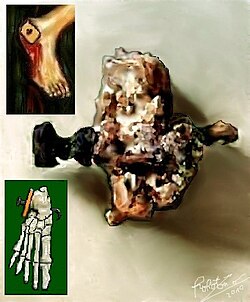
Physical evidence of ancient crucifixion is extremely rare. In 1968, archaeologists at Giv'at ha-Mivtar in northeast Jerusalem discovered the remains of a man named Jehohanan. His heel bone (calcaneum) contained a bent nail, approximately 11.5 cm long, which had struck a knot in the wood, preventing its removal.
Further evidence includes a 2007 find of skeletal remains with transverse holes in the heel bones and a 2017 discovery in Cambridgeshire, UK, of a heel bone with an iron nail, which researchers believe confirms the Roman use of the practice in Britain.
Historical Prevalence
Ancient Rome
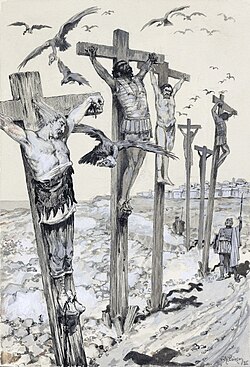
Rome used mass crucifixion as a tool of political terror. After the Third Servile War (73–71 BCE), the general Crassus ordered the crucifixion of 6,000 of Spartacus' followers along the 200-km Appian Way. During the siege of Jerusalem in 70 CE, Roman soldiers reportedly crucified Jewish captives in various positions as a form of amusement.
Japan and Other Regions
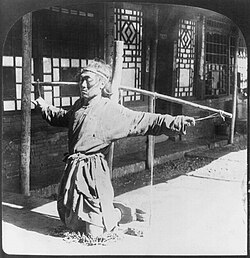
Crucifixion, known as haritsuke, was introduced to Japan during the Sengoku period (1467–1573). It was used during the Tokugawa Shogunate, often involving tying the condemned to a stake with cross-pieces.
![Early Meiji period crucifixion (c. 1865–1868), Yokohama, Japan. A 25-year-old servant, Sokichi, was executed by crucifixion for murdering his employer's son during the course of a robbery. He was affixed by tying to a stake with two cross-pieces.[107][108]](/images/d8/ff/d8ff6f26db08b3a09fdfb15291ec5c3115d48ffdeec092da16f1ffbaeb67556d.jpg)
Modern Applications and Cultural Context
Legal and Political Use
In the 21st century, some Islamic states maintain crucifixion as a legal penalty. In Saudi Arabia, individuals have been sentenced to be beheaded and then crucified, or crucified for several days. For example, Ali Mohammed Baqir al-Nimr was sentenced to public beheading and crucifixion in 2014.
Devotional and Symbolic Use
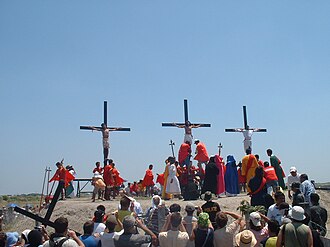
Crucifixion also appears in non-punitive contexts. In some regions, such as San Fernando in the Philippines, individuals engage in devotional crucifixions during Holy Week as a religious practice.
Summary of Crucifixion Practices
| Era/Culture | Primary Method | Purpose/Context | Notable Example |
|---|---|---|---|
| Ancient Rome | Nailing to stipes and patibulum | Political terror, slave punishment | Followers of Spartacus |
| Sengoku/Tokugawa Japan | Tying to stakes (Haritsuke) | Capital punishment | Sokichi (Meiji period) |
| Modern Islamic States | Post-execution display or hanging | Legal sanction for terrorism/robbery | Saudi Arabian legal cases |
| Modern Devotional | Voluntary nailing/tying | Religious penance | Easter in the Philippines |
Frequently Asked Questions
How long did it take for a person to die by crucifixion?
Death could take anywhere from a few minutes to several days. While most died slowly due to exhaustion and starvation, rapid death occurred if a major artery was severed during the nailing process.
What is the archaeological evidence for crucifixion?
The most prominent evidence is the 1st-century remains of Jehohanan from Jerusalem, whose heel bone still contained the iron nail used during his execution.
Did the condemned always carry the entire cross?
No. While a full cross would weigh over 135 kg (300 lb), prisoners typically only carried the crossbeam (patibulum), which weighed approximately 45 kg (100 lb).
Is crucifixion still legal today?
Yes, it remains a legally sanctioned punishment in some Muslim-majority countries, though it is sometimes combined with other methods like beheading.
What was the purpose of the titulus?
The titulus was a sign board that displayed the prisoner's name and their crime, intended to inform the public and maximize the humiliation and deterrent effect of the execution.