Crop Wild Relatives: The Genetic Foundation of Global Food Security
In the quest to feed a growing global population amidst a changing climate, scientists and farmers are looking backward to move forward. The secret to resilient agriculture may lie in Crop Wild Relatives (CWRs)—wild plant species that share a close genetic relationship with the crops we eat every day. These plants are not merely weeds; they are biological treasure troves of evolutionary wisdom.
A CWR is defined as a wild plant taxon that has an indirect use derived from its relatively close genetic relationship to a crop. They may be the direct wild ancestors of our domesticated plants or other closely related species. By crossing these wild relatives with modern crops, breeders can introduce vital traits such as disease resistance, drought tolerance, and improved nutritional content.
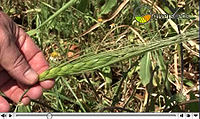
Wild emmer wheat (Triticum dicoccoides), a CWR of cultivated wheats (Triticum spp), can be found in northern Israel.
The Evolutionary Value of CWRs
The importance of these species was first recognized in the early 20th century by the Russian botanist Nikolai Vavilov. Unlike domesticated crops, which have been selected for high yields and ease of harvest, CWRs have undergone natural selection in the wild. This process has allowed them to accumulate a rich set of survival traits that are essential for maintaining sustainable agro-ecosystems.
Modern plant breeding increasingly relies on CWR genes to enhance a wide range of socio-economically important species, including:
- Food and fodder crops: Improving the yield and quality of staples like rice, maize, and wheat.
- Medicinal and ornamental plants: Preserving unique chemical compounds and aesthetic traits.
- Industrial crops: Enhancing the production of oils and fibers.
For example, farmers have long used traditional methods to promote natural crossing, such as growing wild maize (Zea mexicana) alongside cultivated maize to improve yields. Today, this principle is applied at a high-tech scale to improve crops like tomato (Solanum lycopersicum) and various grain legumes.
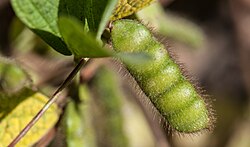
Cajanus scarabaeoides is one of the closest wild relatives to the cultivated pigeonpea and has high drought tolerance and high protein content. Being screened at the campus of the International Crops Research Institute for the Semi-Arid Tropics in Patancheru, India.
Conservation Challenges and Strategies
Despite their critical importance, the natural populations of many CWRs are under severe threat. Habitat loss through deforestation, land conversion, and the degradation of natural environments is rapidly reducing their numbers. In arid and semi-arid regions, overgrazing and desertification are shrinking the populations of wild cereal relatives.
Furthermore, the industrialization of agriculture is reducing the presence of CWRs within traditional agro-ecosystems. To combat these threats, conservationists use two complementary approaches:
In Situ Conservation
This involves protecting species within their natural habitats. This method allows plants to continue evolving and adapting to new environmental challenges in real-time.
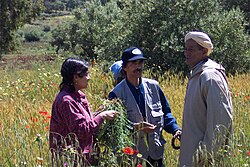
Two conservationists collecting indigenous knowledge on cultural practices that favour CWR populations, from a farmer near Fes, Morocco.
Ex Situ Conservation
This refers to protecting genetic material outside of its natural habitat, typically in genebanks (facilities that store seeds or plant tissues). While ex situ conservation protects genes from immediate extinction in the wild, it can limit the plant's ability to evolve alongside changing environmental conditions.
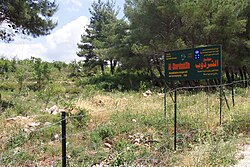
Example of one of the first genetic reserves established to conserve CWRs near Kalakh al Hosn, Syria
Current data highlights a significant gap in our global safety net. In 2016, 29% of wild relative species were entirely missing from the world’s genebanks, and 24% were represented by fewer than 10 samples. Over 70% of all CWR species worldwide require urgent collection to improve their representation, particularly in the Mediterranean, Near East, Southeast Asia, and South America.
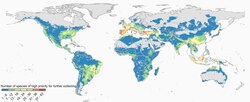
Geographic hotspots of distributions of crop wild relatives not represented in genebanks
Key Facts
- Genetic Reservoir: CWRs provide essential genes for drought tolerance, pest resistance, and nutritional improvement.
- Vavilov's Legacy: The study of CWRs began in the early 20th century with Nikolai Vavilov.
- Conservation Gap: Over 70% of CWR species are insufficiently represented in global genebanks.
- Dual Approach: Effective conservation requires both in situ (in nature) and ex situ (in genebanks) strategies.
- Climate Resilience: CWRs are considered critical resources for ensuring food security in the face of anthropogenic climate change.
Summary of Common Crop Wild Relatives
| Crop Category | Cultivated Species | Wild Relative(s) |
|---|---|---|
| Grains | Rice (Oryza sativa) | Oryza rufipogon |
| Grains | Wheat (Triticum aestivum) | Einkorn wheat (Triticum monococcum) |
| Vegetables | Carrot (Daucus carota) | Daucus gracilis |
| Fruits | Tomato (Solanum lycopersicum) | Solanum chilense |
| Pulses | Pigeonpea (Cajanus cajan) | Cajanus scarabaeoides |
| Tubers | Potato (Solanum tuberosum) | Solanum chacoense |
Frequently Asked Questions
What is the difference between in situ and ex situ conservation?
In situ conservation protects plants in their natural environment, allowing them to continue evolving. Ex situ conservation involves storing genetic material in controlled environments like genebanks to protect it from immediate extinction.
Why are crop wild relatives important for climate change?
As climate change creates ecosystem instability, CWRs provide the genetic diversity needed to breed crops that can survive new stresses like extreme heat, drought, or shifting pest patterns.
Can wild relatives be used for all types of crops?
While many major crops like grains, vegetables, fruits, and pulses have known wild relatives, the availability and usefulness depend on the specific species and its genetic proximity to the cultivated version.
What are the main threats to CWR populations?
The primary threats include habitat loss due to deforestation, land conversion for industrial agriculture, overgrazing in arid lands, and the general degradation of natural ecosystems.
How do scientists use CWRs in plant breeding?
Scientists identify beneficial traits in wild plants—such as resistance to a specific disease—and then use controlled crossing (hybridization) to transfer those genes into modern, high-yielding crop varieties.