Crop Milk: The Fascinating Secretion of Pigeons, Flamingos, and Penguins
While lactation is typically associated with mammals, nature has developed a remarkable parallel in the avian world. Crop milk is a specialized secretion produced by the lining of the crop—a muscular pouch in the throat—which parent birds regurgitate to feed their young. This biological phenomenon is not found in all birds, but has evolved independently across several distinct species to ensure the survival of their offspring during early development.
Key Facts
- Species: Produced by all pigeons and doves, flamingos, and male emperor penguins.
- Hormonal Control: Regulated by prolactin, the same hormone responsible for mammalian lactation.
- Composition: Rich in proteins and fats, but contains no carbohydrates (sugars).
- Production: In pigeons and flamingos, both parents produce it; in emperor penguins, only the male does.
- Mechanism: It is a holocrine secretion, meaning it is produced by cells that detach from the crop lining.
The Science of Avian Lactation
Although it serves a similar purpose to mammalian milk, crop milk is biologically distinct. In mammals, milk is an apocrine secretion, whereas crop milk is a holocrine secretion. This means that instead of secreting fluid through a cell membrane, the cells themselves proliferate and detach from the lining of the crop to form the substance.
The production of this substance is triggered by the hormone prolactin. While mammalian milk is an emulsion, the version found in pigeons is a suspension of fat- and protein-rich cells. Interestingly, crop milk lacks the carbohydrates found in mammalian milk, though it provides essential immune-enhancing factors, antioxidants, and IgA antibodies to protect the young.
Pigeon Milk: Composition and Feeding
In pigeons and doves, crop milk is a semi-solid, pale yellow substance with a consistency similar to cottage cheese. It is exceptionally high in protein and fat—often exceeding the levels found in human or cow milk—and is noted for having a "rancid" flavor.
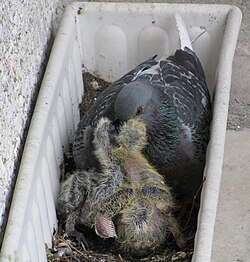
The production cycle begins a few days before the eggs hatch. To ensure the squabs (baby pigeons) receive pure, uncontaminated milk that they can easily digest, parents may stop eating entirely. The feeding process follows a strict timeline:
- First Week: Squabs are fed exclusively on pure crop milk.
- Second Week: Parents gradually introduce adult food, which is softened by the moist conditions of the crop.
- End of Second Week: The young transition entirely to softened adult food.
There is a direct link between crop milk production and clutch size. Pigeons typically lay two eggs because a breeding pair cannot produce enough crop milk to adequately support three squabs. Consequently, if only one egg hatches, that single squab often grows significantly faster due to the surplus of nutrients.
Crop Milk in Other Bird Species
The appearance of crop milk in other species is a prime example of convergent evolution, where different species independently evolve similar traits.
Flamingos
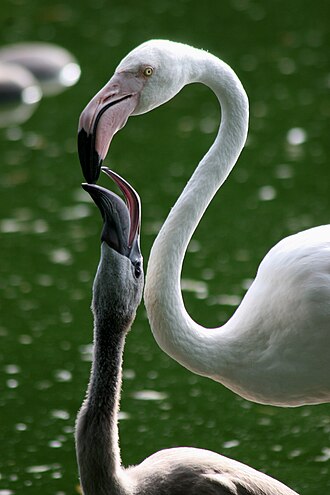
Flamingos produce a crop milk that is a bright red, thin liquid during the first few weeks of a chick's life. This striking color is not caused by blood, but by canthaxanthin, a carotenoid pigment. The color fades over time, and flamingos can continue producing this secretion for up to six months.
Emperor Penguins
In a stark contrast to pigeons and flamingos, the production of crop milk in emperor penguins is exclusive to the male, who provides vital nutrition to the chick in the harsh Antarctic environment.
Comparison of Crop Milk and Mammalian Milk
| Feature | Crop Milk (Birds) | Mammalian Milk |
|---|---|---|
| Primary Hormone | Prolactin | Prolactin |
| Secretion Type | Holocrine (cell detachment) | Apocrine |
| Carbohydrates | None | Present (e.g., lactose) |
| Consistency | Semi-solid (pigeons) or liquid (flamingos) | Liquid emulsion |
| Who Produces It? | Species dependent (Male, Female, or Both) | Typically Female |
Frequently Asked Questions
Is crop milk the same as mammalian milk?
No. While both are nutrient-rich secretions used to feed young and are controlled by prolactin, they differ in secretion method (holocrine vs. apocrine) and composition, as crop milk contains no carbohydrates.
Why is flamingo crop milk red?
The red color is caused by the presence of canthaxanthin, a carotenoid pigment. It does not contain red blood cells.
Why do pigeons only lay two eggs?
Research suggests that a pair of breeding pigeons cannot produce enough crop milk to adequately feed three squabs, which limits the natural clutch size to two.
Which birds produce crop milk?
Crop milk is produced by all species of pigeons and doves, flamingos, and male emperor penguins.
What are squabs?
Squabs are the terms used for baby pigeons and doves during their early stages of development.