Breast Development: The Hormonal and Biochemical Mechanisms of Growth
The development of the human breast is a complex biological process governed by a precise orchestration of steroid hormones, growth factors, and signaling pathways. From the rudimentary structures formed before birth to the mature mammary glands capable of lactation, this progression is driven by systemic endocrine signals and local paracrine interactions.
At the core of this process are steroid hormones—specifically estrogen and progesterone—alongside growth hormone (GH), insulin-like growth factor 1 (IGF-1), and prolactin. These regulators do not act in isolation; instead, they induce the expression of various growth factors, such as amphiregulin and epidermal growth factor (EGF), which execute the actual cellular growth and maturation.
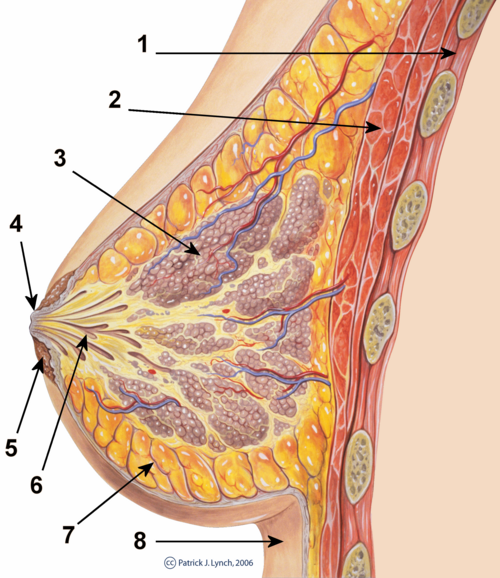
Key Facts
- Essential Duo: Both estrogen and growth hormone (GH) are required for pubertal breast development; the absence of either prevents development.
- IGF-1 Role: Most of GH's effects are mediated through IGF-1, though GH also directly increases estrogen receptor expression in connective tissue.
- Prenatal Stage: Early breast bud development is independent of biological sex and sex hormones.
- Pregnancy Peak: Estrogen and progesterone levels reach several hundred-fold higher than normal menstrual levels during late pregnancy.
- Androgen Inhibition: Androgens (like testosterone) suppress breast growth by reducing estrogen receptor expression.
The Hormonal Cascade of Puberty
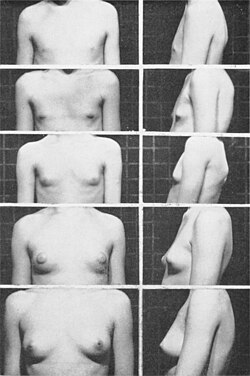
Puberty marks the transition from quiescent breast buds to a functional ductal system. This process begins in the hypothalamus with the pulsatile secretion of gonadotropin-releasing hormone (GnRH). This triggers the pituitary gland to release follicle-stimulating hormone (FSH) and luteinizing hormone (LH), which then stimulate the ovaries to produce estrogen and progesterone.
The Synergy of Estrogen and GH/IGF-1
While estrogen is the primary driver of ductal elongation, it works synergistically with the GH/IGF-1 axis. Growth hormone (GH) stimulates the production of IGF-1, primarily in the liver (80% of circulating IGF-1) and locally within the breasts. Together, they activate estrogen receptor alpha (ERα), causing the rudimentary tubules to transform into a mature ductal system. During this phase, terminal end buds (TEBs)—bulbous structures at the duct tips—penetrate the fat pad and branch to create a tree-like network.
The Role of Progesterone
Progesterone contributes to ductal growth to a lesser extent than estrogen, primarily by inducing the expression of amphiregulin. Its most critical role is the initiation of lobuloalveolar development (the formation of milk-producing alveoli). However, this development remains rudimentary until pregnancy. Notably, estrogen must first "prime" the breast tissue by inducing the expression of progesterone receptors (PR).
Development During Pregnancy and Lactation
Pregnancy induces the most dramatic phase of breast maturation. Estrogen and progesterone levels surge, triggering the anterior pituitary to release prolactin at levels up to 20 times higher than normal. Additionally, placental growth hormone (PGH) increases levels of IGF-1 and IGF-2.
The combined action of prolactin, progesterone (specifically via the PRB receptor), and other lactogens like human placental lactogen (hPL) completes the lobuloalveolar development. By the end of the fourth month of pregnancy, the breasts are fully prepared for lactation. Research in knockout mice confirms that both prolactin and progesterone receptors are essential for this stage.
Regulatory Inhibitors and Modulators
Not all hormones promote growth; some act as critical brakes to ensure proper development.
Androgens and Sex Differences
Androgens, such as testosterone and dihydrotestosterone (DHT), powerfully suppress estrogen's effects by reducing estrogen receptor expression. This explains why males, who have higher androgen and lower estrogen levels, typically do not develop prominent breasts. In contrast, individuals with complete androgen insensitivity syndrome (CAIS) often exhibit above-average breast volume due to the lack of androgenic suppression.
Vitamin D and the VDR Pathway
Calcitriol (active vitamin D) acts through the vitamin D receptor (VDR) as a complex regulator. It generally inhibits ductal development by suppressing cyclooxygenase-2 (COX-2), which in turn reduces the growth-promoting effects of prostaglandin E2 (PGE2). However, vitamin D may be a positive regulator for lobuloalveolar differentiation.
Biochemical Growth Factors and Signaling
Hormones exert their influence by modulating local autocrine and paracrine growth factors. The epidermal growth factor receptor (EGFR) and the IGF-1 receptor (IGF-1R) are both essential for mammary development. Estrogen and progesterone primarily drive ductal growth by inducing amphiregulin, which activates the EGFR.
In rare cases of macromastia (excessive breast enlargement), elevated levels of hepatocyte growth factor (HGF) and IGF-1 in the stromal tissue have been observed. HGF, in particular, has been implicated in promoting epithelial proliferation and is linked to breast cancer aggressiveness via its receptor, c-Met.
| Hormone/Factor | Primary Role | Key Effect/Mechanism |
|---|---|---|
| Estrogen | Ductal Development | Ductal elongation, fat accumulation, and PR induction. |
| Progesterone | Lobuloalveolar Growth | Alveolar bud formation; synergistic with prolactin. |
| GH / IGF-1 | General Growth | Essential for puberty; increases ER expression. |
| Prolactin | Lactation Prep | Completes lobuloalveolar maturation during pregnancy. |
| Androgens | Inhibition | Suppresses estrogen receptor expression. |
| Calcitriol (Vit D) | Regulation | Downregulates COX-2 to inhibit ductal growth. |
Frequently Asked Questions
Why is growth hormone necessary for breast development?
Growth hormone (GH) is essential because it stimulates the production of IGF-1 and directly increases the expression of estrogen receptors in the breast's connective (stromal) tissue, allowing estrogen to work more effectively.
Can breast development occur without GH/IGF-1?
While GH/IGF-1 is essential for the timing and efficiency of puberty, women with Laron syndrome (who lack GH sensitivity) eventually reach full sexual maturity and normal breast size, though the process is delayed. This suggests that very low levels of IGF-1 can still support full development over a longer period.
What is the difference between ductal and lobuloalveolar development?
Ductal development refers to the growth and branching of the milk ducts that transport fluid. Lobuloalveolar development refers to the creation of the alveoli, the grape-like clusters that actually produce and store milk.
How do androgens prevent breast growth in males?
Androgens act as antagonists to estrogen by reducing the number of estrogen receptors in breast tissue, thereby blocking the signals that would otherwise trigger ductal growth.
What role does Vitamin D play in the breast?
Vitamin D acts as a negative regulator of ductal growth by suppressing COX-2, which reduces the production of growth-promoting prostaglandins. However, it may be necessary for the proper differentiation of the lobuloalveolar structures.