Crayfish: Biology, Distribution, and Cultural Significance
Crayfish are freshwater crustaceans belonging to the infraorder Astacidea. Often resembling small lobsters, these resilient creatures have existed since the Triassic period and are found in diverse aquatic environments across the globe. From their role as essential detritivores in river ecosystems to their status as a culinary staple in the American South, crayfish occupy a unique intersection of biological importance and cultural heritage.
Key Facts
- Temporal Range: Present from the Triassic period to the recent era.
- Diet: Primarily detritivores, consuming organic mud and debris.
- Global Giants: Australia is home to the world's three largest freshwater crayfish.
- Economic Powerhouse: Louisiana produces 100 million pounds of crayfish annually.
- Ancient History: Fossil burrows date back to the Early Permian (~300-270 million years ago).
Biological Foundations
Anatomy and Diet
Crayfish are classified as detritivores, meaning they feed primarily on detritus. Detritus is a complex mixture of dead plankton, organic waste from the water column, and debris from both aquatic and terrestrial environments, often appearing as black organic mud. Unlike grazers that feed for hours, crayfish typically ingest this material quickly.
The digestive process is highly specialized. Once ingested, material is mixed with digestive fluids and sorted by size. Coarser particles are processed quickly and eliminated within 10 to 12 hours, while finer particles follow a more exacting route through the hindgut, taking 16 to 26 hours to be eliminated.
Classification and Evolution
Taxonomically, crayfish fall under the class Malacostraca and order Decapoda. Their evolutionary history is documented through a rich fossil record. While body fossils from the Late Triassic (such as Enoploclytia porteri) are well-known, fossil burrows suggesting early crayfish activity date back to the Early Permian in North America and Europe.
Modern families appeared later; for example, the parastacid Palaeoechinastacus from Australia dates back 115 million years, and the cambaroidid Palaeocambarus from China is approximately 120 million years old.
Geographical Distribution and Culture
North America and the Cajun Influence
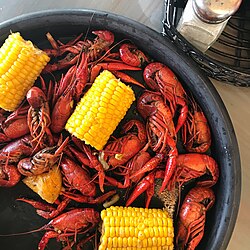
In the United States, crayfish are most prominently associated with Louisiana, where they are commonly called crawfish. Designated as the official state crustacean in 1983, they are central to Cajun culture. Louisiana's industry is massive, producing 100 million pounds per year, primarily consisting of the red swamp (Procambarus clarkii) and white river (Procambarus zonangulus) species.
Beyond food, crayfish iconography has fueled various cottage industries, leading to the creation of crayfish-themed jewelry, apparel, and art.
Australia and New Zealand
Australia boasts an incredible diversity of crayfish, with over 100 species across a dozen genera. It is notably home to the world's three largest freshwater crayfish. Among these is the Murray crayfish (Euastacus armatus), found in the southern Murray-Darling basin, which typically reaches 2.5 kg, with some reports reaching up to 3 kg.

Economic and Practical Uses
Culinary and Aquaculture
The culinary market is heavily concentrated in Louisiana, which hosted 93% of U.S. crayfish farms as of 2018. In 2007, the state's harvest reached approximately 54,800 tons, almost entirely from aquaculture. To support this industry, specific nutrient specifications have been developed for aquaculture feed producers to optimize growth.
Other Applications
- Bait: Frequently used as bait for fishing, particularly for bass, walleye, and pike.
- Education: Used in classrooms to introduce students to biological sciences.
- Sentinel Species: Employed in biomonitoring to detect environmental pollution in waterways.
- Pets: Certain species, such as the Mexican dwarf orange crayfish, are kept as aquarium pets.
| Region | Key Species | Notable Characteristic |
|---|---|---|
| Louisiana, USA | Red swamp & White river crayfish | Major aquaculture hub; cultural icon |
| Australia | Murray crayfish (E. armatus) | Among the world's largest freshwater species |
| Global (Fossil) | Enoploclytia porteri | Late Triassic body fossil |
Frequently Asked Questions
What is the difference between a crayfish and a crawfish?
The terms generally refer to the same animals. "Crawfish" is a regional term used predominantly in the Southern United States, particularly in Louisiana, while "crayfish" is the more common term globally.
What do crayfish eat?
Crayfish are detritivores. They feed on detritus, which is a mixture of dead plankton, organic waste, and debris from aquatic and terrestrial environments.
How large can freshwater crayfish grow?
While most are small, some Australian species are giants. The Murray crayfish, for example, typically reaches 2.5 kg, with some individuals reported up to 3 kg.
Are crayfish used for more than just food?
Yes. They are used as fishing bait, as pets in aquariums, as educational tools in schools, and as sentinel species to monitor the health and pollution levels of river systems.
How old are the earliest crayfish fossils?
Fossil burrows likely made by early crayfish date back to the Early Permian (~300-270 million years ago), while the oldest known body fossils date to the Late Triassic (~230-200 million years ago).