Understanding the Geranium Genus: A Guide to Cranesbills
In the world of gardening, the name "geranium" is frequently used, but it often leads to botanical confusion. While many people use the term to describe the colorful summer bedding plants found in window boxes, those plants actually belong to a different genus called Pelargonium. The true Geranium genus, often referred to as cranesbills, represents a diverse group of 422 species of annual, biennial, and perennial plants found in temperate regions and tropical mountains, with a high concentration of diversity in the eastern Mediterranean.
Botanical Characteristics and Morphology
True geraniums are characterized by their distinctive foliage and floral structures. Their leaves are typically palmately cleft, meaning they are broadly circular and divided into narrow, pointed segments that radiate from a central point, similar to the fingers of a hand. The flowers are generally actinomorphic, a term used to describe radial symmetry where the petals are arranged equally around a central axis. These flowers usually feature five petals in shades of white, pink, purple, or blue, often accented by unique veining.
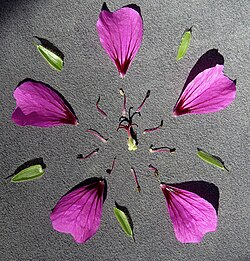
The genus also exhibits fascinating biological traits. Some species are gynodioecious, meaning populations consist of both female plants and hermaphrodite plants. Additionally, the species Geranium viscosissimum (sticky geranium) is considered protocarnivorous, a term describing plants that may trap or digest small organisms.
The "Cranesbill" and Seed Dispersal
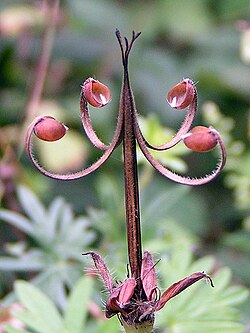
The common name "cranesbill" is derived from the unique appearance of the plant's fruit. The genus name itself comes from the Ancient Greek word géranos, meaning "crane." This name reflects the resemblance of the fruit capsule to a crane's head and beak. The ovary forms the "head," while the elongated stigma creates the appearance of a "bill."
The reproductive process is quite dynamic. The fruit capsule is composed of five cells joined to a central column. As the fruit matures, these cells form lobes that eventually separate, each containing a single seed. When the fruit is fully ripe, the beak-like stigma springs open, forcefully casting the streamlined, ovoid seeds a distance away to ensure dispersal.
Distinguishing Geranium from Pelargonium
One of the most important distinctions for gardeners and botanists is the difference between Geranium and Pelargonium. While both belong to the family Geraniaceae, they were separated into distinct genera by Charles L’Héritier in 1789. A primary way to tell them apart is by their floral symmetry. While Geranium flowers are radially symmetrical, Pelargonium flowers are zygomorphic, meaning they have a single plane of symmetry, typically with two upper petals that differ from the three lower petals.
| Feature | Geranium (Cranesbill) | Pelargonium |
|---|---|---|
| Symmetry | Actinomorphic (Radial) | Zygomorphic (Bilateral) |
| Flower Shape | Five similar petals | Two upper petals differ from three lower petals |
| Common Use | Hardy perennials | Summer bedding plants |
| Winter Hardiness | Many are winter-hardy | Generally not winter-hardy in temperate climates |
Cultivation and Popular Varieties
Geraniums are highly valued in horticulture for their attractive foliage and flowers. Most species are long-lived perennials that exhibit a mounding growth habit, though some species utilize spreading rhizomes. To thrive, they generally require well-draining, moisture-retentive soil rich in humus. They perform best in locations ranging from full sun to partial shade.
Propagation can be achieved through seeds, division in the spring or autumn, or by using semiripe cuttings during the summer. While many species are winter-hardy, some specialized varieties may require protection or be suited for specific environments like rock gardens.
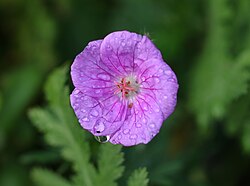
Numerous species are cultivated for both ornamental and pharmaceutical purposes. Notable species include Geranium maculatum (wild geranium), Geranium pratense (meadow cranesbill), and Geranium sanguineum (bloody cranesbill). Many hybrid cultivars have also earned the Royal Horticultural Society's Award of Garden Merit, such as 'Rozanne', 'Ann Folkard', and 'Ballerina'.
Key Facts
- Species Count: There are 422 species within the Geranium genus.
- Etymology: The name "cranesbill" refers to the fruit's resemblance to a crane's head and beak.
- Symmetry: True geraniums are actinomorphic (radially symmetrical).
- Habitat: They are found in temperate regions and tropical mountains, with high diversity in the eastern Mediterranean.
- Ecological Role: Their larvae are eaten by various Lepidoptera species, including the ghost moth and mouse moth.
Frequently Asked Questions
What is the main difference between a Geranium and a Pelargonium?
The primary differences are floral symmetry and hardiness. Geranium flowers are radially symmetrical (all petals look similar), while Pelargonium flowers are bilaterally symmetrical (the top petals differ from the bottom). Additionally, true geraniums are often "hardy geraniums" that survive winter, whereas pelargoniums are typically used as tender summer bedding plants.
Why are they called "cranesbills"?
They are called cranesbills because the fruit capsule and the elongated stigma resemble the head and beak of a crane.
How do geraniums disperse their seeds?
Geraniums use an explosive mechanism. When the fruit capsule is ripe, the beak-like stigma springs open, catapulting the streamlined seeds away from the parent plant.
What kind of soil do geraniums prefer?
Geraniums grow well in most soils as long as the ground is not waterlogged. Ideally, they prefer well-draining but moisture-retentive soil that is rich in humus.
Are all geranium species winter-hardy?
No. While many species are known as "hardy geraniums" because they can survive temperate winters, not all species possess this trait, and some may require specialized care or rock garden environments.