Covert Feathers: The Specialized Layers of Avian Plumage
In the complex architecture of a bird's plumage, not every feather is designed for flight or insulation. Some of the most critical components are the covert feathers, also known as tectrices. These specialized feathers act as protective layers, covering other feathers to create a streamlined surface. By smoothing the airflow over the wings and tail, coverts play a vital role in reducing drag and enhancing aerodynamic efficiency.
Key Facts
- Coverts (tectrices) are feathers that overlay other feathers.
- Their primary function is to smooth airflow over the wings and tail.
- They are found around the ears, on the wings, and at the base of the tail.
- Wing coverts overlap like roof tiles to maintain a sleek profile.
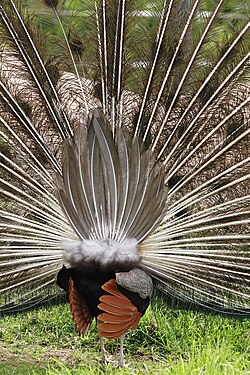
- The peacock's famous "train" consists of modified uppertail coverts.
Types of Covert Feathers
Ear Coverts
Located just behind the eye, ear coverts are small feathers that protect the ear opening. Because birds lack external ear structures, these feathers serve as the primary covering for the auditory opening.
Tail Coverts
Tail coverts are divided into two groups: the uppertail and undertail coverts. These feathers cover the base of the tail feathers from both above and below. In some species, these feathers evolve into highly specialized structures. For example, the iconic "train" of an Indian peacock is actually composed of modified, elongated uppertail coverts rather than true tail feathers.
Wing Coverts
Wing coverts are organized into complex systems to ensure the wing remains aerodynamic during flight. These are categorized by their location and the flight feathers they overlay.
Upperwing and Underwing CovertsThe upperwing coverts are split into two main groups: secondary coverts, which overlay the secondary flight feathers on the inner wing, and primary coverts, which overlay the primary flight feathers on the outer wing. A mirroring set of coverts exists on the underside of the wing, known as underwing coverts.
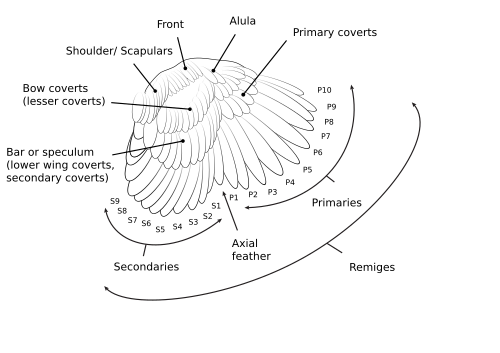
Within the primary and secondary groups, feathers are arranged in rows that overlap like roof tiles. This layering ensures a smooth transition of air. The rows are classified by size and position:
- Greater coverts: The outermost and largest row.
- Median coverts: The row immediately following the greater coverts.
- Lesser coverts: The remaining inner rows.
Additionally, the front edge of the wing is protected by a specific group of feathers called marginal coverts.
Summary of Covert Feather Locations
| Covert Type | Location | Primary Function/Feature |
|---|---|---|
| Ear Coverts | Behind the eye | Covers the ear opening |
| Uppertail Coverts | Above tail base | Protects tail base; forms the peacock's train |
| Undertail Coverts | Below tail base | Protects tail base |
| Primary Coverts | Outer wing | Overlays primary flight feathers |
| Secondary Coverts | Inner wing | Overlays secondary flight feathers |
| Marginal Coverts | Front edge of wing | Protects the wing's leading edge |
Frequently Asked Questions
What is the main purpose of covert feathers?
The primary purpose of covert feathers (tectrices) is to cover other feathers, which helps smooth the airflow over the bird's wings and tail to improve aerodynamics.
Are a peacock's train feathers actually tail feathers?
No, the peacock's train is made of modified, elongated uppertail coverts, not the true tail feathers.
How are wing coverts organized?
Wing coverts are organized in overlapping rows similar to roof tiles, categorized as greater, median, and lesser coverts depending on their size and position.
What is the difference between primary and secondary coverts?
Primary coverts overlay the primary flight feathers on the outer wing, while secondary coverts overlay the secondary flight feathers on the inner wing.
Do birds have external ears?
No, birds have no external ear features; their ear openings are covered by small feathers known as ear coverts.