Coulter Principle and the Evolution of Particle Counting
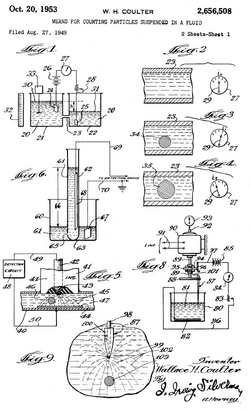
In the late 1940s, Wallace H. Coulter developed a groundbreaking method for counting and sizing particles suspended in a fluid. Motivated by the need for streamlined, large-scale blood screening in the wake of the atomic bombings of Hiroshima and Nagasaki, Coulter sought to replace tedious manual processes with an automated analytical system. With partial funding from the Office of Naval Research, his work culminated in the awarding of US Patent No. 2,656,508 on October 20, 1953.
The resulting instrument, known as the Coulter counter, revolutionized the field of hematology and provided a foundation for modern clinical diagnostics and industrial quality control.
How the Coulter Principle Works
The Coulter principle relies on the electrical properties of particles relative to the fluid they are suspended in. Most cells are poorly conductive compared to the surrounding liquid medium. When these particles pass through a conductive microchannel, they alter the effective cross-section of that channel.
As a particle moves through the channel, it increases the electrical resistance, causing a brief decrease in the electric current passing across the channel. By monitoring these current pulses, the system can achieve two primary goals:
- Counting: Each pulse represents a single particle, allowing the system to determine the number of particles in a specific volume of fluid.
- Sizing: The magnitude of the current change is directly related to the size of the particle. This allows for the measurement of particle size distribution, which can be correlated to concentration, surface charge, and mobility.
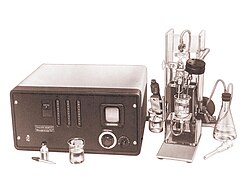
The precision of this data depends heavily on the signal processing circuitry. Modern systems utilize amplifiers with low noise thresholds and digital pulse height analyzers with variable bin widths to provide higher resolution than older analog systems. When integrated with digital computers, these counters can capture and analyze complex electrical pulse characteristics.
Applications in Medicine and Industry
The most significant impact of the Coulter counter has been in the medical field, specifically for the complete blood count (CBC). A CBC determines the proportion and number of red and white blood cells in a patient's body. Before this technology, clinicians had to prepare a peripheral blood smear and manually count cells under a microscope—a process that typically took 30 minutes. The Coulter counter reduced this to a quick, accurate automated analysis.
Beyond medicine, the technology is used for quality control and manufacturing in several industries, including:
- Ceramics and Glass
- Paint and Metals
- Food processing
Furthermore, the Coulter principle was instrumental in the creation of the first cell sorter and the early development of flow cytometry (a technique used to detect and measure physical and chemical characteristics of a population of cells). Some modern flow cytometers still use the principle to determine cell count and size.
Comparison of Coulter Counter Formats
Commercial Coulter counters generally follow one of two primary configurations: the aperture format or the flow cell format.
Aperture Format
Commonly used for quality control, this setup features a small hole (aperture) created in a jewel disk, which is embedded in a glass aperture tube. Because glass is an insulator, the electrical current is forced to flow exclusively through the aperture. A pump draws the sample through the hole, and the resulting variations in conductivity are recorded as pulses.
Flow Cell Format
Predominantly used in hematology and flow cytometry, this format uses electrodes embedded at either end of a flow channel. This allows for continuous analysis and can be paired with a sheath flow to keep particles centered. This configuration enables simultaneous measurements, such as laser probing, though it is more expensive to manufacture and typically limited to a single channel width.
Microfluidic Resistive Pulse Sensing
Modern advancements have led to lab-on-a-chip applications known as microfluidic resistive pulse sensing. By fabricating much smaller pores than those possible in the aperture format, this technology extends the Coulter principle into the deep sub-micron range, enabling the direct detection of virus particles.
Key Facts
- Inventor: Wallace H. Coulter, patented October 20, 1953 (US Patent No. 2,656,508).
- Core Mechanism: Measures changes in electrical resistance as non-conductive particles pass through a conductive channel.
- Primary Medical Use: Automating the Complete Blood Count (CBC), replacing manual microscope counting.
- Industrial Use: Quality control for paint, ceramics, glass, metals, and food.
- Technological Legacy: Contributed to the development of cell sorters and flow cytometry.
| Feature | Aperture Format | Flow Cell Format |
|---|---|---|
| Primary Use | Quality Control | Hematology / Flow Cytometry |
| Analysis Type | Batch/Sample-based | Continuous |
| Flexibility | Wide variety of aperture sizes | Typically fixed channel width |
| Cost | Lower manufacturing cost | Higher manufacturing cost |
| Additional Capabilities | Standard pulse sensing | Compatible with laser probing |
Frequently Asked Questions
What is the Coulter principle?
The Coulter principle is a method of counting and sizing particles by measuring the change in electrical resistance that occurs when a poorly conductive particle passes through a small opening in a conductive fluid.
How did the Coulter counter change blood testing?
It transformed the complete blood count (CBC) from a manual process involving blood smears and microscopes—which took about 30 minutes—into a fast, automated, and accurate laboratory procedure.
What is the difference between aperture and flow cell formats?
The aperture format uses a small hole in a jewel disk and is ideal for quality control due to its variety of sizes. The flow cell format uses a channel with electrodes at each end, allowing for continuous analysis and integration with other tools like lasers.
Can the Coulter principle detect things smaller than cells?
Yes. Through microfluidic resistive pulse sensing (lab-on-a-chip), the principle has been extended to the deep sub-micron range, allowing for the detection of virus particles.
What industries use Coulter counters besides medicine?
Coulter counters are routinely used for quality control in the manufacturing of food, metals, glass, ceramics, and paint.