Differential Cell Counters: Comparing 3-Part and 5-Part Analyzers
In hematology, the ability to accurately count and categorize white blood cells (WBCs) is essential for diagnosing infections, allergies, and other medical conditions. This process is handled by differential cell counters, specialized instruments that analyze the composition of a blood sample. Depending on the clinical need, laboratories use either 3-part or 5-part analyzers, which differ significantly in their technology and the depth of data they provide.
The 3-Part Differential Cell Counter
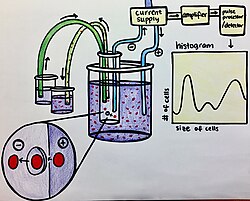
A 3-part differential cell counter relies on Coulter's principle, a method used to determine the size and volume of cells. In this process, the blood sample is lysed (broken down) and dissolved into an electrolyte solution. The system utilizes a container-within-a-container design, where two pumps manage the solution—one creating a vacuum to draw cells through a small hole, known as an orifice, and another replacing the lost solution.
The measurement occurs via two electrodes: an internal electrode located inside the smaller container and an external electrode situated in the surrounding electrolyte solution. As the vacuum pulls cells through the orifice, each cell creates a momentary electrical resistance. This resistance is recorded, amplified, and processed by a computer to generate a histogram, which represents the cell distribution.
This technology allows the analyzer to differentiate between three primary types of white blood cells: neutrophils, lymphocytes, and monocytes.
The 5-Part Differential Cell Counter
For more complex diagnostic requirements, the 5-part differential cell counter is used. This advanced analyzer combines Coulter's principle with flow cytometry—a technique used to analyze the physical and chemical characteristics of particles in a fluid flow. To achieve high precision, these machines use hydrodynamic focusing to ensure cells pass through an aperture one by one.
As each cell passes through the aperture, a laser is directed at it. The device measures the light scattered at multiple angles and records the absorbance. By analyzing the intensity of the scattered light and the level of absorbance, the system can determine the cell's diameter, granularity (the appearance of granules within the cytoplasm), and inner complexity.
Because of this increased precision, a 5-part analyzer can identify all five types of white blood cells: neutrophils, lymphocytes, monocytes, eosinophils, and basophils.
Key Facts
- 3-Part Analyzers: Use Coulter's principle to measure cell size and volume via electrical resistance.
- 5-Part Analyzers: Combine Coulter's principle with flow cytometry and laser scattering for detailed analysis.
- WBC Differentiation: 3-part counters identify 3 cell types; 5-part counters identify all 5 WBC types.
- Clinical Use: While 3-part analyzers suffice for most medical tasks, 5-part analyzers are required for specific needs like allergy testing.
- Cost: 5-part analyzers are more expensive than 3-part models due to their advanced technology.
Comparison of Analyzer Types
| Feature | 3-Part Analyzer | 5-Part Analyzer |
|---|---|---|
| Primary Technology | Coulter's Principle | Coulter's Principle & Flow Cytometry |
| Measurement Method | Electrical Resistance | Laser Scattering & Absorbance |
| WBC Types Identified | Neutrophils, Lymphocytes, Monocytes | Neutrophils, Lymphocytes, Monocytes, Eosinophils, Basophils |
| Data Provided | Size and Volume | Diameter, Granularity, and Inner Complexity |
| Relative Cost | Lower | Higher |
Frequently Asked Questions
What is the main difference between a 3-part and 5-part analyzer?
The main difference is the number of white blood cell types they can identify and the technology used. A 3-part analyzer identifies three cell types using electrical resistance, while a 5-part analyzer identifies all five types using a combination of electrical resistance and laser-based flow cytometry.
How does Coulter's principle work in these devices?
Coulter's principle works by passing cells through a small orifice between two electrodes. As a cell passes through, it creates a momentary electrical resistance proportional to its size, which the computer then processes into a histogram.
When is a 5-part differential analysis necessary?
A 5-part analysis is necessary for specific medical jobs that require the identification of eosinophils and basophils, such as allergy testing.
What is hydrodynamic focusing?
Hydrodynamic focusing is a technique used in 5-part analyzers to align cells in a single-file line as they pass through an aperture, ensuring that the laser hits only one cell at a time for accurate measurement.
Can a 3-part analyzer handle most routine medical tasks?
Yes, most standard medical tasks can be completed using the data provided by a 3-part differential cell counter.