Corps of Guides: The Elite Frontier Force of the British Indian Army
The Corps of Guides was a distinguished joint infantry-cavalry regiment of the British Indian Army, renowned for its versatility and bravery on the North West Frontier. Comprising both British and Indian officers, alongside Indian cavalry sowars (cavalrymen) and infantry sepoys (infantrymen), the unit served as a critical strategic asset in one of the most volatile regions of the Indian Empire.
From its modest beginnings in the mid-19th century to its eventual transition into the modern Pakistan Army, the Corps of Guides established a legacy of endurance and innovation that influenced military dress and tactics for generations.
Key Facts
- Founded: 1846 by Lt. Harry Lumsden.
- Specialization: Joint Infantry-Cavalry unit.
- Innovation: First unit in the British or Indian Armies to adopt khaki (drab) uniforms in 1848.
- Key Engagement: The grueling 580-mile march to relieve the Siege of Delhi in 1857.
- Modern Status: Now exists as the 2nd Battalion (The Guides) of the Frontier Force Regiment of the Pakistan Army.
Founding and Early Expansion
The Corps was the brainchild of Sir Henry Lawrence and was raised in December 1846 at Kalu Khan on the Yusufzai Plain in the Peshawar Valley. Under the leadership of its first commandant, Lt. Harry Lumsden, and second-in-command W.S.R. Hodson, the unit began with just one troop of cavalry and two companies of infantry.
The unit quickly proved its worth, starting with its first action at Mughdara in the Panitar Hills. By the outbreak of the Second Sikh War in 1848, the Guides' reputation for efficiency led to a three-fold increase in size, expanding to three troops of cavalry and six companies of infantry.
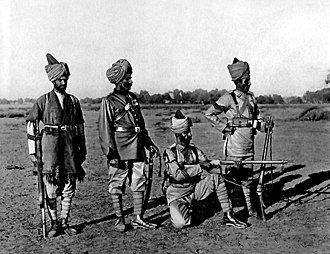
The Siege of Delhi and Frontier Service
In 1852, W.S.R. Hodson became commandant and later supervised the construction of the fort at Mardan in 1854, which became the regiment's primary garrison. One of the most harrowing chapters in the unit's history occurred in 1857 during the Siege of Delhi.
The Guides were ordered to march nearly 600 miles in just over three weeks during the peak of summer. This march was particularly grueling for the Muslim soldiers, as it coincided with the month of Ramadan, requiring them to fast from food and water during daylight hours. Upon arriving at Delhi, the 600-man force was immediately thrust into intense combat; within a single hour, 350 of the men became casualties.

Evolution of the Regiment
Over the decades, the Corps of Guides underwent several name changes and structural shifts. Originally part of the Bengal Army, it later became part of the Punjab Command. In 1911, the cavalry and infantry components were formally designated as separate entities, though they maintained their shared heritage.
| Year | Designation |
|---|---|
| 1846 | The Corps of Guides |
| 1857 | The Corps of Guides, Punjab Irregular Force |
| 1865 | Corps of Guides, Punjab Frontier Force |
| 1876 | Queen's Own Corps of Guides, Punjab Frontier Force |
| 1901 | Queen's Own Corps of Guides |
| 1911 | Queen Victoria's Own Corps of Guides (Frontier Force) (Lumsden's) |
Uniforms and Cultural Legacy
The Corps of Guides is historically significant for introducing khaki (drab) uniforms in 1848, a revolutionary move for camouflage that was eventually adopted globally. The regiment's identity was further marked by scarlet facing colors on collars and cuffs. This tradition persists today, as the modern Pakistan Army units descending from the Guides still wear red piping on their collars.
The unit's prestige extended into literature and art. They are the subject of George John Younghusband's 1908 book, The Story of the Guides, and inspired Rudyard Kipling's "The Ballad of East and West" as well as M.M. Kaye's novel The Far Pavilions.
Transition to the Pakistan Army
Following the independence and partition of India in 1947, the Guides were allocated to Pakistan. The cavalry became the Guides Cavalry (Frontier Force), and the infantry became part of the Frontier Force Regiment. In 1957, following an amalgamation with the Frontier Force Rifles and The Pathan Regiment, the Guides infantry became the 2nd Battalion of the new Frontier Force Regiment. Since 1947, all ranks have been recruited solely from Pakistan.
Frequently Asked Questions
Who founded the Corps of Guides?
The Corps was the brainchild of Sir Henry Lawrence and was raised in December 1846 by Lt. Harry Lumsden, who served as its first commandant.
Why is the Corps of Guides famous for its uniform?
The regiment was the first unit in the British or Indian Armies to adopt "khaki" or drab uniforms in 1848, moving away from traditional bright colors to better blend into the environment.
What happened to the Guides after 1947?
Upon the partition of India, the unit was transferred to Pakistan. Today, it exists as the 2nd Battalion (The Guides) of the Frontier Force Regiment and the Guides Cavalry (Frontier Force) within the Pakistan Army.
What was the most challenging feat performed by the Guides?
One of their most legendary feats was the 580-mile march to Delhi in 1857, completed in just over three weeks during the hottest month of the year, with Muslim soldiers fasting for Ramadan during the journey.