Cornus: The Biology, History, and Uses of Dogwoods
The genus Cornus, commonly known as dogwoods or cornels, comprises a diverse group of 30 to 60 species of woody plants. Ranging from towering deciduous trees and shrubs to nearly herbaceous perennial subshrubs, these plants are celebrated for their striking blossoms, colorful berries, and distinctive bark. Native to temperate and boreal regions of North America and Eurasia—with high concentrations in China, Japan, and the southeastern United States—the genus also extends into South America with species like Cornus peruviana.
From a botanical perspective, dogwoods are distinguished by their unique floral structures. Some species feature inconspicuous flowers surrounded by an involucre of large, petal-like bracts (modified leaves that attract pollinators), while others produce more open clusters of traditional petal-bearing flowers.
Key Facts
- Temporal Range: Existed from the Late Campanian to the Holocene (approximately 73 to 0 million years ago).
- Distribution: Primarily found in North America and Eurasia, with some South American representation.
- Diversity: Includes deciduous trees, evergreen species, and rhizomatous herbs.
- Wood Properties: Extremely dense, fine-grained timber used for specialized tools and crafts.
- Edible Fruit: Certain species, such as Cornus mas, produce edible carnelian-colored berries.
Etymology and Terminology
The name Cornus is Latin for the cornel tree (Cornus mas). The root cornum means "horn," likely referring to the shape or nature of the cornel cherry. The English term "dogwood" appeared by 1614, though "dog-tree" was used as early as 1548.
There are several theories regarding the origin of the name "dogwood." One suggests it derives from the word dag (meaning skewer), as the hard wood was used for butcher's skewers. Another theory posits that the berries were considered inferior—"fit for a dog"—leading to the name "dogberry." While some historical texts mention "whippletrees," these were typically made from oak or ash rather than dogwood.
Botanical Description
Dogwoods are characterized by simple, untoothed leaves with veins that curve distinctly as they approach the margins. While most species possess opposite leaves, a few, such as Cornus alternifolia and C. controversa, exhibit alternate leaf arrangements.
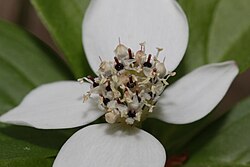
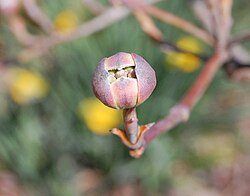
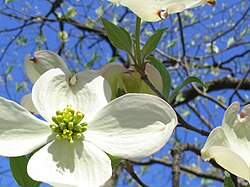
The flowers typically consist of four parts. In species like the flowering dogwood (Cornus florida), the actual flowers are tiny and tightly clustered, lacking showy petals; instead, they are framed by four to six large, typically white bracts that mimic petals.
Horticulture and Environmental Use
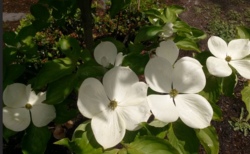
Dogwoods are staples of American landscaping. Cornus florida is ubiquitous in gardens, though it struggles to flower in Northwest Europe due to the lack of extreme seasonal temperature swings. Other species are stoloniferous (spreading via runners) and thrive in wet habitats or along waterways. These are often used in highway landscaping for their vibrant red or yellow winter stems, such as Cornus stolonifera.
The Royal Horticultural Society has granted the Award of Garden Merit to several cultivars, including 'Eddie's White Wonder', 'Norman Hadden', 'Ormonde', and 'Porlock'.
Practical Applications
Woodworking and Industry
Dogwood timber is highly prized for its density (0.79) and fine grain. Because it is exceptionally hard and strong, it is used for specialized items such as loom shuttles, tool handles, and roller skates. Artisans also use it for walking canes, arrow making, and mountain dulcimers. In sports, it serves as an excellent substitute for persimmon in the heads of certain golf clubs and was used in the early production of laminated tennis rackets.
Food and Medicine
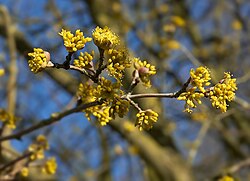
The Cornus mas species is cultivated in southeastern Europe for its edible, carnelian-colored berries, which are processed into preserves and syrups. Additionally, the bark of various Cornus species is rich in tannins and has been utilized in traditional medicine as a substitute for quinine.
Classification and Species
Modern molecular phylogeny recognizes a single inclusive genus Cornus divided into several subgenera. These are generally categorized by their fruit color and floral structure.
| Group | Fruit Characteristics | Key Examples | Native Range |
|---|---|---|---|
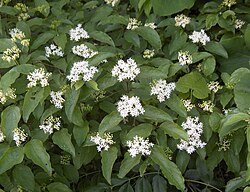
| Blue/White-fruited | Globose; white, blue, or black | C. alba, C. sericea | N. America, Eurasia |
| Cornelian Cherries | Oblong; red | C. mas, C. officinalis | Mediterranean, Asia |
| Big-bracted | Oblong; red | C. florida, C. kousa | N. America, Asia |
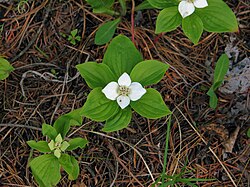
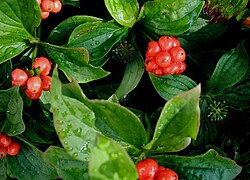
| Dwarf Dogwoods | Globose; red | C. canadensis, C. suecica | Boreal N. America/Eurasia |
Notable species include the common dogwood (Cornus sanguinea) of Eurasia, the Pacific dogwood (Cornus nuttallii) of western North America, and the Kousa dogwood (Cornus kousa) of eastern Asia.
Dwarf Species
The genus also includes rhizomatous herbs known as bunchberries. Cornus canadensis and Cornus suecica are low-growing boreal species found in northern latitudes.
Frequently Asked Questions
Are the white "petals" on a flowering dogwood actually petals?
No, the large white structures are actually bracts, which are modified leaves. The true flowers are the tiny, inconspicuous clusters located at the center of these bracts.
What makes dogwood wood valuable?
Dogwood is highly valued for its extreme density and fine grain, making it ideal for items that require strength and durability, such as tool handles, loom shuttles, and golf club heads.
Which dogwood species produces edible fruit?
Cornus mas, the European cornel, produces edible red berries known as cornelian cherries, which are frequently used in syrups and preserves.
Where are dogwoods naturally found?
They are native to much of temperate and boreal Eurasia and North America, with particularly high species diversity in China, Japan, and the southeastern United States.
Can dogwoods be used for medicinal purposes?
Yes, in traditional medicine, the bark of Cornus species has been used as a substitute for quinine due to its high tannin content.