Core-Based Statistical Areas: Defining US Metropolitan and Micropolitan Regions
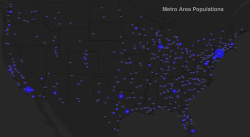
To accurately analyze demographic trends and economic activity, the U.S. Office of Management and Budget (OMB) utilizes a standardized system of Core-Based Statistical Areas (CBSAs). These regions, composed of counties and county equivalents, provide a consistent framework for understanding how people live, work, and move across the United States and Puerto Rico.
How CBSAs are Defined
A CBSA is built around an urban area, which is defined as a central contiguous region with a relatively high population density. The structure of a CBSA is divided into two primary types of counties:
- Central Counties: These are counties that contain the core urban area. To qualify, at least 50% of the county's population must reside in urban areas with a population of 10,000 or more.
- Outlying Counties: These are surrounding counties that maintain strong social and economic ties to the central counties. A county is included as an outlying area if 25% of its residents work in the central county, or if 25% of its total employment is held by workers commuting from the central county.
When the central counties of one CBSA meet the criteria to be an outlying county of another, the adjacent areas are merged into a single CBSA. Furthermore, multiple CBSAs can be grouped into a Combined Statistical Area (CSA) if their Employment Interchange Measure (EIM)—a metric of workforce movement—reaches 15% or higher.
![An enlargeable map of the 935 core-based statistical areas (CBSAs) of the United States and Puerto Rico as of 2023; the 393 MSAs are shown in green.[6]](/images/48/be/48becfed7c536d0ed228a31c99759e6548c0b323c4235cbbf1b71a083cb3d345.jpg)
Types of Statistical Areas
CBSAs are categorized based on the size of their core urban population. This distinction helps policymakers and researchers differentiate between major urban hubs and smaller regional centers.
Metropolitan Statistical Areas (MSAs)
An MSA is formed around an urban area with a population of at least 50,000. In some cases, an MSA may consist of several smaller cities that each have fewer than 50,000 people but collectively exceed that threshold. For exceptionally large MSAs with populations over 2.5 million, the OMB may further subdivide the region into metropolitan divisions.
Micropolitan Statistical Areas (μSAs)
A Micropolitan Statistical Area is a CBSA centered around an urban area that has at least 10,000 residents but fewer than 50,000.
Key Facts
- Governing Body: The Office of Management and Budget (OMB) is responsible for delineating these areas.
- Latest Update: The most recent revised delineations of CBSAs were released on July 21, 2023.
- Population Thresholds: MSAs require a core of 50,000+ people; μSAs require between 10,000 and 49,999.
- Outlying Criteria: A 25% commuting or employment link is required for a county to be considered "outlying."
- CSA Threshold: A Combined Statistical Area requires an Employment Interchange Measure (EIM) of 15% or more.
| Area Type | Core Population Requirement | Composition |
|---|---|---|
| Metropolitan (MSA) | 50,000 or more | Central counties + Outlying counties |
| Micropolitan (μSA) | 10,000 to 49,999 | Central counties + Outlying counties |
| Combined (CSA) | N/A (Based on EIM) | Grouped CBSAs (15%+ EIM) |
Frequently Asked Questions
What is the difference between an MSA and a μSA?
The primary difference is the population of the core urban area. Metropolitan Statistical Areas (MSAs) have a core population of 50,000 or more, while Micropolitan Statistical Areas (μSAs) have a core population between 10,000 and 49,999.
How are outlying counties determined?
Outlying counties are added to a CBSA if there is a strong economic tie to the central county, specifically if 25% of the county's workers commute to the central county or 25% of the county's jobs are filled by people living in the central county.
What is a Combined Statistical Area (CSA)?
A CSA is a larger statistical entity formed by grouping two or more CBSAs together when the Employment Interchange Measure (EIM) between them is 15% or higher.
Were there any recent changes to the MSA population threshold?
In January 2021, the OMB proposed increasing the minimum population for an MSA from 50,000 to 100,000. However, the OMB ultimately decided to maintain the 50,000 threshold for the 2020 cycle.
What are SMSAs and PMSAs?
Standard Metropolitan Statistical Areas (SMSA) and Primary Metropolitan Statistical Areas (PMSA) are previous terms used to describe these regions that are no longer in use.