Convergent Evolution: How Nature Independently Solves Life's Challenges
In the vast tapestry of life on Earth, nature often arrives at the same solution multiple times. This phenomenon, known as convergent evolution, occurs when species from different evolutionary lineages independently develop similar features. These similarities are not inherited from a common ancestor but are instead functional responses to similar environmental pressures or lifestyles.
When organisms develop these shared traits, they create analogous structures—features that serve a similar purpose and may look alike but have different evolutionary origins. This process is also referred to in cladistics as homoplasy.
![Homology and analogy in mammals and insects: on the horizontal axis, the structures are homologous in morphology, but different in function due to differences in habitat. On the vertical axis, the structures are analogous in function due to similar lifestyles but anatomically different with different phylogeny.[a]](/images/34/66/346630cdbabc6100ffed879d5387c74e323a935c383950e93f8a3d2973ead105.webp)
Key Distinctions in Evolutionary Biology
To understand how life evolves, it is essential to distinguish between the different ways traits can be shared across species. While convergence focuses on similarity through different paths, other processes describe different relationships.
Homology vs. Analogy
The difference between homologous and analogous structures is a cornerstone of evolutionary study. Homologous structures are traits that share a common ancestral origin, even if they now serve different functions. For example, the forelimbs of birds, bats, and pterosaurs are homologous because they are derived from a shared ancestral limb structure. However, as organs of flight, they are analogous because each group evolved the ability to fly independently.
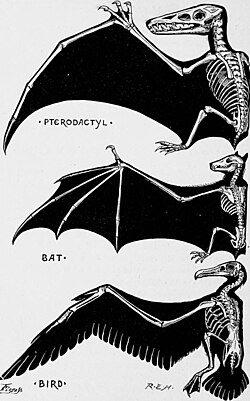
Convergent vs. Parallel Evolution
Convergent evolution is often compared to parallel evolution. In parallel evolution, two independent species evolve in the same direction and acquire similar characteristics, often because they are starting from a similar biological baseline. An example includes various types of tree frogs that have independently evolved gliding capabilities.
In contrast, divergent evolution is the opposite of convergence; it occurs when closely related species evolve increasingly different traits, often as they adapt to different environments.
Convergence at the Molecular and Structural Level
Convergence is not limited to large-scale physical traits like wings or fins; it also occurs at the microscopic level within proteins and DNA.
Protein and Amino Acid Evolution
At the molecular level, different species may undergo convergent evolution at specific amino acid positions within a protein. This means that despite different genetic histories, two species might end up with the same amino acid at a critical functional site to solve a biological problem.

This can extend to complex tertiary structures—the three-dimensional shapes of proteins. A striking example is found in proteases (enzymes that break down proteins). Different protease superfamilies have independently evolved similar catalytic triads—specific arrangements of amino acids that facilitate chemical reactions.
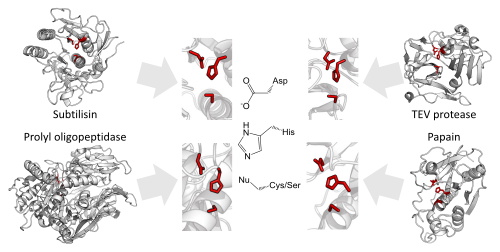
Examples Across the Tree of Life
Convergent evolution is visible across almost every kingdom of life, from the depths of the ocean to the smallest flowering plants.
Animals: Body Plans and Specialized Abilities
- Marine Adaptations: Dolphins and ichthyosaurs (extinct marine reptiles) converged on similar body shapes optimized for fast swimming.
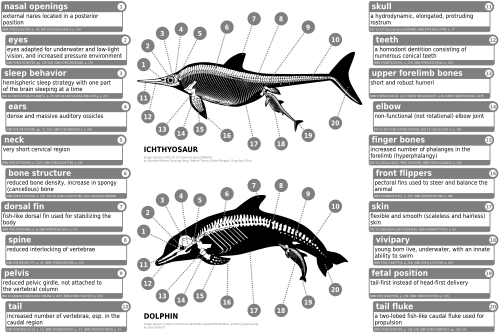
Dolphins and ichthyosaurs converged on many adaptations for fast swimming. - Vision: The camera-type eyes of vertebrates and cephalopods (such as octopuses) developed independently. While they function similarly, their internal wiring is different; for instance, the vertebrate retina is wired in a way that creates a blind spot.
![The camera eyes of vertebrates (left) and cephalopods (right) developed independently and are wired differently; for instance, optic nerve (3) fibres (2) reach the vertebrate retina (1) from the front, creating a blind spot (4).[44]](/images/06/ae/06ae89c17b784cd53e9589ec0b6e9b807c23443854d8269b6a280687a7828d57.webp)
The camera eyes of vertebrates (left) and cephalopods (right) developed independently and are wired differently; for instance, optic nerve (3) fibres (2) reach the vertebrate retina (1) from the front, creating a blind spot (4).[44] - Echolocation: Both certain bats and dolphins have evolved the ability to use sound for navigation and hunting.
- Electric Organs: Weakly electric fishes in South America (gymnotiforms) and Africa (mormyrids) have independently evolved the ability to generate electric fields for electrolocation.
Plants: Survival Strategies
Plants demonstrate remarkable convergence in how they manage energy and reproduction:
- Carbon Fixation: The development of C4 photosynthesis has occurred repeatedly across various plant lineages as an adaptation to specific environmental conditions.
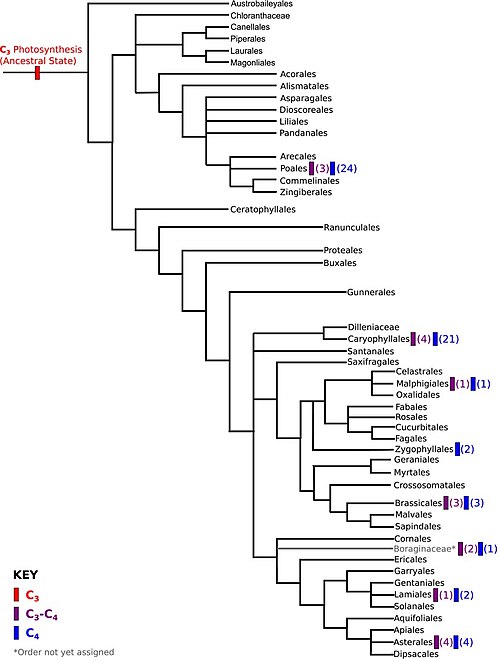
Angiosperm phylogeny of orders based on classification by the Angiosperm Phylogeny Group. The figure shows the number of inferred independent origins of C3-C4 photosynthesis and C4 photosynthesis in parentheses. - Carnivory: Various plant groups have independently evolved the ability to trap and digest insects to supplement their nutrient intake.
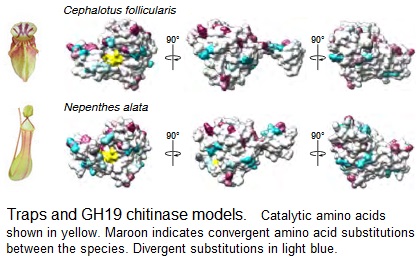
Molecular convergence in carnivorous plants - Seed Dispersal: Some plants use myrmecochory, where seeds with specialized oil bodies (elaiosomes) are dispersed by ants.

In myrmecochory, seeds such as those of Chelidonium majus have a hard coating and an attached oil body, an elaiosome, for dispersal by ants.
Summary of Evolutionary Concepts
| Term | Definition | Relationship to Ancestor |
|---|---|---|
| Convergent Evolution | Independent evolution of similar traits in different lineages. | Traits were not present in the last common ancestor. |
| Divergent Evolution | Related species evolving different traits. | Traits move away from the ancestral state. |
| Homology | Similarity due to shared ancestry. | Traits are derived from a common ancestor. |
| Analogy | Similarity due to similar function/environment. | Traits evolved independently (Homoplasy). |
Frequently Asked Questions
What is the main difference between homology and analogy?
Homology refers to traits that are similar because they were inherited from a common ancestor (like the bones in a human arm and a bat wing). Analogy refers to traits that are similar in function but evolved independently (like the wings of a bird and the wings of a butterfly).
Is convergent evolution predictable?
While evolution involves chance, convergent evolution shows that certain biological solutions are highly effective for specific environmental challenges, leading different species to arrive at similar functional outcomes.
Can convergence happen at a genetic level?
Yes. Convergent evolution can occur at the molecular level, where different species evolve similar amino acid sequences or protein structures to perform specific biological tasks.
How does parallel evolution differ from convergent evolution?
Parallel evolution involves related species evolving similar traits independently, often using similar genetic pathways. Convergent evolution typically involves more distantly related species arriving at similar solutions from different starting points.
Why do plants undergo convergent evolution?
Plants often face similar environmental pressures, such as limited nitrogen or varying CO2 levels. This leads to the repeated, independent evolution of traits like C4 photosynthesis or carnivory to improve survival and efficiency.