Continental Congress: The Provisional Government of Early America
Before the United States had a formal Constitution, it was governed by a series of legislative bodies known as the Continental Congress. Acting as the provisional government for the Thirteen Colonies and the nascent United States, this body navigated the perilous transition from British colonial rule to sovereign independence. From the first sparks of rebellion to the establishment of a federal government, the Continental Congress provided the essential political structure required to wage a war and build a nation.
While often discussed as a single entity, the Continental Congress actually evolved through three distinct phases: the First Congress, the Second Congress, and the Congress of the Confederation. For much of its existence, it operated out of Philadelphia, though the chaos of the Revolutionary War frequently forced it to relocate to maintain safety and continuity.
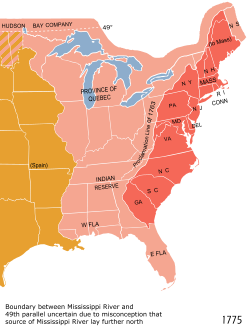
Key Facts
- Three Phases: Comprised the First Continental Congress (1774), the Second Continental Congress (1775–1781), and the Congress of the Confederation (1781–1789).
- Foundational Documents: Adopted the Declaration of Independence (1776) and the Articles of Confederation (1781).
- Military Leadership: Established the Continental Army and appointed George Washington as its commander.
- High Turnover: Maintained a deliberate policy of term limits, with an average delegate turnover rate of 37% to 39%.
- Capital Shifts: Primarily met in Philadelphia, but also convened in Baltimore, Lancaster, York, Princeton, Annapolis, Trenton, and New York City.
The Road to Rebellion: Background and Catalysts
The concept of a unified colonial body first emerged in 1754 during the Albany Congress, where Benjamin Franklin proposed a confederation to coordinate defense during the French and Indian War. Although initially rejected, the seed of colonial cohesion was planted.
Tensions escalated in 1765 when the British Parliament passed the Stamp Act, requiring revenue stamps on printed materials. This led to the Stamp Act Congress in New York City, where delegates issued a Declaration of Rights and Grievances. While the Stamp Act was eventually repealed, subsequent legislation—such as the Townshend Acts and the Tea Act—further inflamed colonial resentment. These tensions culminated in the Boston Tea Party of 1773 and the subsequent Intolerable Acts, which served as the immediate trigger for the First Continental Congress.
The First Continental Congress (1774)
Convening in September 1774 at Carpenter's Hall in Philadelphia, the First Continental Congress brought together 56 delegates from twelve of the thirteen colonies (Georgia did not attend). Led by President Peyton Randolph, the body sought to repair the relationship with Britain while asserting colonial rights.
The Congress established the Continental Association, a unified trade embargo against Great Britain. While the First Congress did not seek independence, it built the necessary consensus to reconvene if grievances remained unaddressed.
The Second Continental Congress (1775–1781)
The Second Continental Congress met on May 10, 1775, shortly after the outbreak of hostilities in Massachusetts. This body functioned as a de facto government, managing the war effort by raising armies, appointing diplomats, and negotiating treaties.
Initially, the Congress attempted a peaceful resolution via the Olive Branch Petition sent to King George III. However, the King's Proclamation of Rebellion in August 1775 convinced many delegates that independence was the only path forward. On July 2, 1776, the body adopted the Lee Resolution for Independence, followed by the formal approval of the Declaration of Independence on July 4, 1776, drafted primarily by Thomas Jefferson.
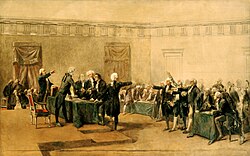
Military and Administrative Actions
Beyond diplomacy, the Second Congress took critical operational steps to ensure the survival of the revolution:
- Established the Continental Army (June 14, 1775) and appointed George Washington as commander.
- Created the Continental Navy (October 13, 1775) and the Continental Marines (November 10, 1775).
- Defined the design of the United States flag via the Flag Resolution on June 14, 1777.
The Congress of the Confederation (1781–1789)
In March 1781, the Articles of Confederation and Perpetual Union came into force, transforming the body into the Congress of the Confederation. This unicameral (single-chamber) government served as the first official federal government of the United States.
During this period, the Congress achieved several landmark successes. It chartered the Bank of North America in 1781 to finance the war and negotiated the Treaty of Paris (1783), which secured official British recognition of American independence. It also passed the Northwest Ordinance in 1787 to manage western territories.
However, the limitations of the Articles of Confederation eventually led to the Philadelphia Convention of 1787. This convention resulted in the drafting of the U.S. Constitution, which replaced the Confederation Congress with the 1st United States Congress in March 1789.
Summary of the Continental Congress Phases
| Phase | Period | Primary Goal | Key Outcome |
|---|---|---|---|
| First Continental Congress | 1774 | Redress grievances with Britain | Continental Association (Embargo) |
| Second Continental Congress | 1775–1781 | Manage Revolutionary War | Declaration of Independence |
| Congress of the Confederation | 1781–1789 | Establish first federal government | Treaty of Paris & Northwest Ordinance |
Frequently Asked Questions
What was the difference between the First and Second Continental Congresses?
The First Continental Congress (1774) focused on petitioning the King and organizing a trade embargo to avoid war. The Second Continental Congress (1775) convened after war had already begun and took active steps to manage the military and eventually declare independence.
Why did the Congress move to different cities?
The Congress moved primarily for safety. When the British captured Philadelphia during the Revolutionary War, the delegates were forced to relocate to cities like Baltimore, Lancaster, and York to avoid capture.
Who were some of the most notable delegates?
Notable attendees included George Washington, Benjamin Franklin, John Adams, Samuel Adams, Patrick Henry, and Thomas Jefferson.
How did the Congress of the Confederation differ from the current U.S. Congress?
The Congress of the Confederation was a unicameral body operating under the Articles of Confederation, which gave it significantly less power than the current bicameral (House and Senate) Congress established by the U.S. Constitution.
What was the purpose of the term limits for delegates?
The Congress implemented a deliberate policy of term limits—specifically during the Confederation phase, where no delegate could serve more than three years in any six—to prevent the concentration of power and ensure rotating representation.