Conserved Signature Indels (CSIs) in Protein Sequences and Phylogenetic Analysis
In the study of evolutionary biology, determining the precise relationship between different species requires reliable molecular markers. While 16S rRNA sequencing has long been the standard, Conserved Signature Indels (CSIs) in protein sequences have emerged as a powerful tool for refining phylogenetic trees. CSIs are specific insertions or deletions of amino acids that occur within highly conserved regions of a protein.
Unlike arbitrary indels, CSIs are defined by their presence within conserved protein regions and are flanked by stable sequences, ensuring their reliability as markers. Because these genetic changes are rare, they are unlikely to occur independently through convergent or parallel evolution (a phenomenon known as homoplasy). Instead, they typically represent synapomorphy—shared derived characters that indicate a common evolutionary descent.
Key Facts
- Definition: CSIs are protein insertions or deletions located specifically within conserved regions.
- Reliability: Their rarity makes them less susceptible to homoplasy compared to other molecular markers.
- Application: They are used to identify known and unknown species and to resolve branching orders in phylogenetic trees.
- Rooting: By comparing CSIs with an out-group species, researchers can determine if the ancestral state was an insertion or a deletion.
- Efficiency: CSI-based circumscriptions are often computationally cheaper and more concrete than varying tree-branching methods.
Types of Conserved Signature Indels
Group-Specific CSIs
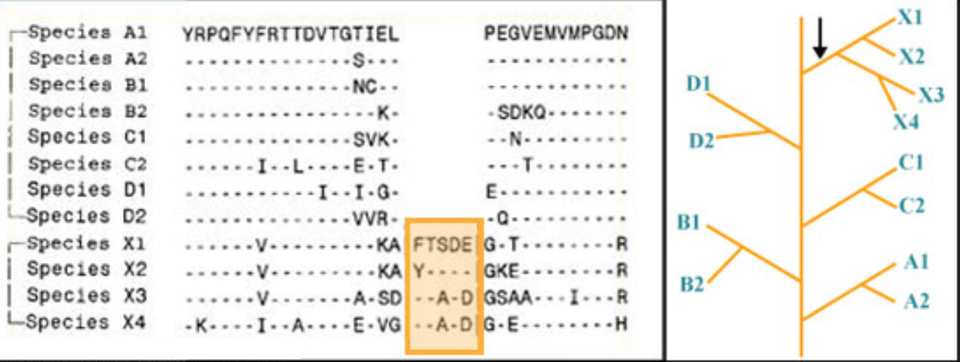
Group-specific CSIs are shared by species within a particular taxon—such as a genus, family, or phylum—but are absent in all other groups. These markers were likely introduced in a common ancestor before the members of that taxon diverged, providing a molecular means to distinguish a specific group from all other organisms.
For example, a 5-amino acid (aa) CSI may be found exclusively in all species of a specific taxon, serving as a distinctive characteristic of that group.
Multi-group or Mainline CSIs
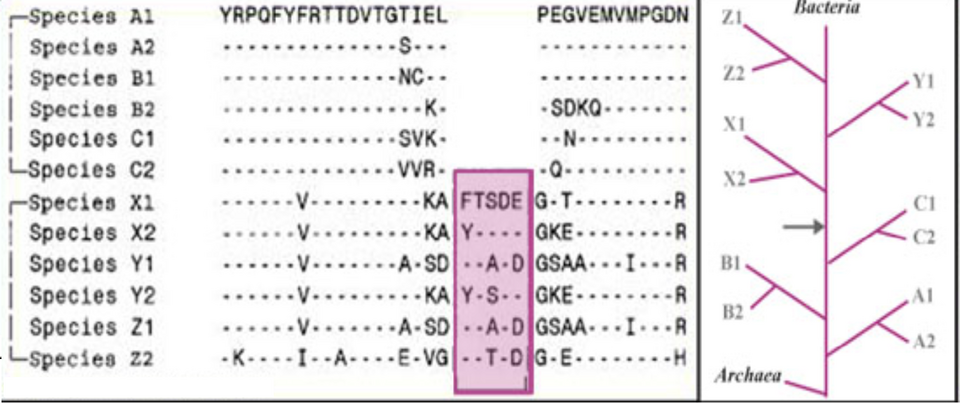
Mainline CSIs are shared across several major phyla but remain absent in others. These markers help reveal broader relationships between different taxa. By analyzing these indels in out-group species (such as Archaea), scientists can infer which groups are ancestral and which are derived.
An example is a 5aa CSI shared by phyla X, Y, and Z, but absent in phyla A, B, and C, indicating a specific evolutionary link between the former group.
CSI Applications in Evolutionary Studies
Traditional phylogenetic trees based on single genes often struggle to resolve complex branching orders. The analysis of CSIs in universally distributed proteins provides a more certain way to understand how bacterial species diverged from common ancestors.
| Taxon/Group | CSI Findings | Phylogenetic Significance |
|---|---|---|
| Thermotogota | Over 60 CSIs identified; 18 unique to the phylum. | Distinguishes phylum from all other bacteria; resolves subgroups. |
| Archaea (Nitrososphaerota) | 6 unique CSIs in Nitrososphaerota. | Distinguishes Nitrososphaerota from Thermoproteota. |
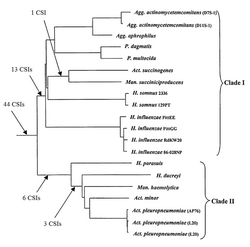
| Pasteurellales | Over 40 CSIs; 13 for Clade I, 9 for Clade II. | Supports dividing the order into two different families. |
| Gammaproteobacteria | 4 unique CSIs for the class; 4 exclusive to Xanthomonadales. | Identifies Xanthomonadales as a deep-branching, ancestral lineage. |
Case Study: Thermotogota
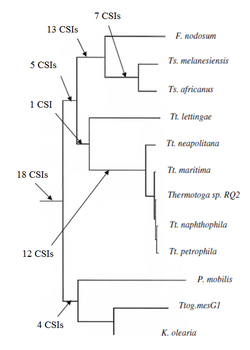
The phylum Thermotogota was previously difficult to distinguish from other bacteria. Researchers discovered 18 CSIs unique to the phylum and several others specific to subgroups. For instance, 14 CSIs were specific to the Fervidobacterium and Thermosipho genera. While some CSIs were shared with other taxa (possibly due to lateral gene transfer), the overwhelming number of specific CSIs clearly defines the phylum.
Case Study: Archaea
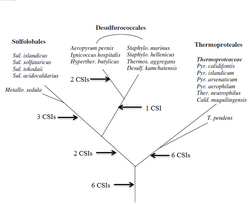
To distinguish the phylum Nitrososphaerota from Thermoproteota, researchers identified 6 unique CSIs in Nitrososphaerota species, including Cenarchaeum symbiosum and Nitrosopumilus maritimus. Additional CSIs were found for specific orders, such as Sulfolobales (3 CSIs) and Thermoproteales (5 CSIs), providing a new tool for classification.
Case Study: Pasteurellales and Gammaproteobacteria
In the order Pasteurellales, the discovery of over 40 CSIs led to the identification of two major clades, suggesting the order should be split into two families. In the class Gammaproteobacteria, CSI analysis revealed that the order Xanthomonadales is a monophyletic group and one of the earliest diverging lineages within the class.
Potential Complications in CSI Analysis
While highly reliable, CSI analysis is not without challenges. Horizontal gene transfer (the movement of genetic material between unicellular and/or multicellular organisms) can occasionally introduce CSIs into unrelated groups, though this is typically detectable through broader phylogenetic comparison.
Additionally, convergent evolution can occur, where similar traits evolve independently. A notable example is the 51aa insertion in the SecA translocase protein shared by thermophilic Thermotogales and Aquificales, which phylogenetic evidence suggests evolved convergently rather than through transfer.
Frequently Asked Questions
What is the difference between a standard indel and a CSI?
A standard indel can be any arbitrary insertion or deletion in a sequence. A Conserved Signature Indel (CSI) must specifically occur within a conserved region of a protein, making it a reliable molecular marker for evolution.
Why are CSIs considered more reliable than some other molecular markers?
Because CSIs are rare genetic events, it is highly unlikely they would arise independently in different lineages (homoplasy). This makes them strong evidence for a common ancestor (synapomorphy).
How do CSIs help in rooting a phylogenetic tree?
By checking for the presence or absence of a CSI in an out-group species, researchers can determine whether the ancestral state was an insertion or a deletion, allowing them to establish the root of the evolutionary relationship.
Can CSIs be used to find new species?
Yes. Because CSIs are highly specific to certain clades, they can be used to identify previously unknown species belonging to those groups when analyzing sequences from different environments.
What is the impact of lateral gene transfer on CSI data?
Lateral gene transfer can cause a CSI to appear in unrelated taxa. However, because the number of shared CSIs due to transfer is usually much smaller than those specific to a phylum, they generally do not disrupt the overall phylogenetic distinction.