Con Edison Steam System: Environmental Impact and Safety
The Con Edison steam system is a critical piece of New York City's urban infrastructure, providing essential heating and energy services. While often invisible to the average pedestrian, the system employs complex engineering to balance energy demands with environmental sustainability and public safety.
Energy Efficiency and Environmental Benefits
A significant portion of the system's output is derived from cogeneration, a process where electricity and useful heat are generated simultaneously from a single fuel source. Currently, cogeneration accounts for approximately 30% of the system's installed capacity and 50% of the annual steam generated.
To further enhance efficiency, the system utilizes Heat Recovery Steam Generation (HRSG), which captures waste heat to produce additional steam. These methods significantly increase fuel efficiency, which in turn reduces the emission of pollutants including nitrogen oxides (NOx), sulfur dioxide, carbon dioxide, and particulate matter, effectively lowering the city's overall carbon footprint.
The Shift Toward Trigeneration
Con Edison is currently promoting the use of steam for cooling during summer months through the installation of absorption chillers. This creates a trigeneration system—providing heating, cooling, and electricity. By shifting cooling loads to the steam system, the city can reduce peak electrical loads and avoid the high construction costs associated with expanding the electrical grid.
Visible Infrastructure and Steam Vapor
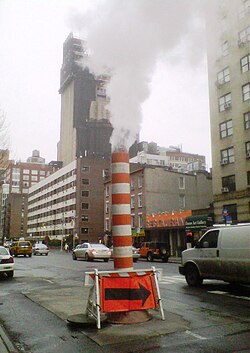
Many New Yorkers are familiar with the plumes of white vapor rising from the streets. This steam vapor is typically caused by leaks in the system or by cooler water coming into contact with the exterior of a hot steam pipe.
To manage this, the vapor is directed through "stacks"—10-foot (3.0 m) orange-and-white funnels that vent from manholes. These iconic structures have become staples of New York City's visual identity, appearing frequently in films and television shows.
Safety Records and Incidents
Despite the system's utility, the high pressure and temperature of the steam pose significant risks. Since 1987, New York City has experienced at least twelve steam pipe explosions.
One of the most significant events occurred in 2018 in the Flatiron District, where an explosion forced the evacuation of 49 buildings. This incident released mud, concrete, asphalt, and asbestos-containing material into the air, though the asbestos was eventually cleaned to safe levels. Other notable incidents include an explosion in 2007 and another on June 28, 1996, at the 74th Street Generating Station.
Beyond explosions, the underground system has seen fatal accidents. In 2002, a person was killed after falling through a manhole into the steam system, and a similar tragedy occurred in 2026 when a woman fell into a manhole while exiting a car in Manhattan.
Key Facts
- Cogeneration Contribution: Provides 50% of annual steam and 30% of installed capacity.
- Pollutant Reduction: HRSG and cogeneration reduce NOx, sulfur dioxide, CO2, and particulate matter.
- Trigeneration: Uses absorption chillers to provide summer cooling and reduce electrical peak loads.
- Venting: Steam is released via 10-foot orange-and-white stacks.
- Safety History: At least 12 pipe explosions recorded since 1987.
| Category | Details | Outcome |
|---|---|---|
| Energy Production | Cogeneration & HRSG | Lower emissions and higher fuel efficiency |
| Summer Cooling | Absorption Chillers | Reduced electrical grid strain |
| Infrastructure | Orange-and-white stacks | Safe venting of steam vapor |
| Safety Risks | Pipe explosions/Manhole falls | Occasional evacuations and fatalities |
Frequently Asked Questions
What is cogeneration in the context of the steam system?
Cogeneration is the simultaneous production of electricity and useful heat from the same fuel source, which increases overall energy efficiency compared to producing them separately.
What are the orange-and-white stacks seen in NYC streets?
These are 10-foot funnels used to vent steam vapor from manholes, caused either by system leaks or cooler water touching hot pipes.
How does trigeneration help the city's electrical grid?
By using absorption chillers to provide cooling via steam, trigeneration reduces the demand for electricity during peak summer months, saving the cost of expanding electrical infrastructure.
What happened during the 2018 Flatiron District explosion?
The explosion forced the evacuation of 49 buildings and released asphalt, concrete, mud, and asbestos-containing material into the air, which was subsequently cleaned to safe levels.
How many steam pipe explosions have occurred since 1987?
There have been at least twelve steam pipe explosions in New York City since 1987.