Commuting Patterns and Their Global Impact on Urban Life
Commuting is the periodically recurring travel between a person's place of residence and their place of work or study. By definition, a commuter is someone who leaves the boundary of their home community to reach their destination. While typically associated with employment, the term can extend to any regular travel between locations. The methods, distances, and time spent commuting vary drastically depending on a region's economic development and infrastructure.
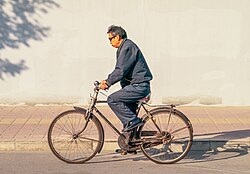
In least-developed countries, walking remains the primary mode of transport. Bicycles offer the next most affordable option and are common in low-income nations, though they are increasingly popular in wealthier countries for health and environmental reasons. Middle-income countries often see a high prevalence of motorcycle commuting. In more developed regions, the choice of transport is often dictated by city age and population; older, populous cities in Eurasia rely heavily on mass transit (rail and bus), whereas younger cities in North America and Australasia are dominated by personal automobiles.
Key Facts
- Super Commuters: Individuals who travel long distances, often enabled by high-speed rail or air travel.
- Urban Sprawl: The process where residential suburbs expand away from the economically focused urban core.
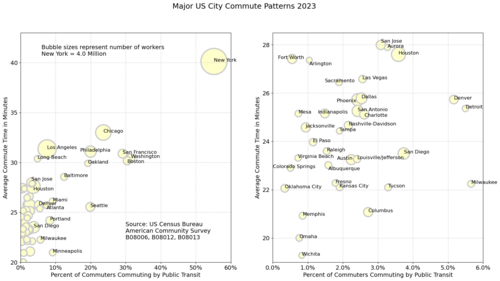
- US Trends: Over 90% of US workers commute by car, with an average commute time of 26.8 minutes (2014 ACS data).
- Gender Gap: Studies indicate women may experience higher psychological stress during commutes than men.
- Environmental Impact: Single-occupancy vehicles are major contributors to air pollution compared to electric rail or carpooling.
The Evolution of the Commute
The separation of home and workplace began with the invention of the steam railway. The term "commuter" originated in 1840s US cities like New York, Boston, Philadelphia, and Chicago, where rail companies offered "commuted" fares—reduced rates for frequent travelers living in emerging suburbs.
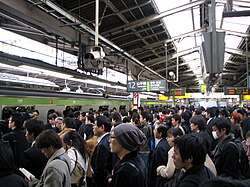
Before the 19th century, most workers lived within a one-hour walk of their jobs. The Industrial Revolution shifted production from homes and rural areas to urban factories, necessitating longer journeys. Today, factors such as high city-center housing costs and traffic congestion drive the variety of transport modes used, from the subways of New York and Tokyo to the freeway grids of Los Angeles.
Suburbs and Urban Dynamics
Commuting has enabled cities to grow beyond previous practical limits, leading to the creation of commuter belts (also known as bedroom communities or dormitory towns). This expansion has created different types of commuters:
- Prototypical Commuter: Lives in a suburb and travels to the urban core.
- Reverse Commuter: Lives in the city core but works in the suburbs.
- Secondary Commuter: Lives in a distant exurb and works in an outlying city or industrial suburb.
This geographic split often creates financial tension between municipalities. Since taxes are typically paid where a person resides, suburbs may collect revenue from economic activity that actually occurs in the central city, while the commuters continue to use the city's public infrastructure.
Environmental and Social Implications
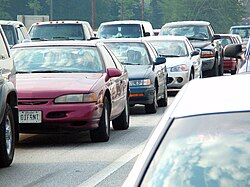
The timing of commutes leads to rush hours, creating peak demands that often overwhelm road and transit systems. In Southern California, for example, commuters on Interstate 405 may face delays of up to two hours due to congestion or accidents.
From an environmental perspective, single-occupant cars are inefficient and increase air pollution. While electric rail options like trams and subways drastically reduce overall emissions, underground stations can still suffer from localized pollution caused by particulate matter from the wear and tear of brakes and rails.
Socially, commuting impacts different demographics uniquely. A 2009 UK study found women suffered four times more psychological stress from commuting than men, while research in Mangalore, India, highlighted that women often feel scared to travel alone at night, necessitating gender-sensitive road safety policies.
Commuting in Education
In the United States, institutions with limited student housing are known as commuter schools, a category that includes many community colleges. The number of commuting students has risen sharply; by 2009, approximately 85% of US college students commuted. In Canada, a study of 10 universities found that 61% of students viewed their commute as a challenge to campus participation, and 30% saw it as a barrier to academic success.
| Category | Key Metric / Detail | Context |
|---|---|---|
| Avg. US Commute Time | 26.8 Minutes | 2014 American Community Survey |
| Longest US Commute | 33.4 Minutes | Construction and Mining sector |
| Shortest US Commute | 21 Minutes | Military personnel |
| US Transport Mode | >90% Car / ~5% Public Transit | General workforce |
| US College Students | 85% Commute | As of 2009 |
Frequently Asked Questions
What is a "super commuter"?
A super commuter is someone who travels exceptionally long distances for work, often utilizing high-speed rail or air travel, sometimes commuting on a weekly basis rather than daily.
How did the term "commuter" originate?
The term comes from the 1840s in US cities where railway passengers paid a "commuted" (reduced) fare for regular travel between the new suburbs and the city center.
What is a reverse commute?
A reverse commute occurs when a person lives in the central urban core of a city but travels outward to work in the suburbs or outlying areas.
Why do some people have to commute long distances?
Commuting is often driven by a scarcity of local employment or insufficient local wages, forcing workers to search for jobs in the nearest metropolitan area to sustain their households.
What are the environmental downsides of car commuting?
Cars carrying only one person use fuel and road space inefficiently, contributing significantly to traffic congestion and air pollution.