Columbia University: A Legacy of Academic Excellence in New York City
Founded in 1754, Columbia University stands as one of the world's most prestigious private research institutions. Located in the heart of New York City, it blends a rich colonial history with a forward-looking approach to global research and education. From its origins as a royal college to its current status as a powerhouse of the Ivy League, Columbia continues to shape leaders in law, medicine, journalism, and the arts.
Key Facts
- Established: May 25, 1754, by King George II of Great Britain.
- Endowment: $15.9 billion (as of 2025).
- Student Population: 36,649 total students (9,761 undergraduates and 26,888 postgraduates).
- Academic Standing: Member of the Association of American Universities (AAU) and the Ivy League.
- Campus Size: 299 acres across various New York City locations.
- Motto: In lumine Tuo videbimus lumen ("In Thy light shall we see light").
Historical Evolution
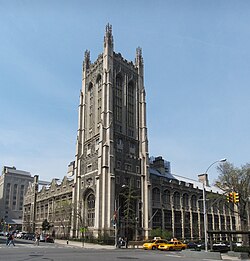
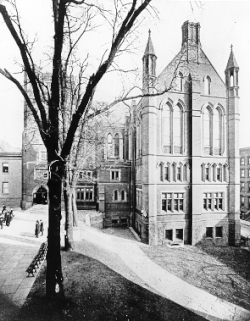
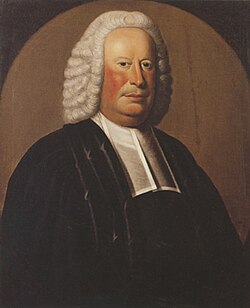
Columbia's journey began as King's College, operating under that name from 1754 to 1784. Following the American Revolution, it was renamed Columbia College, a title it held until 1896 when it transitioned into a full university. The institution's early years were marked by its presence at Trinity Church and later at Park Place.
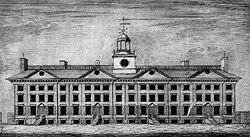
![The 1797 Taylor Map of New York City, showing "The Colledge [sic]" at its Park Place (then Robinson Street) location and its earlier location, Trinity Church, on the lower left](/images/70/e4/70e4e1bb71872dc838bf9e7b33637570fb6093079687c27a0f063abc16b1e559.jpg)
Throughout the 20th and 21st centuries, the university expanded its footprint and academic scope. A significant era of growth occurred during the presidency of Lee Bollinger (2002–2023), which saw the university further cement its global influence and expand its physical campus.
Campus and Facilities
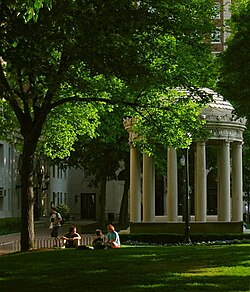
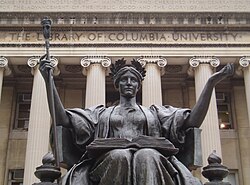
The primary hub of university life is located in Morningside Heights, characterized by its iconic architecture and academic atmosphere. Central to this campus is the Low Memorial Library and the famous Alma Mater statue by Daniel Chester French.
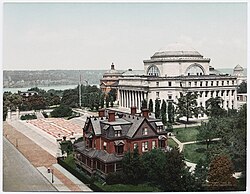
The campus is designed for both study and community, featuring the scenic College Walk and the massive Butler Library. Beyond Morningside Heights, Columbia maintains several other specialized campuses, including the College of Physicians and Surgeons in Washington Heights and the Lamont Campus in Palisades, New York.
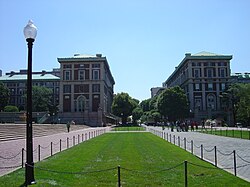
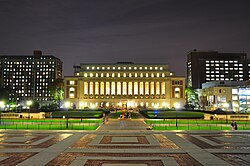
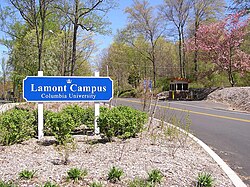
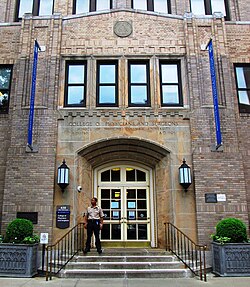
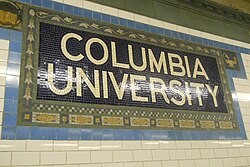
Transportation is a key component of the campus experience, with the 116th Street–Columbia University subway station providing direct access to the city via the IRT Broadway–Seventh Avenue Line.
Notable Landmarks and Research Hubs
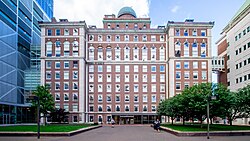
The university is home to several historic and scientifically significant buildings. Havemeyer Hall is recognized as a National Historic Chemical Landmark, notably serving as the site where deuterium was discovered in 1931 and contributing to seven Nobel Prizes in Chemistry. Pupin Hall serves as the center for physics, featuring the Rutherfurd Observatory on its roof.
![Havemeyer Hall, a National Historic Chemical Landmark, where deuterium was discovered in 1931. Research conducted in Havemeyer has been recognized with seven Nobel Prizes in Chemistry.[205]](/images/70/18/7018c1265f47fe0da565afb76c4061674e7785ec2684844e5fe6fd4edd9d9659.jpg)
Academic Organization and Rankings

Columbia is organized into a diverse array of undergraduate and graduate schools, covering nearly every major field of study. The university is consistently ranked among the top institutions globally, particularly excelling in meteorology, geosciences, and social work.
| School/College | Year Founded | Type |
|---|---|---|
| Columbia College | 1754 | Undergraduate |
| College of Physicians and Surgeons | 1767 | Professional |
| Columbia Law School | 1858 | Professional |
| Fu Foundation School of Engineering and Applied Science | 1864 | Undergraduate/Graduate |
| Graduate School of Journalism | 1912 | Professional |
| Columbia Business School | 1916 | Professional |
| Columbia Climate School | 2020 | Professional |
The university's commitment to excellence is reflected in its rigorous admissions process. For the 2021 entering class, the admit rate was 3.9%, with a middle 50% SAT score range of 1510–1560.
Student Life and Culture
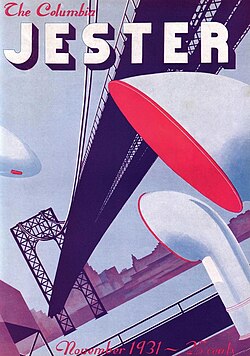
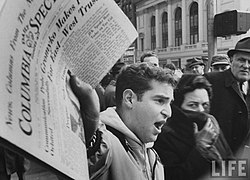
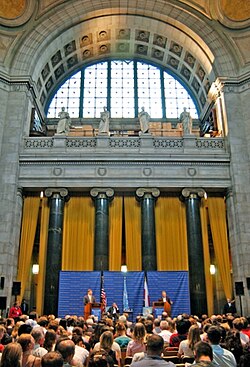
Student life at Columbia is a blend of high-intensity academics and vibrant extracurricular activity. The Columbia Daily Spectator serves as the primary student newspaper, while the World Leaders Forum brings global dignitaries to Low Memorial Library for high-level discourse.
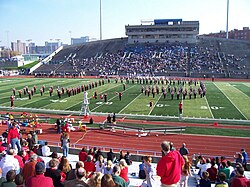
The university also fosters a strong athletic tradition as a member of the Ivy League. The Columbia Lions compete in various sports, with football played at the Robert K. Kraft Field at Lawrence A. Wien Stadium.
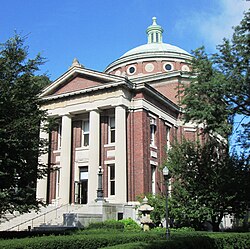
Campus culture is also shaped by its history of activism and social engagement, as seen in various student-led movements and the presence of organizations like the Columbia Queer Alliance, which met in the historic Earl Hall.
![A tent in the Gaza Solidarity Encampment (April 17-30, 2024), part of a broader protest movement at the university during the Gaza war and genocide, April 17, 2024.[119][120]](/images/5b/44/5b445a953902f1bf59f901f831dc2a8235811b66a5217b7d7ff0e54a1055aa73.jpg)
Notable Alumni and Faculty
Columbia has produced some of the most influential figures in history across politics, law, and the arts. Notable alumni include:
- Franklin D. Roosevelt: 32nd U.S. President (Law School).
- Amelia Earhart: Pioneering aviator (School of General Studies).
- Langston Hughes: Harlem Renaissance poet (School of Engineering and Applied Science).
- Neil Gorsuch: U.S. Supreme Court Associate Justice (Columbia College).
- J.D. Salinger: Author of The Catcher in the Rye (School of General Studies).

Frequently Asked Questions
When was Columbia University founded and by whom?
Columbia University was founded on May 25, 1754, by King George II of Great Britain, originally under the name King's College.
What are the university's official colors and mascot?
The official colors of the university are Columbia blue and white, and the mascot is Roar-ee the Lion.
Which academic rankings does Columbia hold?
Columbia is consistently ranked as a top-tier global university, appearing in the top 10 of the ARWU and U.S. News & World Report global rankings, and holding high national rankings in programs such as Social Work (4th) and Public Health (6th).
What is the significance of Havemeyer Hall?
Havemeyer Hall is a National Historic Chemical Landmark where deuterium was discovered in 1931. Research conducted within the building has been recognized with seven Nobel Prizes in Chemistry.
How selective is the undergraduate admission process?
Columbia is highly selective; for example, the 2021 entering class had an admit rate of 3.9%.