Coat of Arms of Argentina: History, Symbolism, and Meaning
The Coat of Arms of the Argentine Republic (Spanish: Escudo de la República Argentina) serves as a powerful visual representation of the nation's identity, sovereignty, and aspirations. While its current official form was established in 1944, its roots stretch back to the early days of the country's struggle for independence.
The emblem is more than a formal seal; it is a collection of symbols that tell the story of a nation rising from colonial rule to establish a society based on unity and freedom.
Key Facts
- Official Adoption: Current form adopted in 1944, based on the 1813 seal.
- Origins: Derived from the seal of the General Constituent Assembly of 1813.
- Core Symbols: The Sun of May, shaking hands, a pike, and a Phrygian cap.
- National Motto: En unión y libertad ("In unity and freedom").
- Colors: Azure (blue) and argent (white), mirroring the national flag.
Historical Evolution
The origins of the Argentine shield are tied to the General Constituent Assembly of 1813. It is believed the design was adopted quickly due to a decree signed on February 22, 1813, which already featured the symbol as a seal. By March 12 of that year, it was mandated that the executive power—specifically the second triumvirate—use the seal.
The emblem's transition to a national symbol happened rapidly. On April 13, the National Assembly minted new gold and silver coins featuring the seal on the reverse, and by April 27, it was officially recognized as a national emblem.
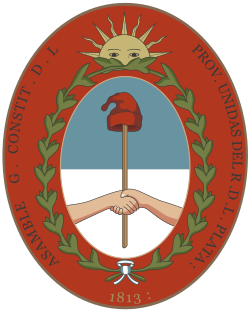
Historically, the coat of arms appeared on various flags during the Argentine War of Independence. For instance, the military leader Manuel Belgrano ordered the emblem to be painted on the flag presented to the city of San Salvador de Jujuy. While it is not featured on the current national flag, it remains a central symbol of state authority.
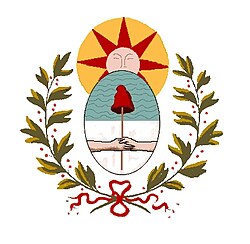
Symbolism and Design
The design of the coat of arms is rich with allegorical meaning, blending classical imagery with the political ideals of the 19th century.
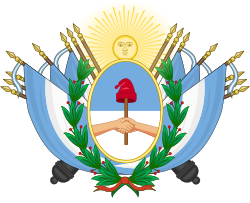
The Sun of May
At the top of the emblem sits the gold-yellowed Sun of May. This symbol, also prominent on the Argentine flag, represents the "rising" of Argentina. This imagery aligns with the first version of the Argentine National Anthem, which describes a "new and glorious nation" rising to the surface of the Earth.
The Central Shield
The shield is divided horizontally into two sections of blue and white, the colors of the Argentine people. These colors were originally used in the cockades during the May Revolution of 1810, drawing inspiration from the colors of the Borbonic dynasty.
In the center, two hands are shown shaking, symbolizing friendship, peace, and the unity of the Argentine provinces. Together, these hands hold a wooden pike, which represents the power and willingness of the people to defend their freedom.
The Phrygian Cap and Laurel
Perched atop the pike is the red Phrygian cap. Historically worn in Phrygia (Anatolia) and later adopted during the French Revolution, the cap is a universal symbol of liberty. It is often confused with the pileus, a cap worn by freed slaves in ancient Rome.
Surrounding the shield are two green sprigs of laurel, tied at the bottom with a blue and white ribbon. The laurel is a classical symbol of triumph and glory, dating back to the crowns awarded to winners of the ancient Olympic Games.
The Philosophy of Unity and Freedom
The arrangement of the elements illustrates the national motto: en unión y libertad ("in unity and freedom"). The visual logic is clear: the shaking hands represent unity; this unity provides the power (the pike) necessary to secure and maintain freedom (the Phrygian cap).
| Element | Visual Description | Symbolic Meaning |
|---|---|---|
| Sun of May | Gold-yellow rising sun | The birth of a new nation |
| Shaking Hands | Two hands joined in a grip | Unity, brotherhood, and peace |
| Pike | Wooden spear/pole | Power and defense of liberty |
| Phrygian Cap | Red conical cap | Freedom and liberty |
| Laurel Sprigs | Green leaves tied with ribbon | Triumph and glory |
| Blue & White | Azure and argent colors | The Argentine people |
Frequently Asked Questions
Who designed the Argentine coat of arms?
The exact designer is unknown. While Alvear, Monteagudo, and Vieytes are often mentioned, President Bernardino Rivadavia had previously asked Antonio Isidoro Castro to create a design; however, those specific schemes have never been found.
What is the difference between a Phrygian cap and a pileus?
The Phrygian cap was traditionally worn by inhabitants of Phrygia in the Anatolian peninsula. The pileus was a specific hat in ancient Rome that symbolized the freedom of slaves, who were touched with a wooden pike by their owners upon being liberated.
Why are blue and white used in the shield?
These colors represent the Argentine people and were derived from the cockades used during the May Revolution of 1810, which in turn were influenced by the colors of the Borbonic dynasty.
Is the coat of arms on the current Argentine flag?
No, the coat of arms is not currently shown on the national flags, although it was common on flags during the Argentine War of Independence.
What does the national motto mean in relation to the symbols?
The motto "in unity and freedom" is visualized through the hands (unity) holding the pike (power), which supports the Phrygian cap (freedom), suggesting that freedom is achieved through unified power.