Coast Guard Station Golden Gate: A History of Maritime Rescue
The waters surrounding the San Francisco Bay and the Pacific coast have long demanded a dedicated presence to ensure the safety of mariners. From the early days of the United States Life-Saving Service to the modern operations of the U.S. Coast Guard, the evolution of rescue stations in this region reflects a commitment to saving lives in one of the world's most challenging maritime environments.
The Origins of Life-Saving Services
The foundation of organized rescue in the area began on June 20, 1877, with the establishment of a life-saving station in Golden Gate Park. This facility served as the inaugural station for the Twelfth District of the United States Life-Saving Service, an organization dedicated to rescuing shipwrecked individuals from the shore.
As the need for comprehensive coverage grew, the Golden Gate Park station was supplemented by four additional strategic locations: Fort Point, Point Reyes, Point Bonita, and Ocean Beach.
Consolidation and the Birth of the Coast Guard
A significant organizational shift occurred in 1915 when the United States Life-Saving Service merged with the United States Revenue Cutter Service. This merger created the United States Coast Guard, combining shore-based rescue with sea-based enforcement and patrol.
Following this merger, the various stations across San Francisco and Marin County were gradually consolidated. These operations were centralized at Fort Point, where the facility became known as Coast Guard Station No. 323.
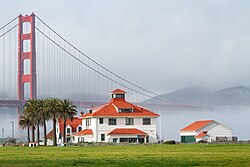
Modern Operations at Station Golden Gate
By 1987, it became clear that the scope of operations needed to expand. Consequently, an agreement was reached to relocate the facility. In 1990, the crews and equipment moved from Fort Point to Fort Baker on Horseshoe Bay, officially becoming Station Golden Gate.
Today, Station Golden Gate stands as the busiest search and rescue (SAR) station on the Pacific coast. The station manages an average of over 600 cases annually, providing a critical safety net for both commercial and recreational vessels.
Geographic Area of Responsibility
The station's jurisdiction is extensive, covering a wide range of treacherous waters. Its responsibilities include:
- The Pacific coast stretching from Point Reyes to Point Ano Nuevo.
- The remote Farallon Islands.
- The waters within San Francisco Bay, spanning from Bluff Point to Pier 39.
Key Facts
- Established: First station opened June 20, 1877, in Golden Gate Park.
- Evolution: Transitioned from the Life-Saving Service to the U.S. Coast Guard in 1915.
- Current Location: Fort Baker on Horseshoe Bay (relocated in 1990).
- Workload: Averages more than 600 search and rescue cases per year.
- Status: The busiest search and rescue station on the Pacific coast.
| Era/Date | Organization | Primary Location |
|---|---|---|
| 1877 | U.S. Life-Saving Service | Golden Gate Park |
| 1915 | U.S. Coast Guard | Fort Point (Station No. 323) |
| 1990 – Present | U.S. Coast Guard | Fort Baker (Station Golden Gate) |
Frequently Asked Questions
When was the first life-saving station established in Golden Gate Park?
The first station was established on June 20, 1877, marking the start of the Twelfth District of the United States Life-Saving Service.
How was the U.S. Coast Guard formed in this region?
The U.S. Coast Guard was formed in 1915 through the merger of the United States Life-Saving Service and the United States Revenue Cutter Service.
Where is Station Golden Gate located today?
Station Golden Gate is currently located at Fort Baker on Horseshoe Bay, having moved from Fort Point in 1990.
What is the current workload of Station Golden Gate?
It is the busiest search and rescue station on the Pacific coast, handling an average of over 600 cases every year.
What areas does Station Golden Gate cover?
Its responsibility extends from Point Reyes to Point Ano Nuevo along the Pacific coast, including the Farallon Islands, and from Bluff Point to Pier 39 within San Francisco Bay.