Citadels: The Evolution of the Defensive Core
A citadel is the most heavily fortified area of a town or city. Derived from a term meaning "little city," it serves as the defensive core of a larger urban center. Whether taking the form of a castle, a fortress, or a specialized fortified center, the citadel is designed to be the ultimate stronghold.
In fortification systems utilizing bastions—projecting parts of a wall that allow defenders to fire upon attackers—the citadel represents the strongest point. While some are built deep within the city's interior, others are integrated into the outer walls for economic efficiency. Regardless of placement, its primary purpose is to serve as the final line of defense should the outer fortifications be breached.
Key Facts
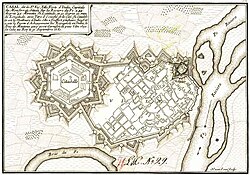
- Definition: The strongest, most fortified part of a city, acting as a final defensive retreat.
- Ancient Origins: Early examples appear in the Indus Valley civilization and ancient Anatolia.
- Dual Purpose: Historically used both to protect citizens from external enemies and to protect rulers from internal rebellion.
- Modern Adaptation: Now often refers to underground command centers or protected sections of warships.
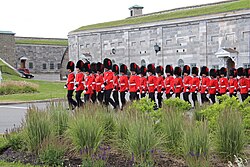
- Notable Example: The Citadelle of Quebec is the largest military citadel still in operation in North America.
Ancient and Classical Citadels
Early Civilizations (3300–1300 BC)
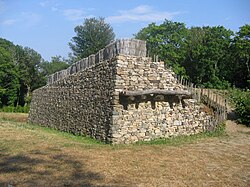
Some of the earliest citadels were constructed by the Indus Valley civilization, where these structures reached heights of nearly 12 meters. While they represented centralized authority, historians debate their exact purpose; some suggest they were defensive, while others believe they were designed to divert flood waters, as seen in the ruins of Mohenjo-daro.
In Anatolia, cities like Kaneš (modern-day Kültepe) featured citadels that housed palaces, temples, and official buildings. Similarly, the Greek city of Mycenae utilized a highly defensible rectangular hill, later adding walls to enhance its security.
The Greek Acropolis and Celtic Oppida (800 BC – 400 AD)
In Ancient Greece, the acropolis (literally "high city") served as a lookout, refuge, and stronghold. These sites, such as the famous Acropolis of Athens and the Acrocorinth, stored military supplies and food and housed shrines and palaces.
During the first millennium BC, the Castro culture in northwestern Portugal and Spain developed settlements known as castros. The larger of these, referred to by Romans as oppida or citadels, featured multiple rings of walls. Notable examples include Citânia de Briteiros and Citânia de Sanfins, some of which required prolonged sieges for the Romans to capture around 138 BC.
The Middle Ages to the Early Modern Era
The Last Line of Defense
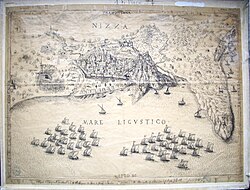
Throughout the Middle Ages and the Renaissance, citadels often operated independently of the main city walls. This allowed a besieged army to hold out even after the rest of the town had fallen. A prime example occurred during the 1543 Siege of Nice, where Franco-Ottoman forces pillaged the city but were unable to capture the citadel.
In the Philippines, the Ivatan people built idjangs on elevated areas. These fortifications functioned similarly to European castles, often utilizing rope ladders as the sole entrance to prevent invader access.
Instruments of Political Control
By the 17th century, citadels were increasingly used to protect political power from the local population. King Charles II of England built the Royal Citadel at Plymouth not only to defend against naval attacks but also to keep the Parliamentarian-leaning town in check by positioning guns to fire upon the city itself.
Similar patterns appeared in Barcelona, where a citadel was built in 1714 to intimidate Catalans. Following political liberalization in the 19th century, this structure was demolished and replaced by the Parc de la Ciutadella. Other symbols of oppressive rule, such as the Bastille in Paris and the Castellamare Citadel in Palermo, were also destroyed during revolutionary periods.
Modern Military Applications
Land-Based Citadels
The effectiveness of citadels persisted into modern warfare. During the Spanish Civil War, Nationalists held the Alcázar against larger forces for two months. Similarly, during the Vietnam War, the North Vietnamese Army held the citadel of Huế for 26 days against better-equipped US and South Vietnamese troops.
In the mid-20th century, the concept shifted toward protecting command and control centers from aerial or nuclear attacks. Examples include the Pindar complex beneath London's Ministry of Defence and the Cheyenne Mountain nuclear bunker in the United States.
Naval Citadels
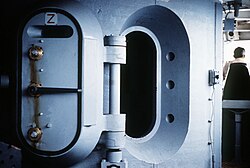
In naval architecture, an armoured citadel is the heavily protected section of a warship that shields ammunition and machinery. In Anglo-American and German terminology, the citadel refers to the semi-armoured freeboard above the "vitals" (the most heavily protected part of the hull), whereas Russian terminology often uses "citadel" to refer to the vitals themselves. Additionally, a ship's safe room is commonly called a citadel.
Summary of Citadel Types
| Type | Primary Purpose | Key Example |
|---|---|---|
| Ancient/Classical | Refuge, religious center, and authority | Acropolis of Athens |
| Medieval/Renaissance | Last line of defense during sieges | Citadel of Nice |
| Early Modern | Political control and garrison protection | Royal Citadel at Plymouth |
| Modern Land | Command and control (nuclear/aerial protection) | Cheyenne Mountain |
| Naval | Protection of machinery and ammunition | USS New Jersey |
Frequently Asked Questions
What is the difference between a city and a citadel?
A city is the entire urban settlement, while a citadel is a smaller, more heavily fortified area within or attached to that city, serving as its defensive core.
Why were some citadels built to fire upon their own cities?
In some cases, rulers used citadels to ensure the loyalty of the local population or to protect the ruling garrison from internal rebellions, as seen with the Royal Citadel at Plymouth.
How has the definition of a citadel changed in the modern era?
While historically referring to walled fortifications, modern citadels are often underground bunkers designed to protect military command centers from nuclear or aerial bombardment.
What is a naval citadel?
In naval terms, it is the heavily armoured section of a warship designed to protect critical areas like machinery and ammunition spaces from enemy fire.
Which is the largest operational citadel in North America?
The Citadelle of Quebec in Canada is the largest citadel still in official military operation in North America.