Christ Church Cathedral Music
The musical tradition of Christ Church Cathedral is a tapestry of historic instruments and world-class vocal ensembles. From the thunderous resonance of its bells to the intricate melodies of its organs and choirs, the cathedral maintains a legacy of liturgical excellence that spans centuries.
The Cathedral Organs
The primary instrument is a 43-rank, four-manual and pedal organ built in 1979 by the Austrian firm Rieger Orgelbau. This impressive instrument is situated at the west end of the cathedral.
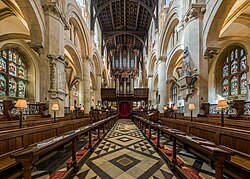
The cathedral is currently expanding its musical capabilities. In April 2024, work began to install a new organ in the east end. To facilitate this, the existing chancel organ—which was rented from the charity Pipe Up For Pipe Organs—was removed to allow for necessary floor surveys.
Distinguished Organists
The role of the organist at Christ Church Cathedral is historically prestigious. The first organist, the Renaissance composer John Taverner, was appointed by Wolsey in 1526. Over the years, the position has been held by notable figures including Basil Harwood, Thomas Armstrong, W. H. Harris, Simon Preston, Francis Grier, Nicholas Cleobury, Stephen Darlington, and Steven Grahl.
Currently, the post is held by Peter Holder. In keeping with the tradition of many English cathedrals, the organist primarily serves as the director of the choir, while the actual organ playing is typically delegated to an organ scholar or sub-organist.
Choral Traditions and Ensembles
The cathedral supports several distinct choral groups, each contributing to the liturgical and musical life of the institution.
Christ Church Cathedral Choir
Directed by Peter Holder, the main choir consists of twelve adults—comprising six professional lay-clerks and six student academical clerks—and sixteen choristers (boys aged 7–13 from Christ Church Cathedral School). While the choir was exclusively male for centuries, it welcomed its first female clerk, Elizabeth Nurse, in 2019. The choir performs during university terms, at Christmas and Easter, and maintains an active recording and touring schedule. Notable former choristers include composer William Walton.
Frideswide Voices
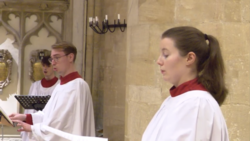
Established to provide girls with opportunities to sing for the liturgy in the chapels of New College, Magdalen College, and Christ Church, Frideswide Voices became a permanently endowed part of the Cathedral's choral foundation in May 2019. Directed by Helen Smee (who succeeded founding director William Dawes), the group consists of girls aged 7–14 from various Oxford schools. They perform Evensong weekly with the Cathedral Choir clerks and join the boys' choir for specific services and concerts.
Additional Choirs
- The Cathedral Singers: A volunteer group directed by Hilary Punnett, typically in residence when the main choir is on holiday outside of term time.
- The College Choir: Composed of current staff and students from the college, singing every one to two weeks during term time.
The Historic Bells
The cathedral houses a ring of 12 bells designed for full circle ringing. The tenor bell, cast in 1589 and recognized as historically important by the Church Buildings Council, weighs 3,495 lb (31 long cwt 0 qr 23 lb), has a diameter of 56 inches, and is tuned to D.
Two other bells in the ring, numbers 9 and 10, are also of significant historical value, having been cast around 1410. Bell 10 weighs 1,850 lb (16 long cwt 2 qr) in F♯, and Bell 9 weighs 1,300 lb (12 long cwt) in G.
Beyond the ringing bells, the cathedral possesses two additional bells: a litany bell from circa 1410 (weighing 170 lb and sounding G) and the famous Bourdon bell, Great Tom. Cast in 1680, Great Tom is a massive instrument weighing 13,940 lb (124 long cwt 2 qr) with a diameter of 85 inches, sounding the note A. While it is sounded every night, it is only swung on a very small number of occasions.
Key Facts
- Main Organ: 43-rank instrument by Rieger Orgelbau (1979).
- First Organist: John Taverner, appointed in 1526.
- Choir Diversity: First female clerk joined in 2019; Frideswide Voices provides a permanent place for girls' voices.
- Great Tom: The Bourdon bell weighing 13,940 lb, cast in 1680.
- Oldest Bells: The litany bell and bells 9 and 10 date back to approximately 1410.
| Category | Item/Group | Key Detail |
|---|---|---|
| Organ | Rieger Orgelbau | 43-rank, installed 1979 |
| Choir | Cathedral Choir | 12 adults, 16 boys |
| Choir | Frideswide Voices | Girls aged 7–14 |
| Bells | Great Tom | Bourdon bell, 1680 |
| Bells | Tenor Bell | Cast 1589, tuned to D |
Frequently Asked Questions
Who is the current organist of Christ Church Cathedral?
The current organist is Peter Holder, who also serves as the director of the choir.
What is the role of Frideswide Voices?
Frideswide Voices is a permanently endowed group of girls aged 7–14 from Oxford schools who sing Evensong and perform in various concerts and services.
How often is Great Tom sounded?
Great Tom is sounded every night, although it is only swung on a very small number of occasions.
When was the main organ installed?
The 43-rank Rieger Orgelbau organ was built and installed in 1979.
Who was the first organist appointed to the cathedral?
The first organist was the Renaissance composer John Taverner, appointed by Wolsey in 1526.