Choirs and Choral Music: History, Structure, and Evolution
A choir, also referred to as a chorus or chorale, is a musical ensemble of singers. Derived from the Latin chorus, meaning "a dance in a circle," these ensembles perform choral music—compositions specifically written for vocal groups. While choirs can perform a vast array of music from the medieval era to modern popular hits, they are most often led by a conductor who guides the performance through hand, arm, and facial gestures.
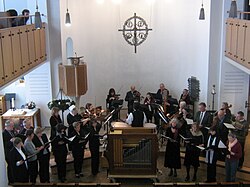
In common usage, the term "choir" is frequently associated with church-affiliated groups, while "chorus" often refers to ensembles performing in concert halls or theaters, though this distinction is not absolute. Depending on the piece, a choir may sing a cappella (unaccompanied) or be supported by instruments ranging from a single piano or pipe organ to a full orchestra of 70 to 100 musicians.

Key Facts
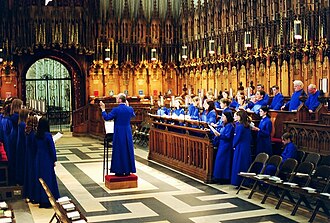
- Composition: Most choirs use four-part harmony, though some complex works feature dozens of parts.
- Leadership: Conductors provide non-verbal communication during performances to shape the artistic interpretation.
- Versatility: Choirs can be categorized by institution (school, church, community) or by genre (Gospel, Jazz, Barbershop).
- Historical Reach: The oldest surviving choral repertoire dates back to ancient Greece.
- Modern Trends: In English cathedral choirs, female choristers outnumbered males by 2019.
Structure and Leadership
The Role of the Conductor
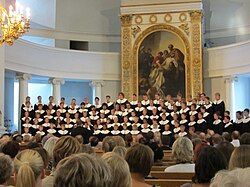
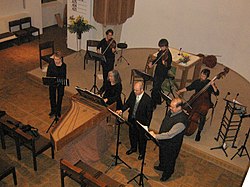
The conductor, or choral director, typically stands on a raised platform to maintain visibility. While some use a baton to make gestures clearer, others prefer using their hands for greater expressiveness. In modern art music, communication during a performance is strictly non-verbal, though verbal instructions are common during rehearsals. Historically, conductors often played an instrument while leading; for example, in Baroque music, a leader might play the harpsichord or violin.

Vocal Arrangement and Parts
While four-part harmony is the standard, there is no theoretical limit to the number of parts in a choir. Some composers have pushed these boundaries significantly: Thomas Tallis wrote a 40-part motet, Spem in alium, and Krzysztof Penderecki's Stabat Mater utilizes 48 parts across three choirs. Other common arrangements include three, five, six, or eight parts.
Types of Choirs
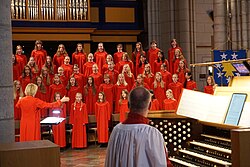
Choirs are often classified by the institution they serve or the specific style of music they perform. Common institutional choirs include collegiate, university, school, and community choirs. Specialized groups include signing choirs, which use sign language instead of vocalization.
Genre-Specific Ensembles
- Bach Choir: Dedicated to the works of J.S. Bach.
- Gospel Choir: Focused on gospel music.
- Show Choir: A hybrid of singing and dancing, similar to musical theater.
- Symphonic and Jazz Choirs: Specialized in orchestral or vocal jazz repertoires.
Gender and Voicing
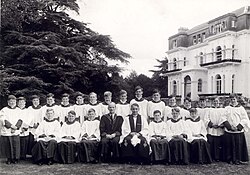
Male choirs often employ the same SATB (Soprano, Alto, Tenor, Bass) voicing as mixed choirs, but utilize boys (trebles) for the upper parts and men singing in falsetto (countertenors) for the alto parts. This was the traditional model for British cathedral choirs, though women are now widely accepted and prevalent in these institutions.

Historical Evolution of Choral Music
Antiquity and the Middle Ages
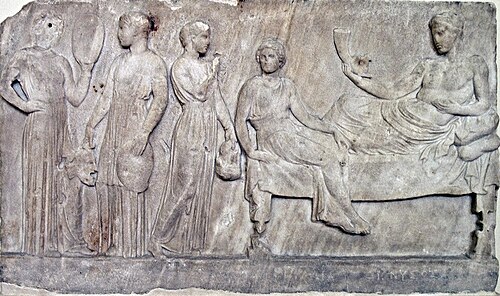
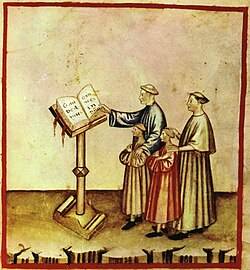
The earliest surviving choral music comes from ancient Greece, including the Delphic hymns. In early Western Europe, Gregorian chant—a form of unison singing—dominated from the 4th to 6th centuries. By the later Middle Ages, polyphony (music with multiple simultaneous melodic parts) emerged through forms like the organum and the motet.
Renaissance and Baroque Eras
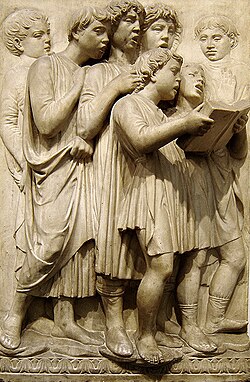
The Renaissance saw the perfection of polyphonic interaction, with the "Palestrina style" remaining a foundational element of musical training today. The Baroque era introduced the stile concertato, which combined voices with instruments. This period saw the rise of the Lutheran church cantata, most notably the works of Johann Sebastian Bach, who composed hundreds of cantatas, masses, and passions.
Classical, Romantic, and Modern Eras
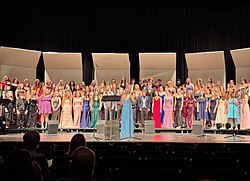
During the Classical period, composers like Mozart and Haydn produced significant sacred choral works. Beethoven further innovated by integrating the chorus into the symphonic texture, most famously in his Ninth Symphony. In the 20th and 21st centuries, the United States saw the rise of mixed choirs and secular choral groups. In the UK, choral singing remains highly popular, with estimates suggesting over 2 million regular participants across 40,000 groups.
Summary of Choral Classifications
| Category | Examples | Primary Characteristic |
|---|---|---|
| Institutional | School, University, Cathedral | Affiliated with an educational or religious body |
| Genre-Based | Gospel, Barbershop, Jazz | Defined by a specific musical style |
| Performance Style | Show Choir, Signing Choir | Includes dance or sign language |
| Voicing | Male Choir, Mixed Choir | Defined by the gender/range of singers |
Frequently Asked Questions
What is the difference between a choir and a chorus?
While often used interchangeably, "choir" is frequently associated with church groups, whereas "chorus" typically refers to ensembles performing in theaters or concert halls.
What does "a cappella" mean?
A cappella refers to singing without instrumental accompaniment. While the term literally means "as in the chapel," it is used for both sacred and secular music.
How many parts are typically in a choir?
Most choirs sing in four-part harmony, but this can vary. Some compositions use three, five, six, or eight parts, and some extreme examples feature up to 48 distinct parts.
Who leads a choir and how?
A choir is led by a conductor, choirmaster, or director. They use non-verbal gestures—sometimes with a baton—to communicate tempo, dynamics, and interpretation to the singers.
Do all choirs sing religious music?
No. While many choirs are affiliated with churches, there are many secular choirs, including community groups, school choirs, and ensembles specializing in jazz or popular music.