Chilean Army
The Chilean Army (Spanish: Ejército de Chile) serves as the land warfare branch of the Chilean Armed Forces. With a force of approximately 80,000 personnel, including 9,200 conscripts, the army is a cornerstone of Chile's national defense. Headquartered at the Edificio Ejército Bicentenario in Santiago, the force is guided by the motto "Siempre vencedor, jamás vencido" ("Always Victorious, Never Defeated").
From its origins in the struggle for independence to its modern role in international peacekeeping, the Chilean Army has evolved through various strategic shifts, most notably a deep period of Prussian emulation that continues to influence its traditions today.
Key Facts
- Total Strength: 80,000 personnel.
- Established: December 2, 1810.
- Patron: Our Lady of Mount Carmel.
- Army Day: September 19th.
- Core Structure: Six divisions, one army aviation brigade, and one special operations brigade.
- Primary Role: Land warfare and national defense.
Historical Evolution
Independence and Early Republic
The National Army of Chile was created on December 2, 1810, by the First National Government Junta. It played a pivotal role in the second Independence War against royalist forces, achieving critical victories at the battles of Chacabuco and Maipú. Early leadership included figures such as José Miguel Carrera, the first commander-in-chief, and Bernardo O'Higgins, who later founded the Military Academy of Chile in 1817 to professionalize the officer corps.
To balance the power of the regular army, Diego Portales established the Guardia Nacional, a civil militia. This parallel force remained active until the Chilean Conscription Law of 1900 began to phase it out.
The Era of Prussian Emulation
Between 1885 and 1914, the Chilean Army underwent a massive transformation known as Prussian emulation. This began in earnest in 1886 with the appointment of Captain Emil Körner and 36 Prussian officers to modernize the Military Academy. This influence extended far beyond tactics, impacting armaments, logistics, medical services, and even uniforms.
During this period, Chile invested heavily in German technology, purchasing 100,000 Mauser rifles and Krupp artillery. The army also established the Academia de Guerra (War Academy) in 1886 to provide technically oriented military education based on the German system of continuous study in cartography, logistics, and tactics.
20th Century Political Shifts
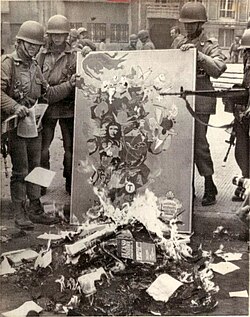
The 20th century saw the army navigate internal political turmoil, including the creation and subsequent disbandment of the Milicia Republicana in the 1930s. In the decades leading up to 1973, the army was increasingly influenced by United States anti-communist ideology through programs like the US Army School of the Americas.
On September 11, 1973, the Armed Forces led a coup d'état that overthrew President Salvador Allende. Under the leadership of Captain General Augusto Pinochet, the army maintained significant political power well into the transition back to democracy in the 1990s.
Modern Organization and Strategy
Plan Alcázar and Restructuring
Following territorial tensions in the 1970s and 80s, the army addressed its lack of strategic depth (the distance between the front lines and the core industrial/political heartland) by implementing Plan Alcázar. Starting in 1994, this plan shifted the army from traditional large divisions to smaller, more mobile units organized into three military zones, with a heavy concentration of forces in the north.
Current Order of Battle
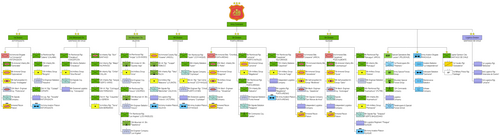
The army is managed by the General Headquarters in Santiago and is organized into several key commands:
- Regional Divisions: Including the 4th Army Division (Coyhaique) and 5th Army Division (Punta Arenas).
- Training and Doctrine Command: Overseeing education and doctrine divisions.
- Force's Support Command: Managing logistics, engineers, telecommunications, and infrastructure.
- Independent Commands: Including the General Garrison Command in Santiago and the Medical Command.
Personnel and Equipment
As of 2013, the army's personnel breakdown included 3,900 officers, 17,300 NCOs, 3,600 professional soldiers, and 9,200 conscripts. To modernize, the army has focused on mechanization and the creation of armored brigades and a special operations brigade.
| Category | Number of Personnel |
|---|---|
| Officers | 3,900 |
| Noncommissioned Officers (NCOs) | 17,300 |
| Professional Soldiers | 3,600 |
| Conscripts | 9,200 |
| Civilian Employees | 8,400 |
Traditions and Drill
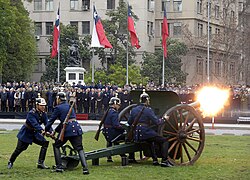
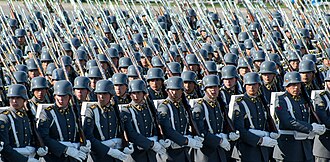
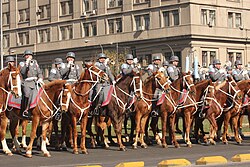
The Chilean Army is globally recognized for its elaborate drill, which heavily retains 19th-century Prussian patterns. This is most visible during the Parada Militar de Chile on September 19th. Soldiers perform the goose step and wear traditional German-style stahlhelm (steel helmets) and pickelhaube (spiked helmets).
The army also maintains historical dress uniforms for specific regiments, such as the 1st Infantry Regiment "Buin" and the 6th Reinforced Regiment "Chacabuco," to honor their roles in the War of the Pacific.
Military Bands
The Army Band Service is a vital part of the army's public image. The Gran Banda de la Guarnición de Santiago performs during the Great Military Parade, while the Concert Band of the Chilean Army represents the nation internationally, having performed in Rome, Canada, Germany, and the United States.
Frequently Asked Questions
Why does the Chilean Army use Prussian-style helmets and marching?
This is a result of a period of intense military emulation between 1885 and 1914, during which Chile hired Prussian officers and adopted German military doctrine, uniforms, and drill patterns to modernize its force.
What is Plan Alcázar?
Plan Alcázar is a strategic restructuring effort implemented in the 1990s to improve the army's defensive capabilities by replacing traditional large divisions with smaller, more mobile units distributed across three military zones.
Who is the current leadership of the Chilean Army?
The army is under the authority of the Minister of National Defense and the Chief of the Joint Chiefs of Defence, with Army General Javier Iturriaga del Campo serving as the Commander-in-chief of the Chilean Army.
What role does the army play in international peacekeeping?
The Chilean Army has a long history of participating in UN and OAS missions, with deployments ranging from UNFICYP in Cyprus to MINUSTAH in Haiti and various observer missions in Africa and Asia.
What is the significance of September 19th?
September 19th is celebrated as Army Day and is the date of the Great Military Parade of Chile, where the army showcases its traditions, drill, and modernization.