Chevron Beads: The Art and History of Star-Patterned Glass
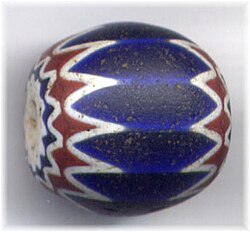
Chevron beads are exquisite examples of glass artistry, recognized by their striking concentric star patterns. Also known as rosetta or star beads, these objects represent a sophisticated intersection of chemistry, geometry, and craftsmanship. While they are highly prized by modern collectors, their origins lie in the competitive glass-blowing hubs of Renaissance Italy.
Key Facts
- Origin: Created in Venice and Murano, Italy, toward the end of the 14th century.
- Inventor: The first specimens are attributed to Marietta Barovier.
- Composition: Made from drawn glass canes with alternating colored layers.
- Global Reach: Heavily traded in West Africa and the Americas since the 15th century.
- Modern Production: Currently manufactured in Italy, India, China, and the United States.
The Origins of the Rosetta Bead
The history of the chevron bead begins in the late 14th century with the glassmakers of Venice and Murano. The earliest examples were invented by Marietta Barovier, a pioneer in glasswork. The term "rosetta" first appeared in the inventory of the Barovier Glass works in 1496, referring to both beads and other glass objects.
Early Venetian chevron beads, appearing toward the end of the 15th century, typically featured seven layers of alternating colors and six facets. While later versions standardized the use of a 12-point star mould, these early pieces varied in their construction.
The Craftsmanship: How Chevron Beads Are Made
The creation of a chevron bead is a complex process involving the manipulation of molten glass and precise molding. The process begins with a gather—a molten ball of glass taken from a furnace.
Creating the Core and Layers
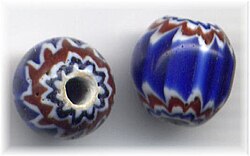
To create a bead, the glassworker uses a blowpipe to insert an air bubble into the center of the gather, which will eventually become the bead's perforation (the hole). This gather is then plunged into a star-shaped mould, which can feature between five and fifteen points. The artisan applies several layers of colored glass, returning to the mould repeatedly to achieve either a smooth or star-shaped effect for each layer.
Drawing the Cane
Once the layers are complete, metal plates are attached to the hot glass. The glass is then "drawn"—stretched into a long rod called a cane—by pulling from both ends in opposite directions. This process stretches the central air bubble into a long tube. The final diameter of the bead depends on the initial size of the gather and how thinly the glass is drawn.
Finishing the Pattern
The cooled cane is cut into short segments, revealing a star pattern in the cross-section. To transform a star bead into a true "chevron" bead, the ends must be ground, beveled, or chamfered. This grinding process exposes the inner layers, creating the characteristic V-shaped chevron pattern. Beads with flat ends remain classified as rosetta or star beads.
Global Trade and Cultural Significance
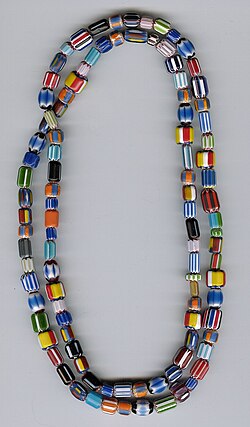
Venetian chevron beads became powerful commodities in international trade. Most beads exported to the Americas and West Africa featured red, blue, and white layers, though some were produced in green, black, and yellow.
- West Africa: Introduced by Dutch merchants in the late 15th century, these beads remain highly valued today for ceremonial purposes, prestige, and as funerary objects.
- The Americas: Small 7-layer beads from the late 15th century have been found in Peru and are attributed to the voyages of Christopher Columbus.
International Variations in Production
While Venice remains the ancestral home of the chevron bead, other regions have developed their own techniques.
India and China
In the 1980s, India began producing chevron beads. In centers like Purdalpur, artisans created star beads without moulds, instead fusing hot strips of glass to form a cane. This method results in slight indentations at the points of the stars. In contrast, Chinese chevron beads are made using moulded star canes, closely imitating the Venetian style.
Contemporary Masters
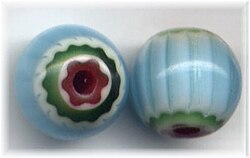
Today, chevron beads are produced in a wide array of color combinations. Notable contemporary makers include Luigi Cattelan of Murano and Art Seymour of the United States, the latter of whom has pushed the technical limits of the craft by creating beads with up to 19 layers.
Summary of Chevron Bead Characteristics
| Origin/Maker | Production Method | Distinctive Feature | Typical Era/Status |
|---|---|---|---|
| Venetian (Murano) | Star mould & drawn cane | Precise star patterns; red/blue/white | 14th Century to Present |
| Indian (Purdalpur) | Fused glass strips (no mould) | Indentations at star points | 1980s to Present |
| Chinese | Moulded star canes | Imitation of Venetian style | Contemporary |
| Art Seymour (USA) | Advanced layering | Up to 19 layers | Contemporary |
Frequently Asked Questions
What is the difference between a star bead and a chevron bead?
A star bead (or rosetta bead) has flat ends that show the star cross-section. A chevron bead is a star bead that has been ground, beveled, or chamfered at the ends to expose the inner layers, creating the chevron pattern.
Who invented the first chevron beads?
The first chevron beads were invented by Marietta Barovier in Venice and Murano, Italy, toward the end of the 14th century.
How is the hole in the center of the bead created?
The hole is created by blowing an air bubble into the center of the molten glass gather using a blowpipe before the glass is shaped and drawn into a cane.
Why are these beads significant in West Africa?
Introduced by Dutch merchants in the late 15th century, they became symbols of prestige and are still used today for ceremonial purposes and in burial rites.
Are chevron beads still made in Venice?
Yes, although the Societa Veneziana Conterie of Murano stopped making chevron canes in the 1950s, they are still produced in Venice today in very small quantities.