Understanding the Port Orford Cedar: A Guide to Chamaecyparis lawsoniana
The Port Orford cedar, scientifically known as Chamaecyparis lawsoniana, is a magnificent evergreen conifer that holds a significant place in both the natural ecosystems of the Pacific Northwest and the world of horticulture. Often referred to by botanists as Lawson's cypress, this species is a striking example of resilience and beauty, though it currently faces serious environmental challenges.
Native to the rugged landscapes of Oregon and northwestern California, this tree thrives in diverse environments, ranging from sea level up to 1,500 metres (4,900 ft) in the valleys of the Klamath Mountains. Whether growing along stream banks or in upland areas, the Port Orford cedar is a vital component of its native habitat.
Key Facts
- Scientific Name: Chamaecyparis lawsoniana
- Common Names: Port Orford cedar, Lawson's cypress
- Conservation Status: Near Threatened (IUCN 3.1)
- Native Range: Southwestern Oregon and northwestern California
- Maximum Height: Can reach 50 m (160 ft), with exceptional specimens up to 81 m (266 ft)
- Lifespan: Can live up to approximately 600 years
Physical Characteristics and Description
The Port Orford cedar is a large evergreen characterized by its impressive scale. Mature specimens typically feature trunks between 1.2 and 2 metres in diameter, though exceptional trees can reach a diameter of 3.65 metres. Its bark is silver-brown, vertically furrowed, and can grow up to 25 centimetres thick near the base, providing natural resistance to wildfires.
Foliage and Scent
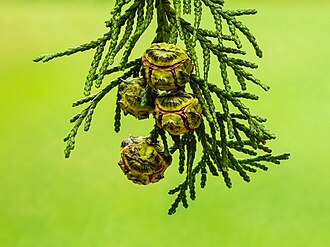
The tree's foliage is arranged in lacy, flat sprays that create a feathery appearance. The leaves are scale-like, measuring 3–5 millimetres in length, and often exhibit a glaucous (blue-green) hue with narrow white markings on the underside. A unique characteristic of the foliage is its pungent, parsley-like scent.
Cones and Seeds
The reproductive structures of the tree include both male and female cones:
- Female Cones: These are globose (spherical), measuring 7–14 millimetres in diameter. They start green and mature to brown in the early fall, roughly 6–8 months after pollination.
- Male Cones: These are small, 3–4 millimetres long, and dark red, turning brown after releasing pollen in early spring.
Once mature, the seeds fall quickly and possess the ability to float on water.
Taxonomy and History
The species was first documented near Port Orford, Oregon. In 1854, it was introduced into cultivation by collectors working for Charles Lawson of the Lawson & Son nursery in Edinburgh, Scotland. In honor of Lawson, the botanist Andrew Murray named the species Lawson's cypress. While the United States Department of Agriculture and local residents primarily use the name Port Orford cedar, the term "Lawson's cypress" remains widely used in the horticultural industry.
Ecology and Habitat
Port Orford cedar is highly adapted to the moist environments of the Klamath Mountains. While it is shade tolerant, it cannot compete as effectively in deep shade as species like the western hemlock or white fir. The tree regenerates well on disrupted land across various soil types, provided there is consistent moisture available.
Historically, the species has faced significant setbacks. Old-growth populations near Coos Bay, Oregon, were decimated by logging and wildfires in the late 1860s, and later by a combination of fire and root disease in 1936.
The Threat of Phytophthora lateralis
The most critical threat to the Port Orford cedar is a unique root disease caused by the oomycete (a water mold) pathogen Phytophthora lateralis. This pathogen was accidentally introduced to the Pacific Northwest in the early 1950s via infected nursery trees.
How the Disease Spreads
The infection begins when mycelium (a network of fungal-like filaments) from a germinated spore invades the roots. The disease then spreads through the inner bark and cambium—the layer of actively dividing cells—around the base of the tree. This process effectively girdles the tree, cutting off its nutrient supply. While large trees can sometimes survive for several years despite infection, they are more susceptible due to their larger root systems.
The spread of P. lateralis is heavily influenced by water and human activity:
- Water: The pathogen produces mobile zoospores that travel through water, making streamside populations highly vulnerable. It also produces chlamydospores (resting spores) that can persist in the soil for long periods.
- Human Movement: Most long-distance infections are facilitated by humans. Soil carried on vehicle tires (especially logging trucks), boots, and mountain bike tires is a primary vector for moving the pathogen to new areas.
- Animal Movement: While animals can facilitate spread, this is generally considered a localized phenomenon.
To combat this, organizations like the United States Forest Service and the Bureau of Land Management implement road closures, monitoring, and educational programs. Research is ongoing into breeding resistant trees and using treatments like Mancozeb or the parasitic fungus Pythium oligandrum for pest control.
Economic and Practical Uses
The wood of the Port Orford cedar is highly prized for its unique properties. It is light yet exceptionally strong and possesses natural rot resistance, even when exposed to salt water. This made it a historical favorite for boatbuilding.
Other notable uses include:
- Aromatics: The wood emits a fragrant ginger aroma due to natural oils that repel insects, including termites.
- Craftsmanship: Due to its straight grain, it is used for arrow shafts and is highly regarded for guitar soundboards.
- Cultural Significance: In East Asia, particularly Japan, the wood is used for constructing shrines, temples, and coffins.
- Industrial Applications: Historically used for Venetian blinds and storage battery cell separation.
Horticultural Cultivation
In gardens and parks, the Port Orford cedar is a popular ornamental choice. It thrives in full sun and well-drained but moist soil. Because of its versatility, hundreds of cultivars have been developed, ranging from weeping forms to tight, columnar shapes.
| Cultivar Name | Height (m) | Spread (m) | Shape | Foliage Colour |
|---|---|---|---|---|
| 'Aurea Densa' | 1.5 | 1.0 | Broadly conical | Yellow-green |
| 'Chilworth Silver' | 2.5 | 1.0 | Broadly columnar | Silver-blue |
| 'Dik's Weeping' | 12.0 | 4.0 | Columnar, weeping | Blue-green |
| 'Ellwoodii' | 8.0 | 4.0 | Columnar | Grey-green |
| 'Golden Wonder' | 20.0 | 4.0 | Columnar | Yellow-green |
| 'Imbricata Pendula' | 8.0 | 4.0 | Conical, weeping | Green |
| 'Pembury Blue' | 12.0 | 8.0 | Conical | Blue-green |
Frequently Asked Questions
What is the difference between Port Orford cedar and Lawson's cypress?
They are two names for the same species, Chamaecyparis lawsoniana. "Port Orford cedar" is the common name used by the USDA and locals in its native range, while "Lawson's cypress" is frequently used in horticulture and by some botanists.
Why is the Port Orford cedar considered "Near Threatened"?
The species faces significant pressure from the Phytophthora lateralis root disease, which can wipe out entire populations, especially those located near water sources. Historical logging and wildfires have also impacted its population density.
Can the Port Orford cedar be grown in a home garden?
Yes. There are hundreds of cultivars specifically selected for garden use. They prefer full sun and well-drained, moist soil. Many varieties, such as 'Green Globe' or 'Little Spire', are available in different sizes to suit various landscape needs.
How can I help prevent the spread of tree diseases like Phytophthora?
Since human activity is a major factor in spreading the pathogen, it is important to clean boots, mountain bike tires, and vehicle tires when moving between different forested areas to ensure no contaminated soil is transferred.
What makes the wood of this tree so special?
The wood is light, strong, and highly resistant to rot and insects due to its natural oils. It also has a distinct ginger aroma and a fine grain that makes it excellent for musical instruments and high-quality woodworking.