Pinus radiata: The Global Impact of the Monterey Pine
Pinus radiata, commonly known as the Monterey pine, presents a striking paradox in the botanical world. While it is one of the most widely cultivated timber trees on the planet, it is simultaneously listed as Endangered by the IUCN and Critically Imperiled by NatureServe in its native habitats. This coniferous evergreen is prized for its rapid growth and versatility, yet it faces severe threats from disease and invasive species in the wild.
Key Facts
- Growth Rate: Can grow up to 1.5 meters per year in optimal conditions.
- Conservation Status: Endangered (IUCN) and Critically Imperiled (NatureServe).
- Primary Threat: Pine pitch canker (Fusarium circinatum) and the pine shoot moth.
- Native Range: Coastal California and islands off the coast of Mexico.
- Economic Role: Dominates plantation forestry in New Zealand, Australia, and Chile.
Botanical Description
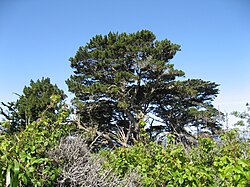
In its natural wild state, Pinus radiata typically reaches heights of 15 to 30 meters, characterized by upward-pointing branches and a rounded crown. However, under optimum cultivation, these trees can soar to 60 meters. The bark is dark gray to brown and deeply fissured.
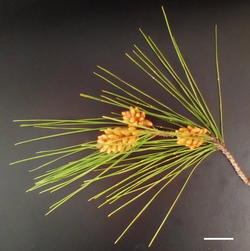
The foliage consists of bright green needles that are generally found in clusters of three, though the variety binata features clusters of two. These needles range from 8 to 15 cm in length with blunt tips. The tree produces brown, egg-shaped (ovoid) ovulate cones measuring 7 to 17 cm, which typically attach to branches at an oblique angle.
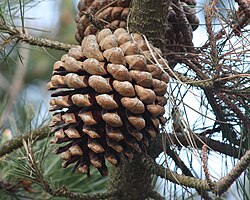
The lifespan of a Monterey pine is generally between 80 and 90 years, provided it is not cut short by harvesting or disease.
Natural Distribution and Habitat
The native range of the Monterey pine is highly restricted. In Mexico, it is found on Cedros Island and Guadalupe Island. On Guadalupe Island, the trees cling to ridgetops and steep slopes at elevations between 500 and 1,200 meters. On Cedros Island, they are more abundant and found at lower elevations (285 to 690 meters) along windward ridges and canyons.
A critical environmental factor for these wild populations is a high frequency of fog, upon which the trees seem heavily dependent for survival.
Variety binata and Conservation
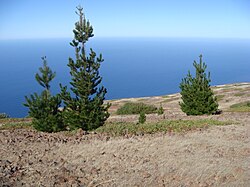
The variety Pinus radiata var. binata on Guadalupe Island was nearly wiped out by feral goats, which caused massive soil erosion and consumed seedlings. By 2001, only about one hundred trees remained. Following the extermination of goats by 2005, hundreds of young pines have begun to grow in fenced habitats for the first time in 150 years.
Global Cultivation and Environmental Impact
Due to its adaptability and fast growth, Pinus radiata has been introduced to various temperate regions, often becoming the dominant plantation species.
New Zealand and Australia
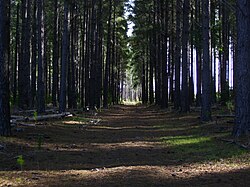
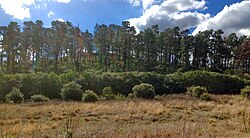
In New Zealand, the species (known as Radiata Pine) makes up 89% of plantation forests, including the massive Kaingaroa Forest. While economically vital, it is considered an invasive "wilding pine" in areas where it escapes cultivation. Similarly, in Australia, it is the dominant plantation tree but is regarded as an environmental weed in southeastern and southwestern regions due to the loss of native wildlife habitat.
Chile and Spain
In Chile, vast plantations of Monterey pine have replaced Valdivian temperate rain forests. As of 2021, 1.3 million hectares of Chile's forest plantations were Pinus radiata, accounting for 95% of the country's lumber production in 2001. In Spain, the tree was introduced in the 19th century for paper pulp and coal mine shoring, primarily in northern regions like Galicia and the Basque Country.
Industrial Uses and Timber Properties
The wood of the Monterey pine is highly versatile. It is typically kiln-dried to 12% moisture and available in lengths up to 6 meters. To increase durability, the wood is often treated with chemical salts, a process known as tanalizing.
Treatment grades vary by use: H1 and H2 for indoors, H3 for fence palings, and H4 and H5 for inground use. In New Zealand, a historical lack of borate treatment in house framing led to a "leaky homes crisis," which prompted stricter regulations after 2003.
Beyond construction, the wood is used for:
- Pulp: Lower grade timber is converted into newsprint.
- Sheet Products: Chipped for particle board, hardboard, softboard, and structural plywood.
- Specialty Craft: High-grade, knot-free ply is used for cabinetry and boat building.
Threats and Conservation Status
The most significant threat to wild stands is pine pitch canker, caused by the fungus Fusarium circinatum. Introduced to California from the southeast United States, this disease can infect 80–90% of trees in some stands. Decaying trees attract bark beetles, which further spread the infection to healthy trees.
| Feature | Wild State | Cultivated State |
|---|---|---|
| Height | 15–30 m | Up to 60 m |
| Growth Rate | Variable | Up to 1.5 m / year |
| Needle Clusters | 3 (2 in var. binata) | 3 |
| Conservation Status | Endangered / Critically Imperiled | Widespread / Invasive in some areas |
| Main Threat | Pine pitch canker / Feral goats | Disease / Pests |
Frequently Asked Questions
Why is the Monterey pine endangered if it is grown everywhere?
The trees grown in plantations are cultivated varieties. The original wild populations in California and on Mexican islands are very small and face specific threats like pine pitch canker and habitat loss, making them biologically vulnerable despite the abundance of cultivated clones elsewhere.
What is tanalized wood?
Tanalized wood is timber that has been treated with chemical salts to prevent decay and insect attack, making it suitable for use in ground contact, such as for retaining walls or fence posts.
How did feral goats affect the variety binata?
On Guadalupe Island, tens of thousands of feral goats ate seedlings and caused severe soil erosion from the mid-19th century until 2005, preventing new growth for nearly 150 years.
What is the impact of Pinus radiata in Chile?
While it is a massive economic driver—providing the vast majority of Chile's lumber—it has significantly displaced the native Valdivian temperate rain forests.
Can Pinus radiata survive extreme cold?
The species is adaptable to many climates but generally does not tolerate temperatures below approximately −15 °C (5 °F).