Centro Popular de la Memoria: Preserving the History of Rosario's Secret Detention Center
The Centro Popular de la Memoria (CPM) stands as a poignant reminder of one of the darkest chapters in Argentine history. Located in the heart of Rosario, Santa Fe, this site was once a clandestine center of detention and torture. Today, it serves as a vital space for remembrance, education, and the pursuit of justice for the victims of state-sponsored violence.
During the period known as the Dirty War—a campaign of state terrorism carried out by the military junta under the self-styled National Reorganization Process—the provincial police utilized this facility to hold individuals without formal charges. While the state claimed to be fighting radical left-wing political subversion and terrorism, the reality was far broader. Most detainees were social activists, political dissidents, or simply the relatives and acquaintances of those deemed ideologically suspect.
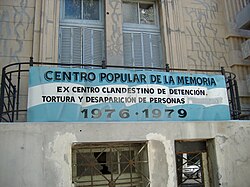
The History of "The Pit" and "The Favela"
The CPM is situated in a large building occupying an entire city block, bounded by Dorrego and Moreno streets, and Santa Fe and Córdoba streets. During the years of repression, the building served as the police headquarters and housed the Servicio de Informaciones de la Unidad Regional II, an intelligence division of the provincial police.
Evidence confirms that the site operated as a secret detention center from 1976 until 1979. Among those imprisoned, the facility was informally and chillingly referred to as El Pozo ("The Pit") and La Favela ("The Favela").
Command and Accountability
The Intelligence Service was led by Gendarmería Commander Agustín Feced. Feced was not merely an administrator; he frequently participated personally in the kidnappings, torture sessions, and executions of detainees. One of his primary collaborators, José Rubén Lo Fiego, has been under investigation since 2004 as part of the effort to hold perpetrators accountable for these crimes.
The Path to Recovery and Memorialization
Following the collapse of the military junta and Argentina's return to democracy in 1983, the building continued to function as a police facility. It was not until 2001 that human rights organizations successfully campaigned for the site to be preserved as a memorial to the victims.
The transition began on March 22, 2001, when the Ministry of Government of the province of Santa Fe issued Resolution No. 0060. This led to the dismantling of official police facilities and the relocation of the headquarters. The building was then partitioned: one section was granted to municipal control, another became a provincial government delegation, and the central courtyard was transformed into a public square.
On May 9, 2002, Decree No. 0717 officially established the Centro Popular de la Memoria. The site is now managed by the relatives of the desaparecidos (the "disappeared") and hosts a memorial exhibition featuring newspaper clips, mementos, and photographs used in demonstrations to demand the return of their loved ones.
To further document this history, a documentary film produced by Calanda Producciones was released. The film chronicles the recovery of the detention center and features testimonies from survivors and the research team involved in the project.
Key Facts
- Location: Rosario, Santa Fe, Argentina.
- Period of Operation: 1976 to 1979.
- Former Use: Intelligence division of the provincial police (Servicio de Informaciones de la Unidad Regional II).
- Informal Names: El Pozo ("The Pit") and La Favela ("The Favela").
- Key Figure: Commander Agustín Feced, who oversaw operations and participated in torture and executions.
- Legal Status: Established as a memorial via Decree No. 0717 in 2002.
Summary of the Site's Evolution
| Period | Function/Status | Key Characteristics |
|---|---|---|
| 1976–1979 | Illegal Detention Center | Clandestine torture and imprisonment during the Dirty War. |
| 1983–2001 | Official Police Facility | Continued use as police headquarters after the return to democracy. |
| 2001–2002 | Transition Period | Police relocated; building partitioned by Resolution No. 0060. |
| 2002–Present | Memorial Center (CPM) | Managed by victims' families; hosts exhibitions and archives. |
Frequently Asked Questions
What was the purpose of the Centro Popular de la Memoria before it became a museum?
It was originally the police headquarters in Rosario and served as a secret detention center between 1976 and 1979, where the provincial police tortured and held political dissidents and social activists.
Who were the primary victims held at this facility?
While the military junta claimed to target terrorists and subversives, most detainees were actually social activists, political dissidents, or people associated with those suspected of having opposing ideologies.
Who was Agustín Feced?
Agustín Feced was the Gendarmería Commander and head of the Intelligence Service at the site. He is noted for his direct involvement in kidnappings, torture, and executions.
How did the site become a public memorial?
Following demands from human rights organizations, the provincial government issued Resolution No. 0060 in 2001 and Decree No. 0717 in 2002, which removed the police and granted the space to the families of the victims.
What can visitors see at the CPM today?
The center hosts a memorial exhibition managed by the relatives of the disappeared, featuring mementos, newspaper clippings, and photographs from the era of the Dirty War.